Meta-Analysis
. 2022 Apr 28;23(9):4917.
doi: 10.3390/ijms23094917.

Systematic Review and Meta-Analysis of Mass Spectrometry Proteomics Applied to Human Peripheral Fluids to Assess Potential Biomarkers of Schizophrenia

Affiliations
Meta-Analysis

Systematic Review and Meta-Analysis of Mass Spectrometry Proteomics Applied to Human Peripheral Fluids to Assess Potential Biomarkers of Schizophrenia

João E Rodrigues et al. Int J Mol Sci. .

Abstract

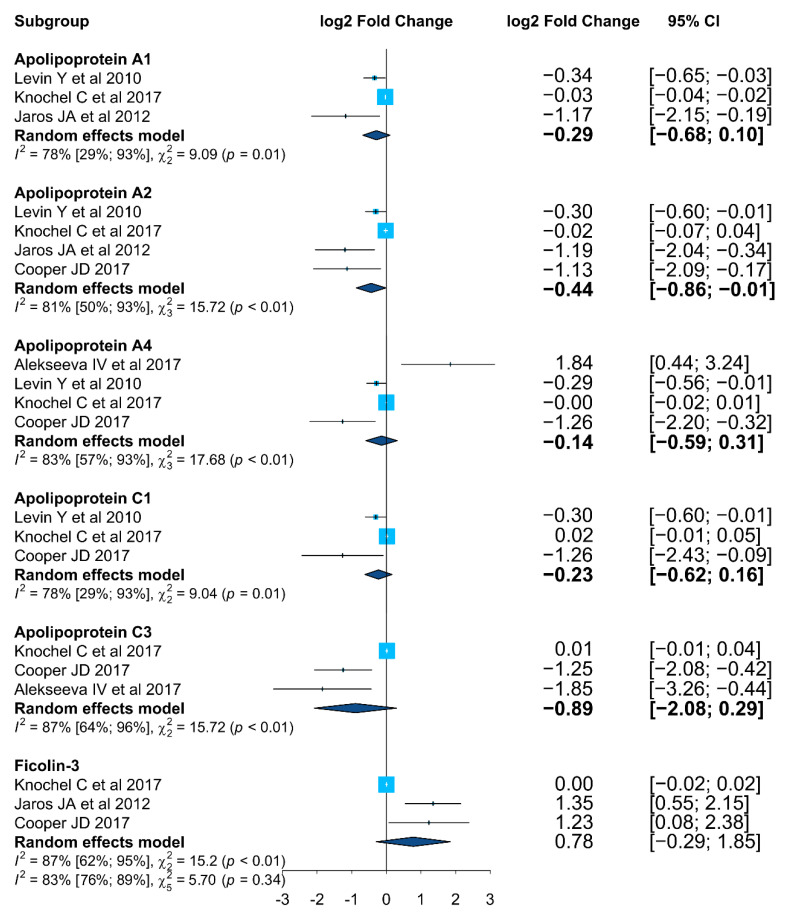
Mass spectrometry (MS)-based techniques can be a powerful tool to identify neuropsychiatric disorder biomarkers, improving prediction and diagnosis ability. Here, we evaluate the efficacy of MS proteomics applied to human peripheral fluids of schizophrenia (SCZ) patients to identify disease biomarkers and relevant networks of biological pathways. Following PRISMA guidelines, a search was performed for studies that used MS proteomics approaches to identify proteomic differences between SCZ patients and healthy control groups (PROSPERO database: CRD42021274183). Nineteen articles fulfilled the inclusion criteria, allowing the identification of 217 differentially expressed proteins. Gene ontology analysis identified lipid metabolism, complement and coagulation cascades, and immune response as the main enriched biological pathways. Meta-analysis results suggest the upregulation of FCN3 and downregulation of APO1, APOA2, APOC1, and APOC3 in SCZ patients. Despite the proven ability of MS proteomics to characterize SCZ, several confounding factors contribute to the heterogeneity of the findings. In the future, we encourage the scientific community to perform studies with more extensive sampling and validation cohorts, integrating omics with bioinformatics tools to provide additional comprehension of differentially expressed proteins. The produced information could harbor potential proteomic biomarkers of SCZ, contributing to individualized prognosis and stratification strategies, besides aiding in the differential diagnosis.

Keywords: biomarkers; human peripheral fluids; mass spectrometry; proteomics; schizophrenia.


Conflict of interest statement

The authors declare no conflict of interest.

Figures
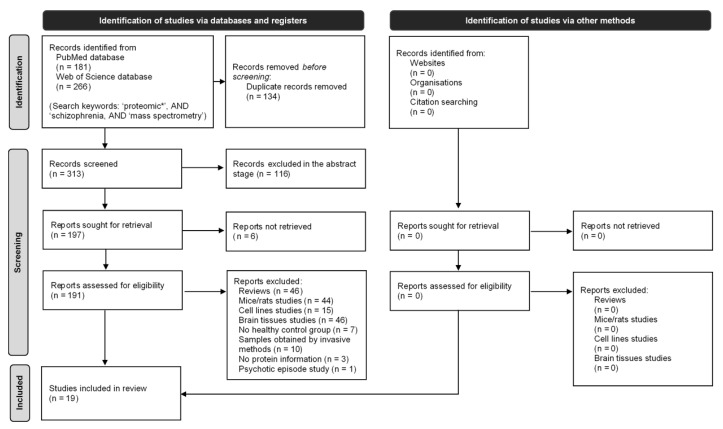
Figure 1
Figure 1
Flow chart of the selection process of the studies included in this systematic review of peripheral fluids MS-based proteomics in SCZ disorder, following PRISMA 2020 [54].
Figure 2
Figure 2
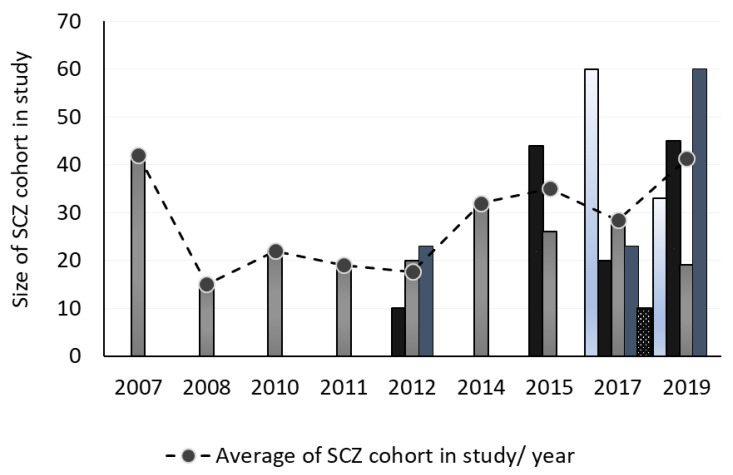
Publication frequency. The number of bars shown in the graphic reflects the number of articles published per year, and the height of each bar reflects the number of SCZ patients in the cohort of the study. The average number of SCZ patients in the cohorts per year is shown in the markers connected by the dashed line.
Figure 3
Figure 3
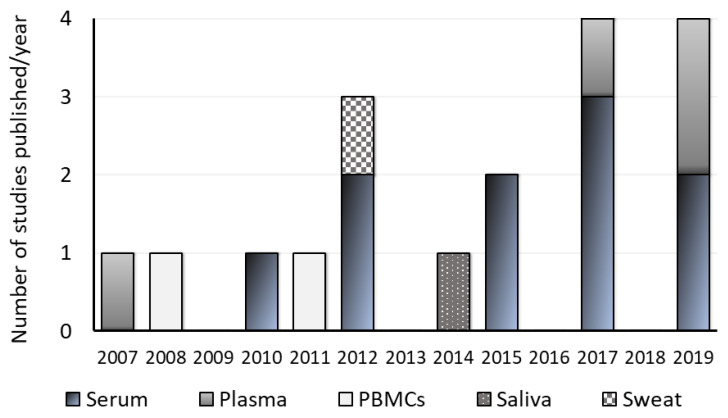
Sample type. The image shows the number of publications per year that fit the criteria of this review. Each color shows the type of samples used, and its height indicates the number of studies.
Figure 4
Figure 4
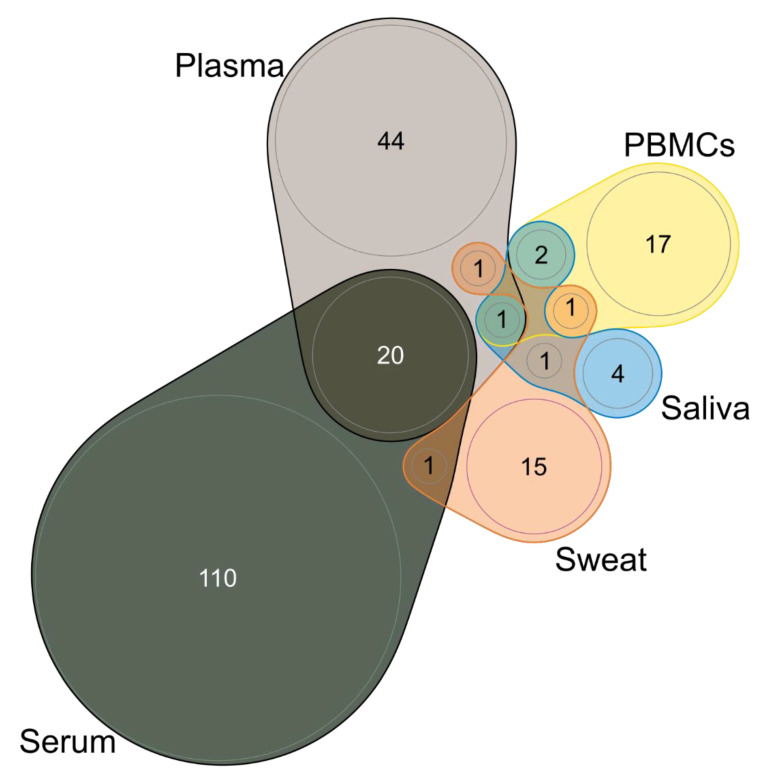
Venn diagram of the 217 proteins identified as altered in the human peripheral fluids serum, plasma, PBMCs, saliva and sweat in the selected studies of schizophrenia (SCZ) vs. control. The proteins identified as altered in: (i) only serum: 110 proteins; (ii) only plasma: 44 proteins; (iii) only PBMCs: 17 proteins; (iv) only saliva: 4 proteins; (v) only sweat: 15 proteins; (vi) plasma vs. PBMCs vs. saliva: 1 protein; (vii) plasma vs. serum: 20 proteins; (viii) plasma vs. PBMCs: 1 protein; (ix) plasma vs. sweat: 1 protein; (x) serum vs. sweat: 1 protein; (xi) PBMCs vs. sweat: 1 protein; (xii) PBMCs vs. saliva: 1 protein; (xiii) sweat vs. saliva: 1 protein.
Figure 5
Figure 5
Forest plot from the meta-analysis of proteins identified as altered in SCZ vs. control studies in at least two studies (95% CI, confidence intervals). Squares (whiskers represent 95% CI) indicate the effect sizes of the individual studies. The size of the squares reflects the sample size of each individual study. Diamonds represent summary statistics.
Figure 6
Figure 6
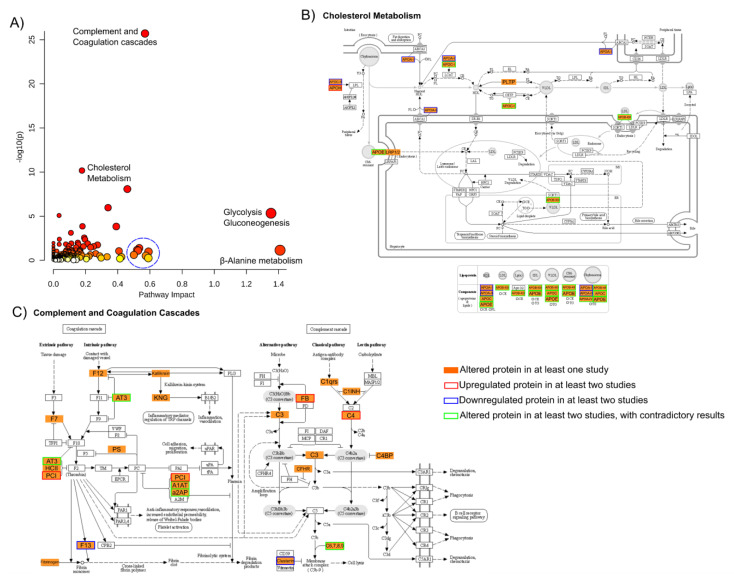
Gene ontology analysis of all proteins considered altered throughout the analyzed reports. A gene ontology approach was used to assess pathway impact and enrichment (here presented by the p-value and color scheme in (A)) of all proteins described as altered between controls and SCZ in at least one study (Supplementary Information, Table S2), represented here as a scatter plot [60]. The blue circle highlights a cluster of ontologies, all belonging to metabolic pathways. From the pathways shown as enriched by this list of proteins, two were selected and their visual representation was obtained through the KEGG Mapper Color tool [61,62]: (B) cholesterol metabolism and (C) complement and coagulation cascades. In these KEGG panels, the proteins found in any of the studies are shown in orange, and proteins found to be altered in at least two studies are highlighted in red or blue when the protein is always found to be up- or down-regulated in SCZ cases (respectively) or highlighted in green when the results from the two or more studies are contradictory.

References

    1. Hyman S.E. A glimmer of light for neuropsychiatric disorders. Nature. 2008;455:890–893. doi: 10.1038/nature07454. - DOI - PubMed
    1. Peedicayil J. Identification of Biomarkers in Neuropsychiatric Disorders Based on Systems Biology and Epigenetics. Front. Genet. 2019;2019:985. doi: 10.3389/fgene.2019.00985. - DOI - PMC - PubMed
    1. Guest F.L., Guest P.C., Martins-de-Souza D. The emergence of point-of-care blood-based biomarker testing for psychiatric disorders: Enabling personalized medicine. Biomark. Med. 2016;10:431–443. doi: 10.2217/bmm-2015-0055. - DOI - PubMed
    1. Taurines R., Dudley E., Grassl J., Warnke A., Gerlach M., Coogan A.N., Thome J. Proteomic research in psychiatry. J. Psychopharmacol. 2011;25:151–196. doi: 10.1177/0269881109106931. - DOI - PubMed
    1. Hawton K., van Heeringen K. Suicide. Lancet. 2009;373:1372–1381. doi: 10.1016/S0140-6736(09)60372-X. - DOI - PubMed