Review
. 2022 May 6;23(9):5188.
doi: 10.3390/ijms23095188.

Friend or Foe: The Relativity of (Anti)oxidative Agents and Pathways

Affiliations
Review

Friend or Foe: The Relativity of (Anti)oxidative Agents and Pathways

András Szarka et al. Int J Mol Sci. .

Abstract

An element, iron, a process, the generation of reactive oxygen species (ROS), and a molecule, ascorbate, were chosen in our study to show their dual functions and their role in cell fate decision. Iron is a critical component of numerous proteins involved in metabolism and detoxification. On the other hand, excessive amounts of free iron in the presence of oxygen can promote the production of potentially toxic ROS. They can result in persistent oxidative stress, which in turn can lead to damage and cell death. At the same time, ROS-at strictly regulated levels-are essential to maintaining the redox homeostasis, and they are engaged in many cellular signaling pathways, so their total elimination is not expedient. Ascorbate establishes a special link between ROS generation/elimination and cell death. At low concentrations, it behaves as an excellent antioxidant and has an important role in ROS elimination. However, at high concentrations, in the presence of transition metals such as iron, it drives the generation of ROS. In the term of the dual function of these molecules and oxidative stress, ascorbate/ROS-driven cell deaths are not necessarily harmful processes-they can be live-savers too.

Keywords: ascorbate; cancer; cell death; iron; oxidative stress; reactive oxygen species.


Conflict of interest statement

The authors declare no conflict of interest.

Figures
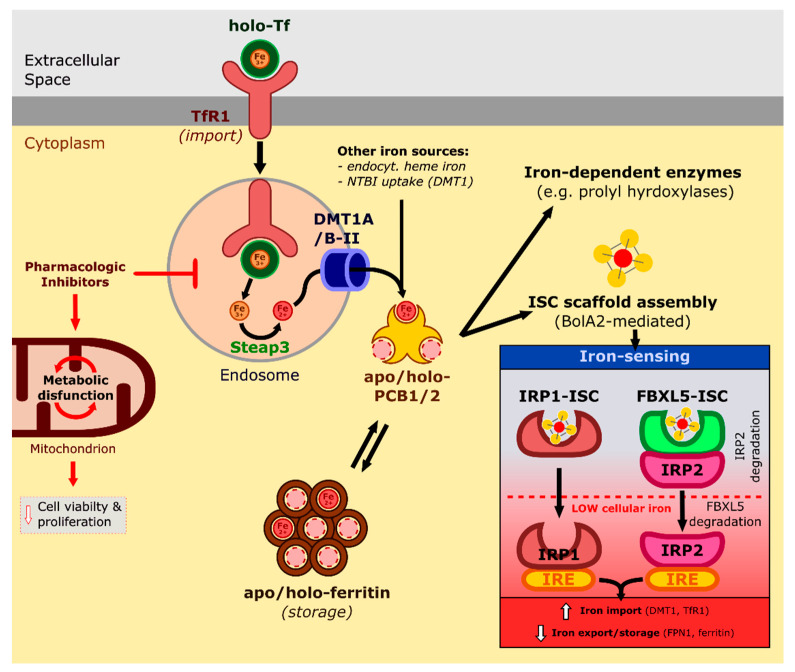
Figure 1
Figure 1
Transport and regulation of intracellular iron levels. Transferrin (Tf)-bound iron is internalised through the transferrin receptor (TfR1) pathway. Inside the endosome, imported ferric iron is released and reduced to ferrous iron by Steap3. DMT1A/B-II transports ferrous iron to the cytoplasm, where it binds to PCB1/2. Cytoplasmic iron can either be stored in ferritin or incorporated into iron-dependent enzymes or the assembly of iron–sulfur cluster (ISC) scaffolds. Low levels of intracellular iron can hinder ISC assembly, thus activating the IRP1/2 iron-sensing pathways as the activity of both IRP1 and FBXL5-IRP2 is dependent on ISC availability. Activated IRP1/2 can bind to iron response elements (IREs) which regulate iron import, export and storage.
Figure 2
Figure 2
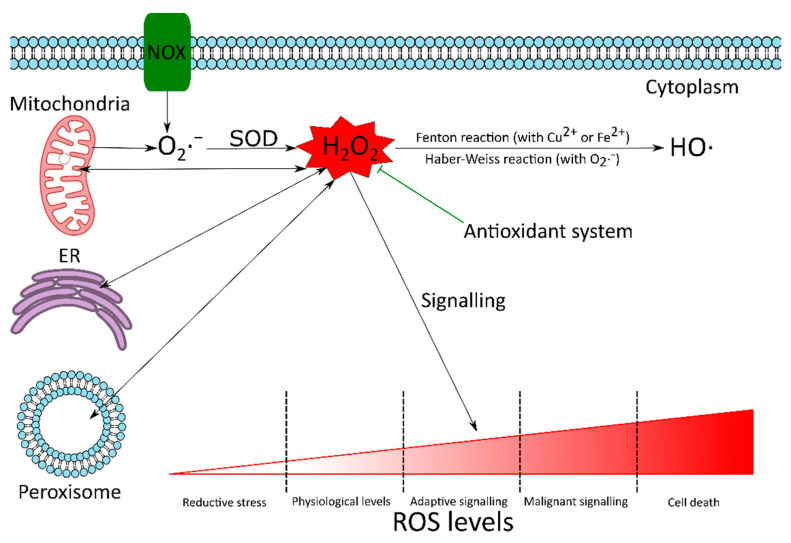
The dual role of ROS. There are many reactive oxygen species (ROS) sources in the cell. Although mitochondria are known to produce around 90% of the cellular ROS under physiological conditions, there are other notable sources too. These include NADPH oxidases (NOX), endoplasmic reticulum (ER) and peroxisomes. The superoxide radical (O2·) produced in the cell is converted by superoxide dismutase (SOD) to hydrogen peroxide (H2O2). H2O2 can be converted to highly reactive and cytotoxic hydroxyl radical (HO·), via the Haber–Weiss (Equation (1)) or Fenton reactions (Equation (2)). Although ROS can cause oxidative damage to biomolecules, at strictly regulated levels they are required to maintain the redox homeostasis of the cell and are involved in adaptive signalling to overcome various stresses. If the antioxidant system fails to keep ROS under control, high ROS concentrations can initiate malignant signalling or cell death. Since H2O2 is relatively stable and can cross biological membranes, it is considered to be the most important redox signalling molecule.
Figure 3
Figure 3
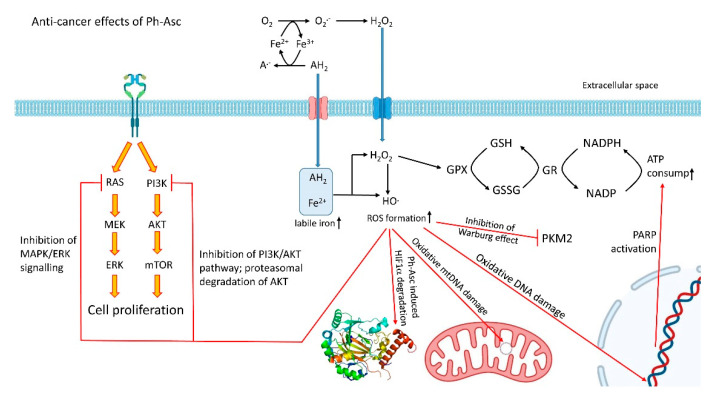
The anti-cancer effects of Ph-Asc. Pharmacologic ascorbate (Ph-Asc) in the presence of transition metals such as iron (Fe) induces the generation of H2O2 and the most powerful known oxidizing agent, hydroxyl radical. In this way, Ph-Asc treatment induces extended oxidative DNA damage that initiates PARP1-dependent repair process which lead to significant NAD+ and consequent ATP consumption. mtDNA proved to be more susceptible due to its less efficient repair system. Ph-Asc also induces the PHD2-independent downregulation of HIF-1α. Ph-Asc could inhibit the phosphorylation of PKM2 that halted the nuclear translocation of PKM2, resulting in the impairment of the Warburg effect in cancer cells and xenografts. Finally, Ph-Asc treatment could significantly inhibit the activity of both MAPK/ERK and PI3K/AKT signalling. All the observed cancer cytotoxicity could be reversed by intracellular or extracellular catalase supplementation.

References

    1. Snezhkina A.V., Kudryavtseva A.V., Kardymon O.L., Savvateeva M.V., Melnikova N.V., Krasnov G.S., Dmitriev A.A. ROS Generation and Antioxidant Defense Systems in Normal and Malignant Cells. Oxid. Med. Cell. Longev. 2019;2019:6175804. doi: 10.1155/2019/6175804. - DOI - PMC - PubMed
    1. Wang C.Y., Knutson M.D. Hepatocyte divalent metal-ion transporter-1 is dispensable for hepatic iron accumulation and non-transferrin-bound iron uptake in mice. Hepatology. 2013;58:788–798. doi: 10.1002/hep.26401. - DOI - PMC - PubMed
    1. Yanatori I., Kishi F. DMT1 and iron transport. Free Radic. Biol. Med. 2019;133:55–63. doi: 10.1016/j.freeradbiomed.2018.07.020. - DOI - PubMed
    1. Lane D.J.R., Bae D.H., Merlot A.M., Sahni S., Richardson D.R. Duodenal cytochrome b (DCYTB) in Iron metabolism: An update on function and regulation. Nutrients. 2015;7:2274–2296. doi: 10.3390/nu7042274. - DOI - PMC - PubMed
    1. Coffey R., Ganz T. Iron homeostasis: An anthropocentric perspective. J. Biol. Chem. 2017;292:12727–12734. doi: 10.1074/jbc.R117.781823. - DOI - PMC - PubMed