. 2022 May 6;23(9):5197.
doi: 10.3390/ijms23095197.

Rev-erb α Knockout Reduces Ethanol Consumption and Preference in Male and Female Mice

Affiliations

Rev-erb α Knockout Reduces Ethanol Consumption and Preference in Male and Female Mice

Yasmine Al-Sabagh et al. Int J Mol Sci. .

Abstract

Alcohol use is a contributor in the premature deaths of approximately 3 million people annually. Among the risk factors for alcohol misuse is circadian rhythm disruption; however, this connection remains poorly understood. Inhibition of the circadian nuclear receptor REV-ERBα is known to disrupt molecular feedback loops integral to daily oscillations, and impact diurnal fluctuations in the expression of proteins required for reward-related neurotransmission. However, the role of REV-ERBα in alcohol and substance use-related phenotypes is unknown. Herein, we used a Rev-erbα knockout mouse line and ethanol two-bottle choice preference testing to show that disruption of Rev-erbα reduces ethanol preference in male and female mice. Rev-erbα null mice showed the lowest ethanol preference in a two-bottle choice test across all genotypes, whereas there were no ethanol preference differences between heterozygotes and wildtypes. In a separate experiment, alcohol-consuming wildtype C57Bl/6N mice were administered the REV-ERBα/β inhibitor SR8278 (25 mg/kg or 50 mg/kg) for 7 days and alcohol preference was evaluated daily. No differences in alcohol preference were observed between the treatment and vehicle groups. Our data provides evidence that genetic variation in REV-ERBα may contribute to differences in alcohol drinking.

Keywords: NR1D1; REV-ERBα; addiction; alcohol; circadian rhythms.


Conflict of interest statement

The authors declare no conflict of interest.

Figures
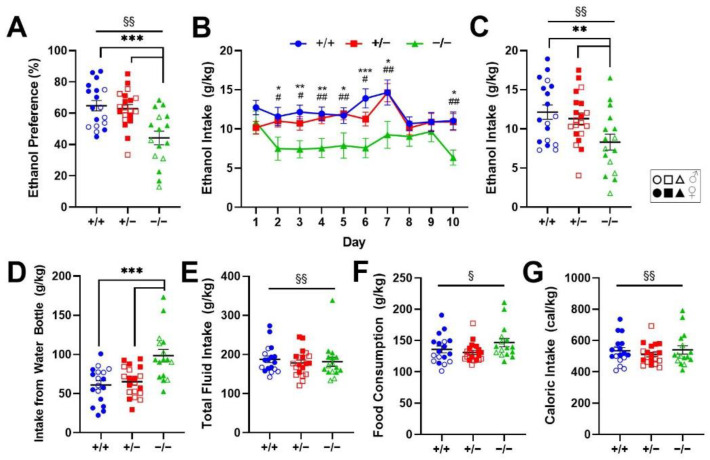
Figure 1
Figure 1
Genetic deletion of Rev-erbα reduces ethanol preference and consumption in male and female mice. Preference for 10% ethanol is (A) reduced in Rev-erb−/− mice relative to Rev-erb+/+ and Rev-erb+/− mice (p < 0.001 ***) and elevated in females compared to males (p < 0.01 §§). Ethanol intake normalized to body mass is also (B) reduced in Rev-erb−/− mice compared to the other groups on most testing days (p < 0.05 *, < 0.01 **, < 0.001 *** vs. Rev-erb+/+, p < 0.05 #, <0.01 ## vs. Rev-erb+/−) and (C) greater in females compared to males according to daily average consumption (p < 0.01 §§). (D) Water consumption normalized to body mass was greater in Rev-erb−/− compared to the Rev-erb+/+ and Rev-erb+/− groups (p < 0.001 ***). Average daily (E) total fluid intake (p < 0.01 §§), (F) food intake (p < 0.05 §), (G) calorie intake (p < 0.01 §§) normalized to body mass was greater in females than males.
Figure 2
Figure 2
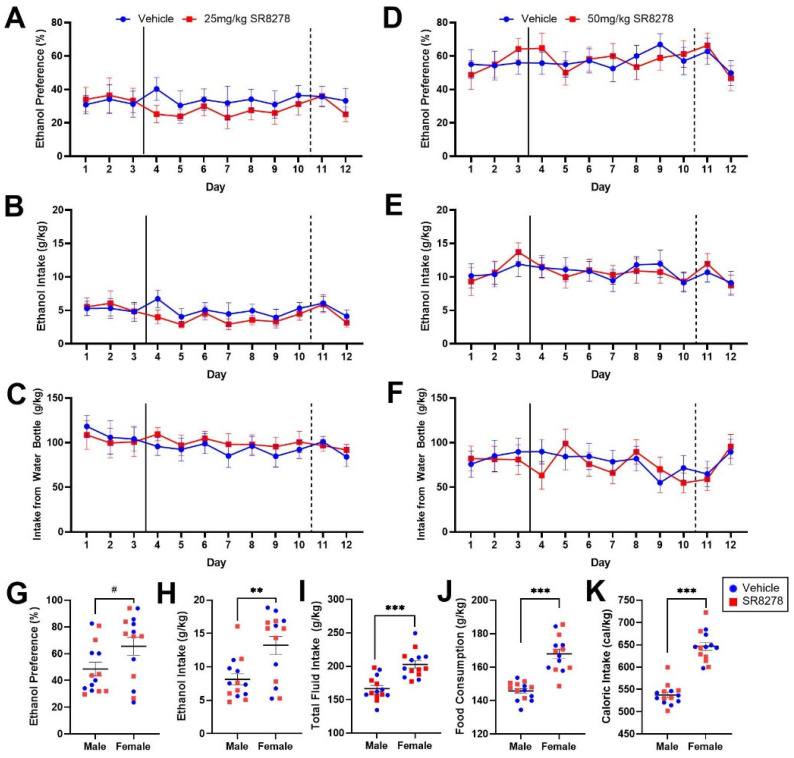
Pharmacological inhibition of REV-ERBα/β with 25 mg/kg (AC) or 50 mg/kg (DK) of SR8278 did not alter ethanol preference, ethanol intake, or water intake from the water-only bottle in mice. In male mice, 25 mg/kg of SR8278 did not alter (A) ethanol preference, (B) ethanol intake normalized to body mass, or (C) water intake from the water-only bottle normalized to body mass compared to vehicle treatment. In male and female mice, 50 mg/kg of SR8278 did not alter (D) ethanol preference, (E) ethanol intake normalized to body mass, or (F) water intake from the water-only bottle normalized to body mass compared to vehicle treatment. Irrespective of treatment (50 mg/kg SR8278 or vehicle), there was a (G) trend toward a significant effect of sex on ethanol preference (p = 0.06), with females showing greater average daily (H) ethanol intake (p < 0.01), (I) total fluid intake (p < 0.001), (J) food intake (p < 0.001), and (K) caloric intake (p < 0.001) compared to males when normalized to body mass. p = 0.06 #, p < 0.01 **, p < 0.001 ***. (AF) Solid lines indicate time of onset of SR8278 injection; dashed lines indicate time of cessation of daily injections.

References

    1. World Health Organization . Global Status Report on Alcohol and Health 2018. WHO; Geneva, Switzerland: 2018.
    1. Substance Abuse and Mental Health Services Administration . Key Substance Use and Mental Health Indicators in the United States: Results from the 2019 National Survey on Drug Use and Health. Substance Abuse and Mental Health Services Administration; Rockville, MD, USA: 2020.
    1. Richter K., Peter L., Rodenbeck A., Weess H.G., Riedel-Heller S.G., Hillemacher T. Shiftwork and Alcohol Consumption: A Systematic Review of the Literature. Eur. Addict. Res. 2021;27:9–15. doi: 10.1159/000507573. - DOI - PubMed
    1. Hasler B.P., Soehner A.M., Clark D.B. Sleep and Circadian Contributions to Adolescent Alcohol Use Disorder. Alcohol. 2015;49:377–387. doi: 10.1016/j.alcohol.2014.06.010. - DOI - PMC - PubMed
    1. Burkholder J.D., Joines R., Cunningham-Hill M., Xu B. Health and Well-Being Factors Associated with International Business Travel. J. Travel Med. 2010;17:329–333. doi: 10.1111/j.1708-8305.2010.00441.x. - DOI - PubMed

Substances

LinkOut - more resources