. 2022 Apr 19;12(9):1399.
doi: 10.3390/nano12091399.

Unexpected Anisotropy of the Electron and Hole Landé g-Factors in Perovskite CH3NH3PbI3 Polycrystalline Films

Affiliations

Unexpected Anisotropy of the Electron and Hole Landé g-Factors in Perovskite CH3NH3PbI3 Polycrystalline Films

Guadalupe Garcia-Arellano et al. Nanomaterials (Basel). .

Abstract

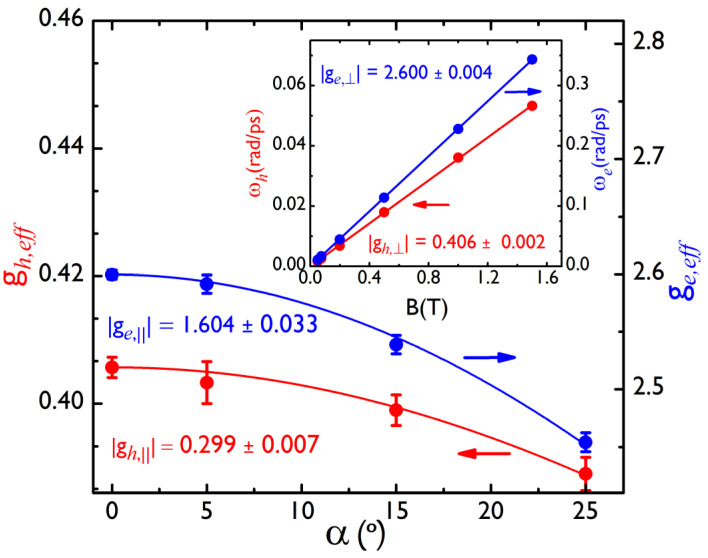
In this work, we studied, at low temperature, the coherent evolution of the localized electron and hole spins in a polycrystalline film of CH3NH3PbI3 (MAPI) by using a picosecond-photo-induced Faraday rotation technique in an oblique magnetic field. We observed an unexpected anisotropy for the electron and hole spin. We determined the electron and hole Landé factors when the magnetic field was applied in the plane of the film and perpendicular to the exciting light, denoted as transverse ⟂ factors, and when the magnetic field was applied perpendicular to the film and parallel to the exciting light, denoted as parallel ∥ factors. We obtained |ge,⟂|=2.600 ± 0.004, |ge,∥|=1.604 ± 0.033 for the electron and |gh,⟂|=0.406 ± 0.002, |gh,∥|=0.299 ± 0.007 for the hole. Possible origins of this anisotropy are discussed herein.

Keywords: CH3NH3PbI3; g-factor; halide perovskite; photo-induced Faraday rotation; polycrystalline film.


Conflict of interest statement

The authors declare no conflict of interest.

Figures
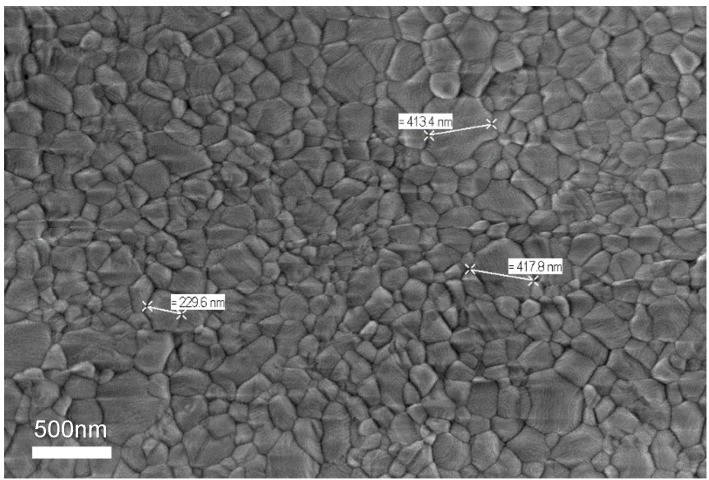
Figure 1
Figure 1
SEM image of MAPI polycrystalline films used in this study.
Figure 2
Figure 2
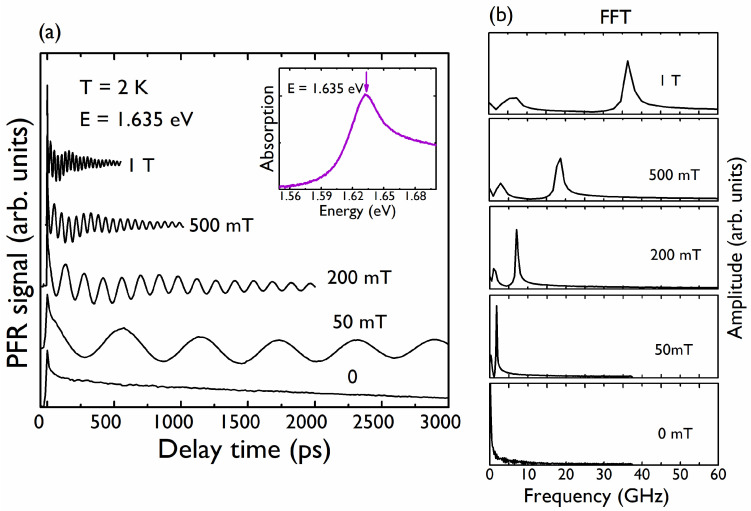
(a) PFR signals at 2 K for different magnetic fields. The curves have been shifted for clarity. The magnetic field is perpendicular to the propagation direction of the pump and probe beams (α = 0°). Inset: Absorption spectrum on MAPI sample obtained at 11 K. The arrow denotes the energy at which the PFR measurements were performed; (b) FFT of the PFR signals appearing in (a).
Figure 3
Figure 3
Effective Landé factors for the hole (left, red color) and the electron (right, blue color) versus the angle α. The points represent the experimental data, and the solid lines are fits to Equation (3). Inset: Larmor precession frequencies of the hole (left, red line) and the electron (right, blue line) versus the magnetic field, when the sample is perpendicular to pump and probe beams (α=0°) with an in-plane magnetic field.
Figure 4
Figure 4
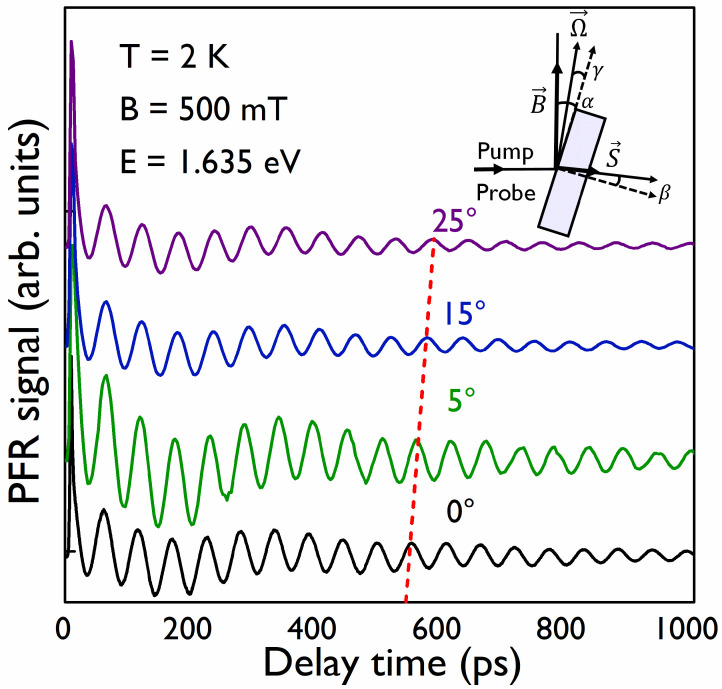
PFR signals obtained at 2 K and at B = 500 mT for different values of α angle. The red dashed line follows the 10-th maximum peak of the high-frequency component, showing the increase of the period as the angle α increases.
Figure 5
Figure 5
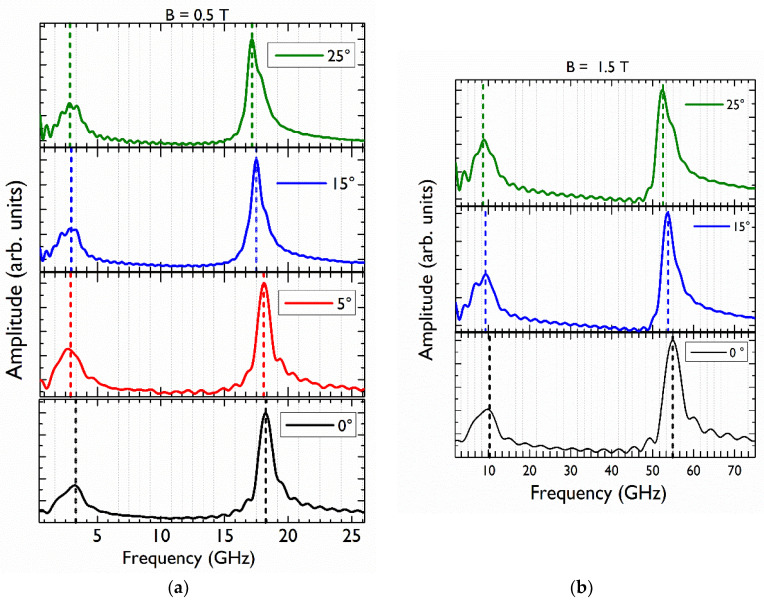
(a) FFT of the PFR signals appearing in Figure 4 obtained at a fixed magnetic field B = 0.5 T and different angles 0° (black), 5° (red), 15° (blue), 25° (green). The curves have been vertically shifted for clarity. The vertical dashed lines indicate the two identified frequencies corresponding to the hole and electron in each case. (b) FFT of the PFR signals obtained at B = 1.5 T. The decrease in the frequencies as the angle increases is indicated with the dashed lines.

References

    1. Stoumpos C.C., Malliakas C.D., Peters J.A., Liu Z., Sebastian M., Im J., Chasapis T.C., Wibowo A.C., Chung D.Y., Freeman A.J., et al. Crystal Growth of the perovskite semiconductor CsPbBr3: A material for high energy radiation detection. Cryst. Growth Des. 2013;13:2722–2727. doi: 10.1021/cg400645t. - DOI
    1. Lee M.M., Teuscher J., Miyasaka T., Murakami T.N., Snaith H.J. Efficient hybrid solar cells based on mesosuperstructured organometal halide perovskites. Science. 2012;338:643–647. doi: 10.1126/science.1228604. - DOI - PubMed
    1. Manser J.S., Christians J.A., Kamat P.V. Intriguing optoelectronic properties of metal halide perovskites. Chem. Rev. 2016;116:12956–13008. doi: 10.1021/acs.chemrev.6b00136. - DOI - PubMed
    1. Li G., Rocca Rivarola F.W., Davis N.J.J.L., Bai S., Jellicoe T.C., de la Peña F., Hou S., Ducatin C., Gao F., Friend R.H., et al. Highly efficient perovskite nanocrystals light-emitting diodes enabled by a universal crosslink method. Adv. Mater. 2016;28:3528–3534. doi: 10.1002/adma.201600064. - DOI - PubMed
    1. Cho H., Jeong S.H., Park Y.H., Kim M.H., Wolf C., Lee C.L., Heo J.H., Sadhanala A., Myoung N.S., Yoo S., et al. Overcoming the electroluminescence efficiency limitations of perovskite light- emitting diodes. Science. 2015;350:1222–1225. doi: 10.1126/science.aad1818. - DOI - PubMed

LinkOut - more resources