. 2022 Apr 22;12(9):1437.
doi: 10.3390/nano12091437.

Superfluidity of Dipolar Excitons in a Double Layer of α - T3 with a Mass Term

Affiliations

Superfluidity of Dipolar Excitons in a Double Layer of α - T3 with a Mass Term

Oleg L Berman et al. Nanomaterials (Basel). .

Abstract

We predict Bose-Einstein condensation and superfluidity of dipolar excitons, formed by electron-hole pairs in spatially separated gapped hexagonal α-T3 (GHAT3) layers. In the α-T3 model, the AB-honeycomb lattice structure is supplemented with C atoms located at the centers of the hexagons in the lattice. We considered the α-T3 model in the presence of a mass term which opens a gap in the energy-dispersive spectrum. The gap opening mass term, caused by a weak magnetic field, plays the role of Zeeman splitting at low magnetic fields for this pseudospin-1 system. The band structure of GHAT3 monolayers leads to the formation of two distinct types of excitons in the GHAT3 double layer. We consider two types of dipolar excitons in double-layer GHAT3: (a) "A excitons", which are bound states of electrons in the conduction band (CB) and holes in the intermediate band (IB), and (b) "B excitons", which are bound states of electrons in the CB and holes in the valence band (VB). The binding energy of A and B dipolar excitons is calculated. For a two-component weakly interacting Bose gas of dipolar excitons in a GHAT3 double layer, we obtain the energy dispersion of collective excitations, the sound velocity, the superfluid density, and the mean-field critical temperature Tc for superfluidity.

Keywords: Bose-Einstein condensation; dipolar exitons; superfluidity.


Conflict of interest statement

The authors declare no conflict of interest.

Figures
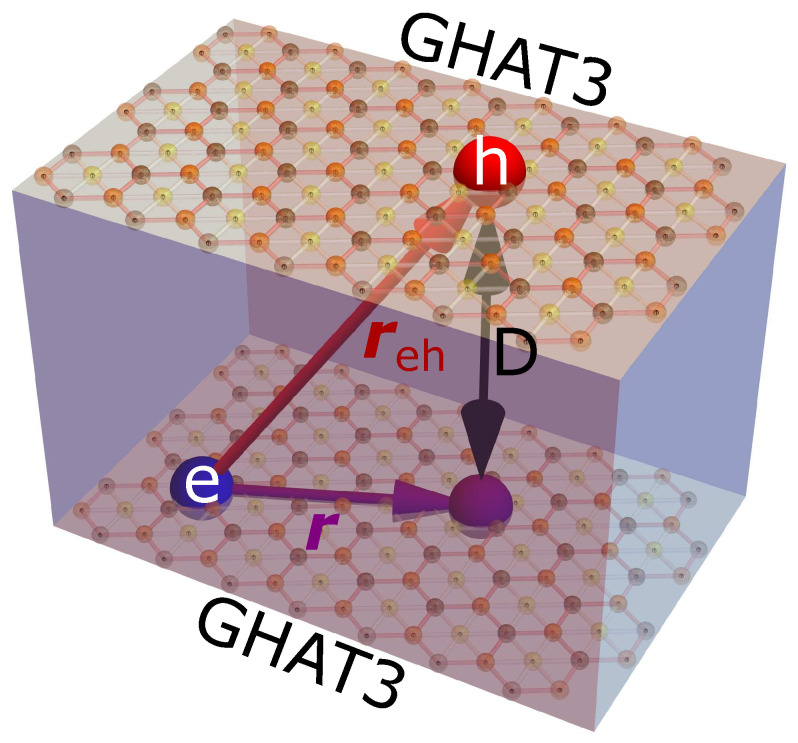
Figure 1
Figure 1
Schematic illustration of a dipolar excitonin a pair of GHAT3 double layers embedded in an insulating material.
Figure 2
Figure 2
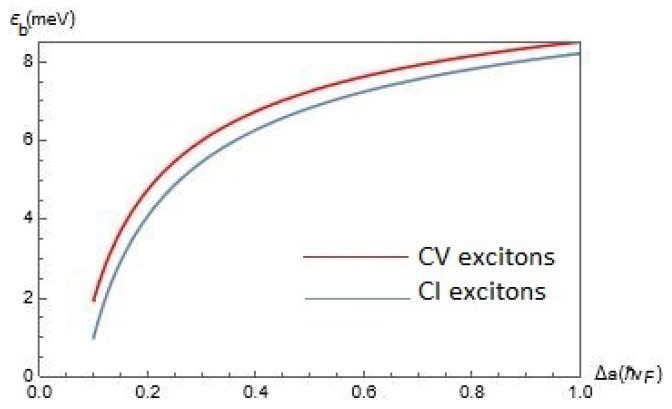
The exciton binding energy Eb(α,Δ,D) for CV and CI excitons as functions of the gap Δ for chosen parameter α=0.6 and interlayer separations D=25nm. The lattice constant of αT3 is a=2.46.
Figure 3
Figure 3
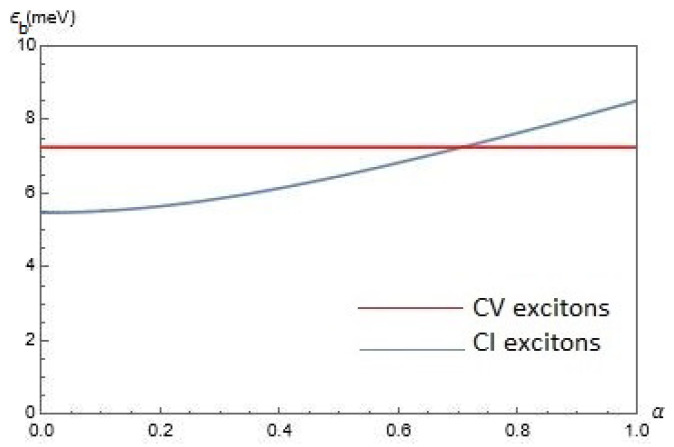
The exciton binding energy Eb(α,Δ,D) for CV and CI excitons as functions of the parameter α for chosen gap Δ=0.5ħvF/a and interlayer separations D=25nm.
Figure 4
Figure 4
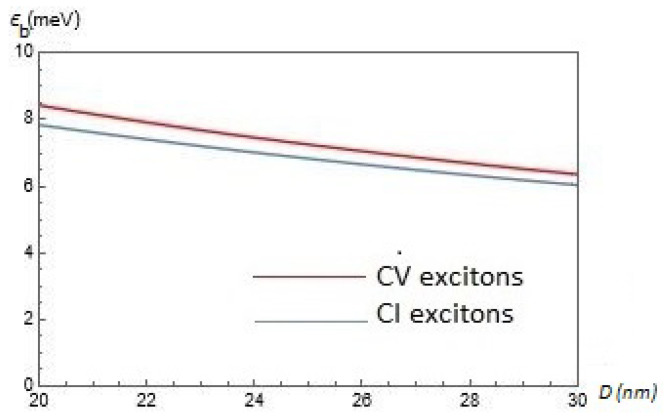
The exciton binding energy Eb(α,Δ,D) for CV and CI excitons as functions of the interlayer separation D for chosen parameter α=0.6 and gap Δ=0.5ħvF/a.
Figure 5
Figure 5
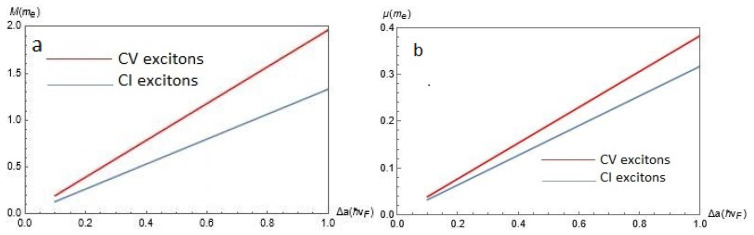
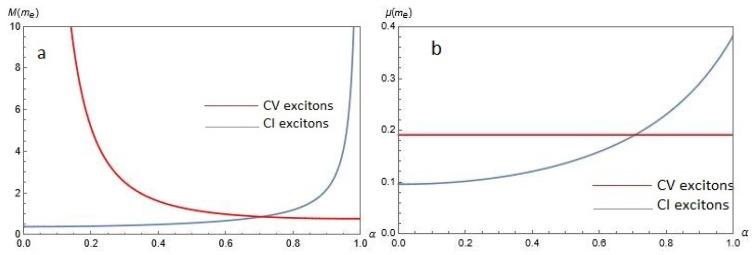
The effective masses of a dipolar exciton for CV and CI excitons as functions of the gap Δ for chosen α=0.6 for (a) center-of-mass exciton mass M on the left panel and (b) reduced exciton mass μ, on the right.
Figure 6
Figure 6
The effective masses of dipolar excitons for CV and CI excitons as functions of the hopping parameter α for chosen gap Δ=0.5ħvF/a for (a) center-of-mass exciton mass M in the left panel and (b) reduced exciton mass μ, on the right.
Figure 7
Figure 7
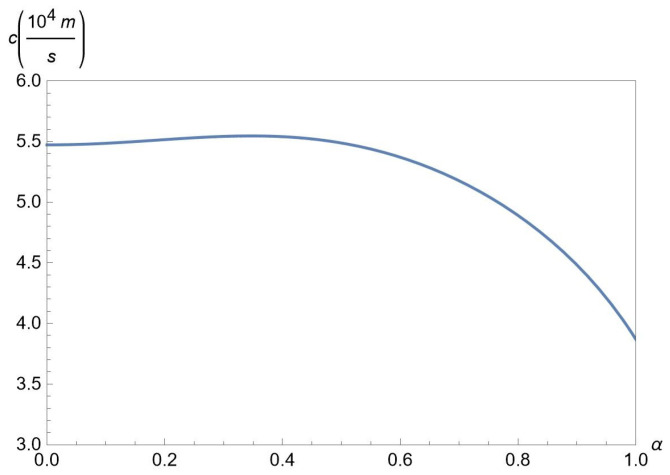
Plot of the sound velocity cc1 versus α for chosen gap Δ=ħvF/a, interlayer separations D=25nm at fixed concentrations nA=50×1011cm2 and nB=50×1011cm2 of A and B excitons, respectively.
Figure 8
Figure 8
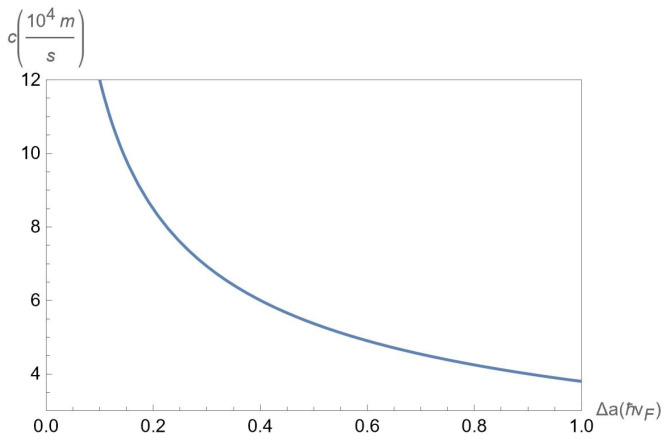
The sound velocity cc1 versus the gap Δ for chosen parameter α = 0.6, interlayer separations D=25nm at the fixed concentrations nA=50×1011cm2 and nB=50×1011cm2 of A and B excitons, respectively.
Figure 9
Figure 9
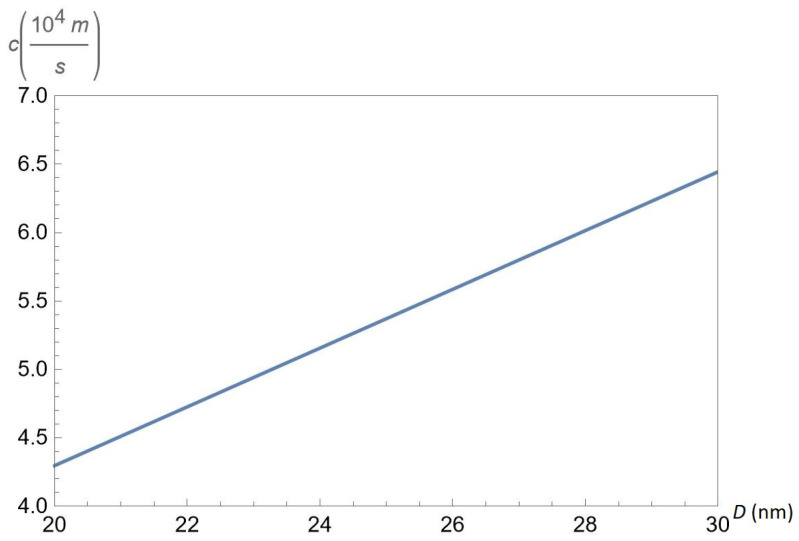
The sound velocity cc1 versus the interlayer separation D for chosen parameter α=0.6 and gap Δ=0.5ħvF/a, at fixed concentrations nA=50×1011cm2 and nB=50×1011cm2 of A and B excitons, respectively.
Figure 10
Figure 10
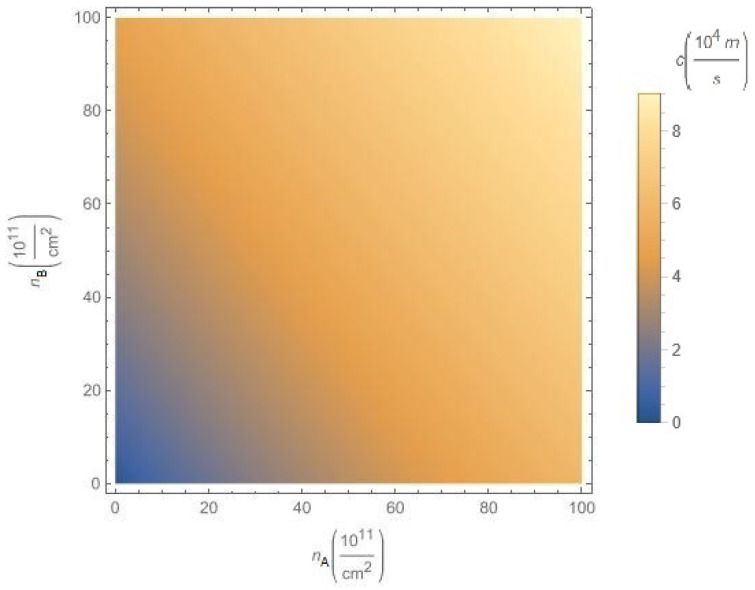
The sound velocity cc1 versus the concentrations nA and nB of A and B excitons, respectively, for chosen parameter α=0.6 and gap Δ=0.5ħvF/a, at the fixed interlayer separation D=25nm.
Figure 11
Figure 11
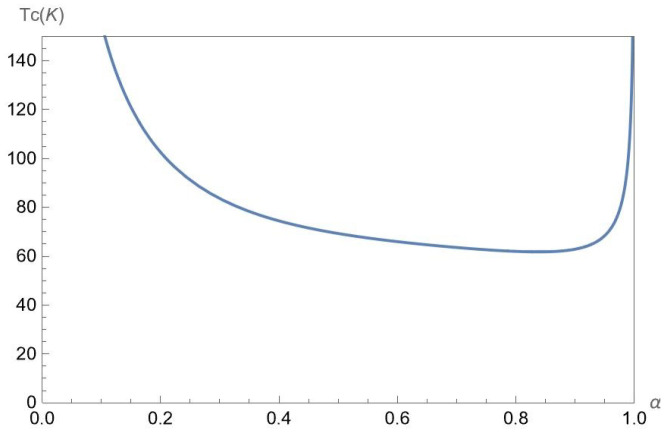
The mean-field phase transition critical temperature Tc(nA,nB,α,Δ,D) versus the parameter α for chosen gap Δ=0.5ħvF/a, interlayer separations D=25nm at the fixed concentrations nA=50×1011cm2 and nB=50×1011cm2 of A and B excitons, respectively.
Figure 12
Figure 12
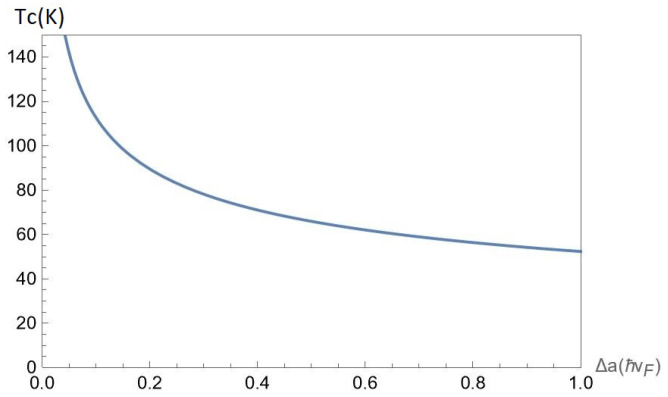
The mean-field phase transition critical temperature Tc(nA,nB,α,Δ,D) versus the gap Δ for chosen parameter α=0.6, interlayer separations D=25nm at the fixed concentrations nA=50×1011cm2 and nB=50×1011cm2 of A and B excitons, respectively.
Figure 13
Figure 13
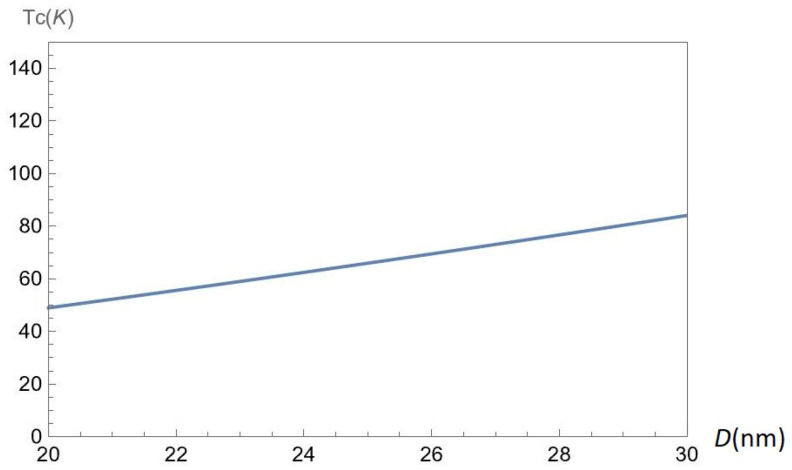
The mean-field phase transition critical temperature Tc(nA,nB,α,Δ,D) versus the interlayer separation D for chosen parameter α=0.6 and gap Δ=0.5ħvF/a, at fixed concentrations nA=50×1011cm2 and nB=50×1011cm2 of A and B excitons, respectively.
Figure 14
Figure 14
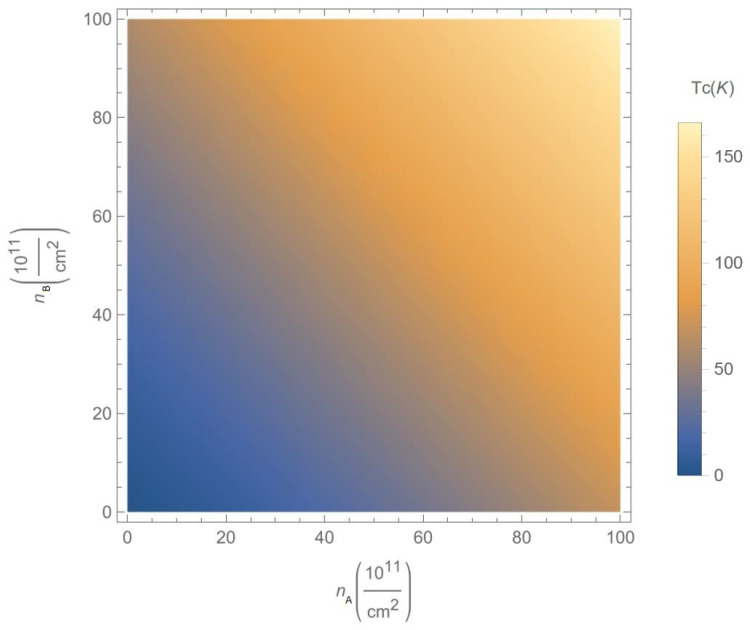
Density plot for the mean-field phase transition critical temperature Tc(nA,nB,α,Δ,D) versus the concentrations nA and nB of A and B excitons, respectively, for chosen parameter α=0.6 and gap Δ=0.5ħvF/a, at the fixed interlayer separation D=25nm.

References

    1. Lozovik Y.E., Yudson V.I. Feasibility of superfluidity of paired spatially separated electrons and holes; a new superconductivity mechanism. Sov. Phys. JETP Lett. 1975;22:274.
    1. Lozovik Y.E., Yudson V.I. A new mechanism for superconductivity: Pairing between spatially separated electrons and holes. Sov. Phys. JETP Lett. 1976;44:389.
    1. Snoke D.W. Spontaneous Bose coherence of excitons and polaritons. Science. 2002;298:1368. doi: 10.1126/science.1078082. - DOI - PubMed
    1. Butov L.V. Condensation and pattern formation in cold exciton gases in coupled quantum wellsm. J. Phys. Condens. Matter. 2004;16:R1577. doi: 10.1088/0953-8984/16/50/R02. - DOI - PubMed
    1. Eisenstein J.P., MacDonald A.H. Bose–Einstein condensation of excitons in bilayer electron systems. Nature. 2004;432:691. doi: 10.1038/nature03081. - DOI - PubMed

LinkOut - more resources