


Turn Performance Variation in European Elite Short-Course Swimmers
- PMID: 35564428
- PMCID: PMC9102928
- DOI: 10.3390/ijerph19095033
Turn Performance Variation in European Elite Short-Course Swimmers
Abstract
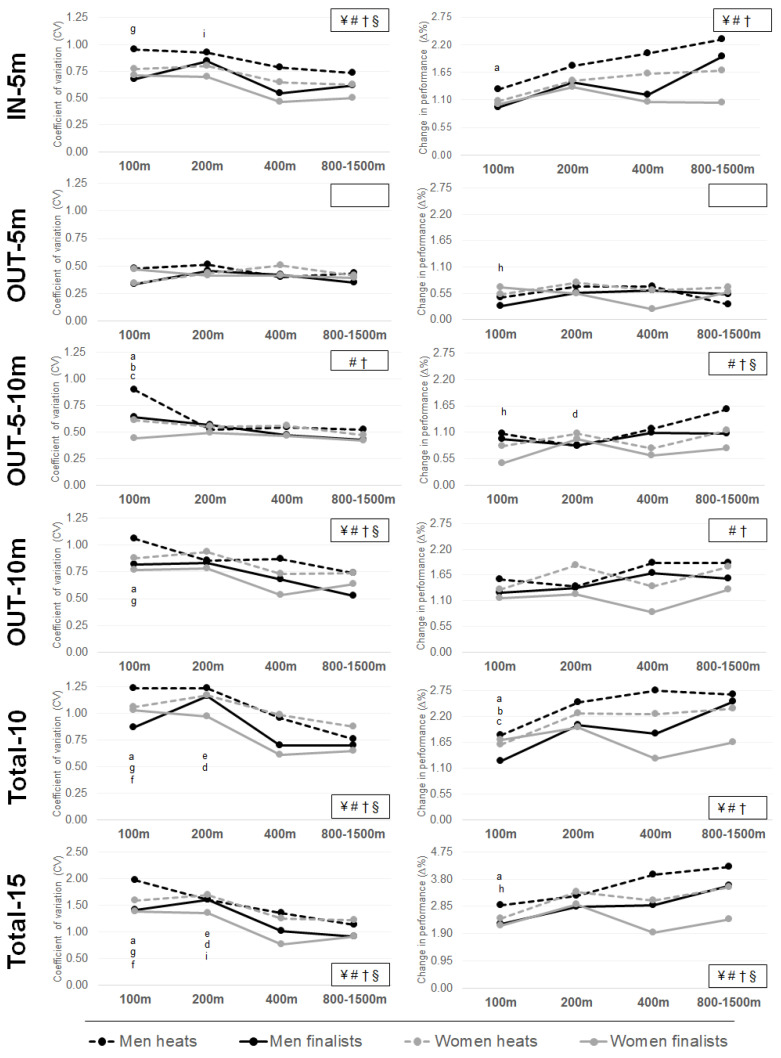
Turn performances are important success factors for short-course races, and more consistent turn times may distinguish between higher and lower-ranked swimmers. Therefore, this study aimed to determine coefficients of variation (CV) and performance progressions (∆%) of turn performances. The eight finalists and eight fastest swimmers from the heats that did not qualify for the semi-finals, i.e., from 17th to 24th place, of the 100, 200, 400, and 800 (females only)/1500 m (males only) freestyle events at the 2019 European Short Course Championships were included, resulting in a total of 64 male (finalists: age: 22.3 ± 2.6, FINA points: 914 ± 31 vs. heats: age: 21.5 ± 3.1, FINA points: 838 ± 74.9) and 64 female swimmers (finalists: age: 22.9 ± 4.8, FINA points: 904 ± 24.5 vs. heats: age: 20.1 ± 3.6, FINA points: 800 ± 48). A linear mixed model was used to compare inter- and intra-individual performance variation. Interactions between CVs, ∆%, and mean values were analyzed using a two-way analysis of variance (ANOVA). The results showed impaired turn performances as the races progressed. Finalists showed faster turn section times than the eight fastest non-qualified swimmers from the heats (p < 0.001). Additionally, turn section times were faster for short-, i.e., 100 and 200 m, than middle- and long-distance races, i.e., 400 to 1500 m races (p < 0.001). Regarding variation in turn performance, finalists showed lower CVs and ∆% for all turn section times (0.74% and 1.49%) compared to non-qualified swimmers (0.91% and 1.90%, respectively). Similarly, long-distance events, i.e., 800/1500 m, showed lower mean CVs and higher mean ∆% (0.69% and 1.93%) than short-distance, i.e., 100 m events (0.93% and 1.39%, respectively). Regarding turn sections, the largest CV and ∆% were found 5 m before wall contact (0.70% and 1.45%) with lower CV and more consistent turn section times 5 m after wall contact (0.42% and 0.54%). Non-qualified swimmers should aim to match the superior turn performances and faster times of finalists in all turn sections. Both finalists and non-qualified swimmers should pay particular attention to maintaining high velocities when approaching the wall as the race progresses.
Keywords: competition analysis; freestyle; performance; race analysis; swimming.
Conflict of interest statement
The authors have no conflict of interest to declare. The funder had no role in the development of the study design, data interpretation, or decision to publish the results.
Figures
References
Publication types
MeSH terms
LinkOut - more resources
Full Text Sources
