


Functional Properties of Meat in Athletes' Performance and Recovery
- PMID: 35564540
- PMCID: PMC9102337
- DOI: 10.3390/ijerph19095145
Functional Properties of Meat in Athletes' Performance and Recovery
Abstract
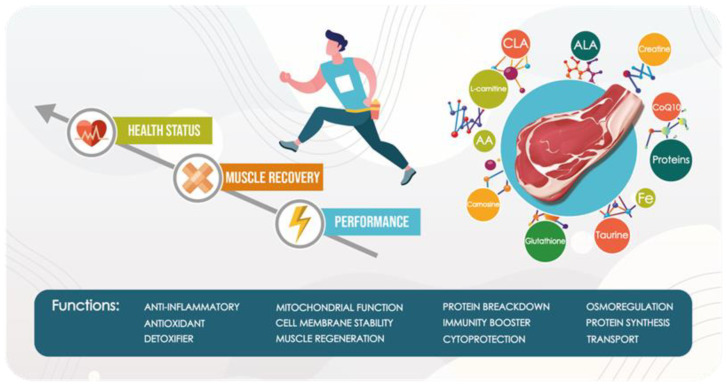
Physical activity (PA) and sport play an essential role in promoting body development and maintaining optimal health status both in the short and long term. Despite the benefits, a long-lasting heavy training can promote several detrimental physiological changes, including transitory immune system malfunction, increased inflammation, and oxidative stress, which manifest as exercise-induced muscle damages (EIMDs). Meat and derived products represent a very good source of bioactive molecules such as proteins, lipids, amino acids, vitamins, and minerals. Bioactive molecules represent dietary compounds that can interact with one or more components of live tissue, resulting in a wide range of possible health consequences such as immune-modulating, antihypertensive, antimicrobial, and antioxidative activities. The health benefits of meat have been well established and have been extensively reviewed elsewhere, although a growing number of studies found a significant positive effect of meat molecules on exercise performance and recovery of muscle function. Based on the limited research, meat could be an effective post-exercise food that results in favorable muscle protein synthesis and metabolic performance.
Keywords: diet; exercise-induced muscle damages (EIMDs); health; meat; muscle recovery; physical activity (PA); wellbeing.
Conflict of interest statement
The authors declare no conflict of interest.
Figures
References
-
- Monda V., Sessa F., Ruberto M., Carotenuto M., Marsala G., Monda M., Cambria M.T., Astuto M., Distefano A., Messina G. Aerobic Exercise and Metabolic Syndrome: The Role of Sympathetic Activity and the Redox System. Diabetes Metab. Syndr. Obes. 2020;13:2433–2442. doi: 10.2147/DMSO.S257687. - DOI - PMC - PubMed
-
- Braun B., Hamilton K.L., Lark D.S., Newman A. Biochemistry of Exercise Effects in Type 2 Diabetes. In: Tiidus P.M., MacPherson R.E.K., LeBlanc P.J., Josse A.R., editors. The Routledge Handbook on Biochemistry of Exercise. 1st ed. Routledge; New York, NY, USA: 2020. pp. 433–454.
Publication types
MeSH terms
Substances
LinkOut - more resources
Full Text Sources
