


Impact of Oral Rinsing with Octenidine Based Solution on SARS-CoV-2 Loads in Saliva of Infected Patients an Exploratory Study
- PMID: 35564977
- PMCID: PMC9099814
- DOI: 10.3390/ijerph19095582
Impact of Oral Rinsing with Octenidine Based Solution on SARS-CoV-2 Loads in Saliva of Infected Patients an Exploratory Study
Abstract
Objective: In this study, the in-vivo effect of an antiseptic mouth rinse with Octenisept plus phenoxyethanol (OCT + PE) on the oral SARS-CoV-2 load was investigated.
Material and methods: In eight COVID-19 patients, saliva samples were obtained before mouth rinsing and at five time points post rinsing with OCT + PE (n = 47 saliva samples in total). SARS-CoV-2 RNA was detected and quantified by RT-qPCR and virus isolation in cell culture was performed to assess for infectivity.
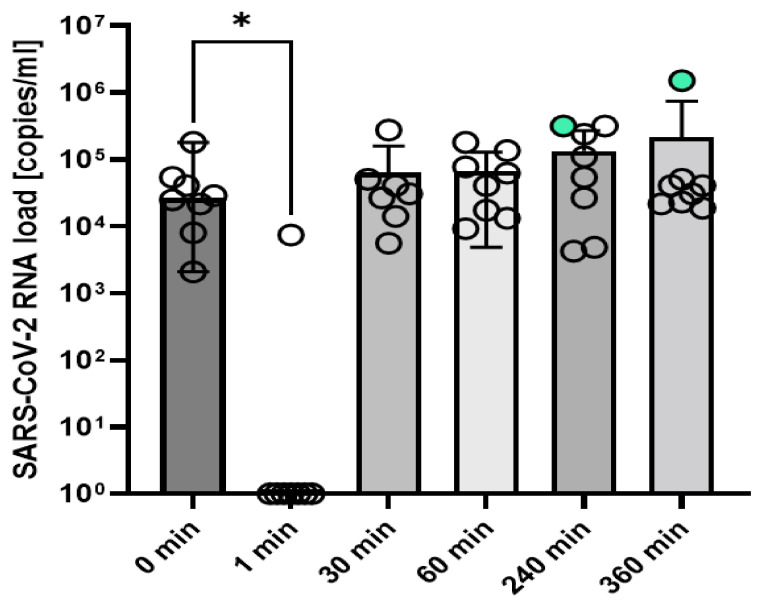
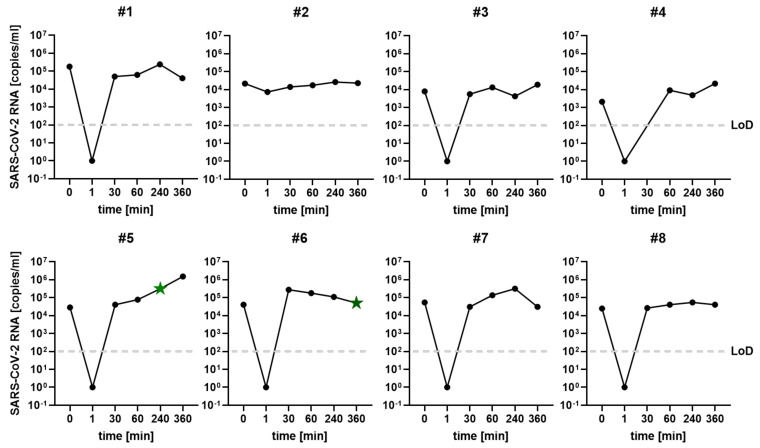
Results: Immediately after mouth rinsing (1 min), a significant reduction of the SARS-CoV-2 RNA loads in saliva was achieved (p = 0.03) with 7/8 participants having SARS-CoV-2 RNA levels undetectable by RT-qPCR. At later time points, RNA levels returned to baseline levels in all study participants. Infectivity of saliva samples was demonstrated by successful virus isolation from saliva samples collected at later time points.
Conclusions: This study highlights that saliva samples from COVID-19 patients are infectious and demonstrates that mouth rinsing with OCT + PE temporarily leads to a significant reduction of the SARS-CoV-2 load in saliva.
Clinical relevance: Mouth rinsing with OCT + PE could provide a simple, rapid, and efficient method for SARS-CoV-2 infection prevention, particularly in the field of dental and respiratory medicine.
Keywords: SARS-CoV-2; octenidine; oral rinsing.
Conflict of interest statement
M.L. received speaker honoraria and related travel expenses from Roche Diagnostics. All other authors report no conflict of interest.
Figures
References
-
- Schijven J., Vermeulen L.C., Swart A., Meijer A., Duizer E., de Roda Husman A.M. Quantitative Microbial Risk Assessment for Airborne Transmission of SARS-CoV-2 via Breathing, Speaking, Singing, Coughing, and Sneezing. Environ. Health Perspect. 2021;129:47002. doi: 10.1289/EHP7886. - DOI - PMC - PubMed
-
- Heinzerling A., Stuckey M.J., Scheuer T., Xu K., Perkins K.M., Resseger H., Magill S., Verani J.R., Jain S., Acosta M., et al. Transmission of COVID-19 to Health Care Personnel during Exposures to a Hospitalized Patient—Solano County, California, February 2020. MMWR Morb. Mortal. Wkly. Rep. 2020;69:472–476. doi: 10.15585/mmwr.mm6915e5. - DOI - PMC - PubMed
-
- Deutscher Arbeitskreis für Hygiene in der Zahnmedizin SARS-COV-2/COVID-19—Risikomanagement in Zahnarztpraxen. DAHZ–Stellungnahme Corona 20.04.2020. [(accessed on 20 April 2020)]. Available online: http://dahz.org/wp-content/uploads/2020/04/DAHZ-Stellungnahme-Corona-20.....
Publication types
MeSH terms
Substances
LinkOut - more resources
Full Text Sources
Medical
Miscellaneous
