


Analysis of Characteristics and Quality of Life of Elderly Women with Mild to Moderate Urinary Incontinence in Community Dwellings
- PMID: 35565009
- PMCID: PMC9105851
- DOI: 10.3390/ijerph19095609
Analysis of Characteristics and Quality of Life of Elderly Women with Mild to Moderate Urinary Incontinence in Community Dwellings
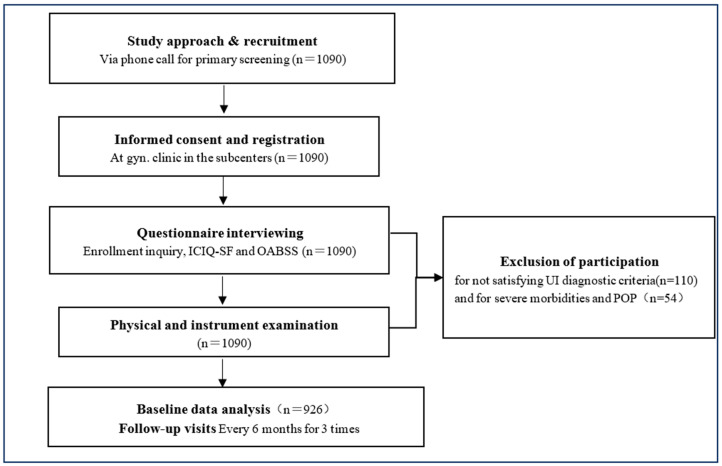
Abstract
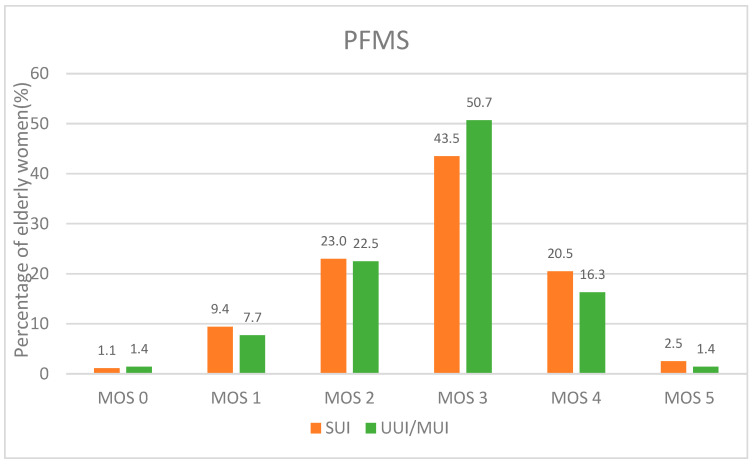
Introduction: The incidence of urinary incontinence (UI) increases with age. Mild and moderate UI have little impact on women and are easily ignored. This study reports the characteristics of non-severe UI and quality of life (QOL) in elderly women using data from a Development and Evaluation of a Senile UI Alert System study. Methods: 926 women aged ≥60 were enrolled from six subcenters across China, among whom 717 SUI patients and 209 UUI/MUI patients were grouped into Group A and Group B, respectively, according to leakage symptoms. Demographic and clinical data, pelvic organ prolapse quantification and pelvic floor muscle strength measurement (PFMS) were collected from participants, followed by evaluation of QOL and sexual life. Result: The major type of UI in community women was SUI (77.4%); MUI and UUI accounted for 20.63% and 1.94%, respectively. Weakened PFMS was detected in 78.2% of the participants. Group B was significantly higher in terms of median age, weight, BMI, waist circumference and menopausal years, and had the greater UI severity and impact on QOL, as well as less active sex live than group A (p < 0.05). Conclusion: SUI distributes dominantly in elderly community women, but UUI/MUI has greater impact on QOL and is related to a less active sex life, which requires more attention from medical staff.
Keywords: mild and moderate; quality of life; sex life; urinary incontinence.
Conflict of interest statement
The authors declare no conflict of interest.
Figures
References
-
- Sultan A.H., Monga A., Lee J., Emmanuel A., Norton C., Santoro G., Hull T., Berghmans B., Brody S., Haylen B.T. An International Urogynecological Association (IUGA)/International Continence Society (ICS) joint report on the terminology for female anorectal dysfunction. Neurourol. Urodyn. 2017;36:10–34. doi: 10.1002/nau.23055. - DOI - PubMed
-
- Hagen S., McClurg D., Bugge C., Hay-Smith J., Dean S.G., Elders A., Glazener C., Abdel-Fattah M., Agur W.I., Booth J., et al. Effectiveness and cost-effectiveness of basic versus biofeedback-mediated intensive pelvic floor muscle training for female stress or mixed urinary incontinence: Protocol for the OPAL randomised trial. BMJ Open. 2019;9:e024153. doi: 10.1136/bmjopen-2018-024153. - DOI - PMC - PubMed
Publication types
MeSH terms
LinkOut - more resources
Full Text Sources
Medical
