


Productive Performance, Egg Quality and Yolk Lipid Oxidation in Laying Hens Fed Diets including Grape Pomace or Grape Extract
- PMID: 35565504
- PMCID: PMC9100342
- DOI: 10.3390/ani12091076
Productive Performance, Egg Quality and Yolk Lipid Oxidation in Laying Hens Fed Diets including Grape Pomace or Grape Extract
Abstract
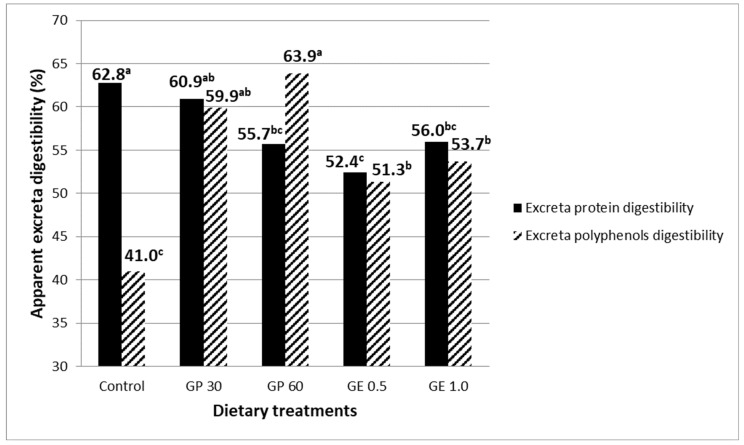
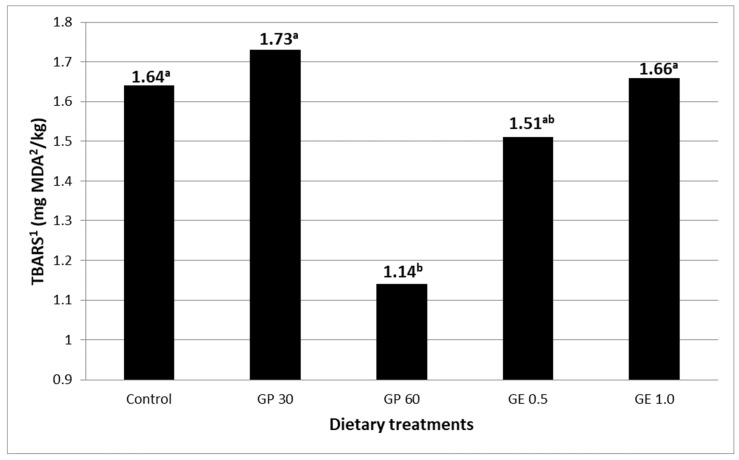
An experiment was conducted to assess in laying hens the effect of including grape pomace (GP, at 30 or 60 g/kg) or grape extract (GE, at 0.5 or 1.0 g/kg) on egg production, feed conversion ratio, protein and polyphenol digestibility, egg weight, egg quality, yolk fatty acid profile and oxidative stability of yolk lipids. No differences were detected among diets for egg production (83.8%, on average) or egg mass (56.8 g/d, on average). However, the average egg weight was lower (p = 0.004) for dietary treatments GP 30, GP 60 and GE 0.5 (67.5 g, on average) than for control hens (68.5 g). Accordingly, in hens fed the GP diets the proportion of XL eggs was lower (p = 0.008) than in control hens, while the proportion of M eggs was higher (p < 0.001) in hens fed the diets GP 30, GP 60 and GE 0.5 than in the control group. The dietary inclusion of both GP and GE decreased daily feed intake (120.9 vs. 125.3 g/d, p < 0.001) and the feed conversion ratio (2.09 vs. 2.18, p = 0.01). Feeding GP at 60 g/kg or GE reduced excreta protein digestibility (54.7 vs. 62.8%, p < 0.001), whereas all GP and GE diets showed higher excreta polyphenol digestibility than the control treatment (57.2 vs. 41.0%, p < 0.001). While yolk colour score was increased with all grape diets (8.12 vs. 7.34, p < 0.001), the dietary inclusion of GP, either at 30 or 60 g/kg, and that of GE at 1.0 g/kg increased the Haugh units of the albumen (80.8 vs. 76.4 Haugh units, p = 0.001). Shell thickness remained unaffected by dietary treatments (365.2 μm, on average). When included in the diet at 60 g/kg, GP reduced the proportion of saturated fatty acids in the yolk (31.6 vs. 32.9%, p = 0.001) and that of monounsaturated fatty acids (39.5 vs. 41.4%, p < 0.001), while it increased the percentage of polyunsaturated fatty acids (28.9 vs. 25.7%, p < 0.001). In fresh eggs, no significant differences were found for the malondialdehyde (MDA) concentration (0.146 mg/kg, on average). In stored eggs, the MDA amount was lower in the eggs of the laying hens fed GP at 60 g/kg than in the eggs of the control hens (1.14 vs. 1.64 mg/kg, p = 0.025). In conclusion, the inclusion of grape pomace, either at 30 or 60 g/kg, and grape extract at 1.0 g/kg in the diet of laying hens improved some egg quality traits, but feeding grape pomace resulted in a lower average weight of eggs. Nevertheless, feeding laying hens with diets containing grape pomace resulted in a higher antioxidant potential in egg yolk than dietary inclusion of grape extract.
Keywords: antioxidant activity; egg quality; grape extract; grape polyphenols; grape pomace; laying hens.
Conflict of interest statement
The authors declare no conflict of interest.
Figures
References
-
- Nau F., Yamakawa Y.N.Y., Réhault-Godbert S. Nutritional value of the hen egg for humans. Prod. Anim. Paris Inst. Natl. Rech. Agron. 2010;23:225–236.
-
- López-Sobaler A.M., Aparicio Vizuete A., Ortega R.M. Role of the egg in the diet of athletes and physically active people. Nutr. Hosp. 2017;34:31–35. - PubMed
-
- Anton M., Nau F., Nys Y. Bioactive egg components and their potential uses. World Poultry Sci. J. 2006;62:429–438. doi: 10.1079/WPS2005105. - DOI
Grants and funding
LinkOut - more resources
Full Text Sources
