


Prevalence and Genotyping of Anaplasma phagocytophilum Strains from Wild Animals, European Bison (Bison bonasus) and Eurasian Moose (Alces alces) in Poland
- PMID: 35565648
- PMCID: PMC9105415
- DOI: 10.3390/ani12091222
Prevalence and Genotyping of Anaplasma phagocytophilum Strains from Wild Animals, European Bison (Bison bonasus) and Eurasian Moose (Alces alces) in Poland
Abstract
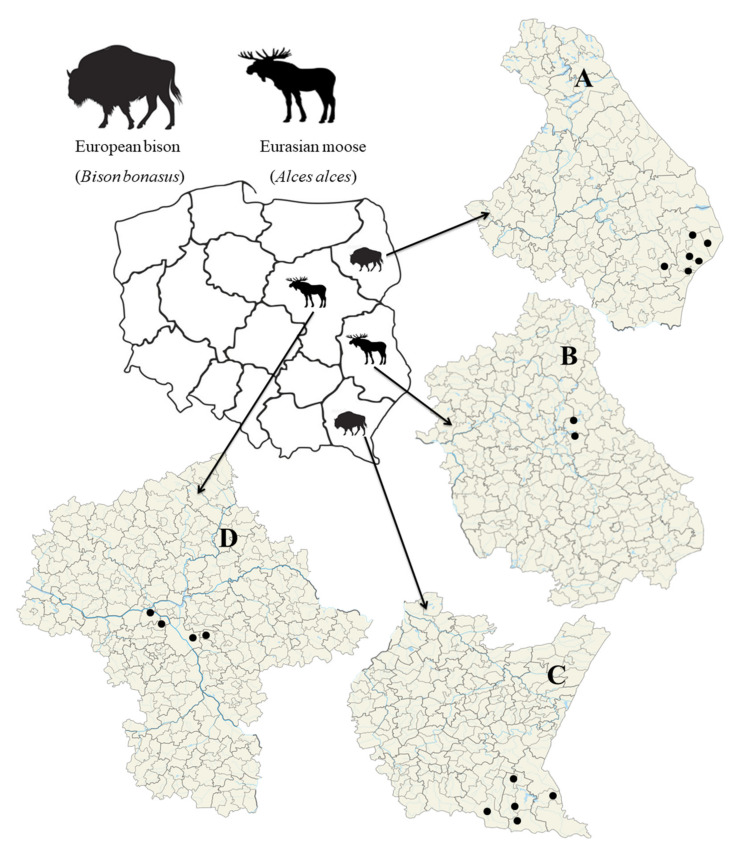
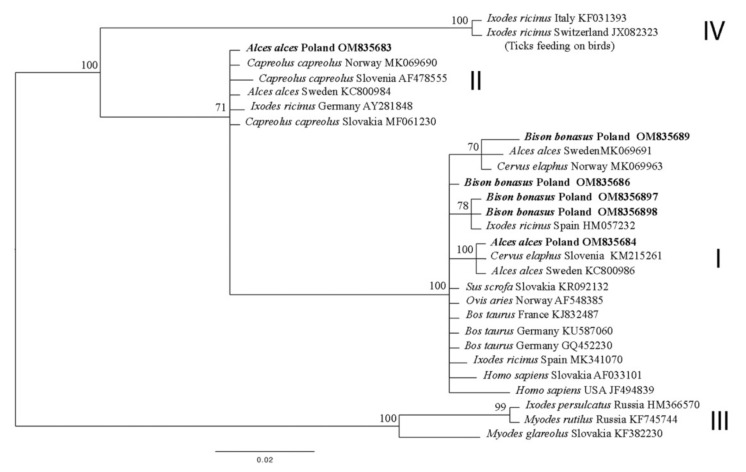
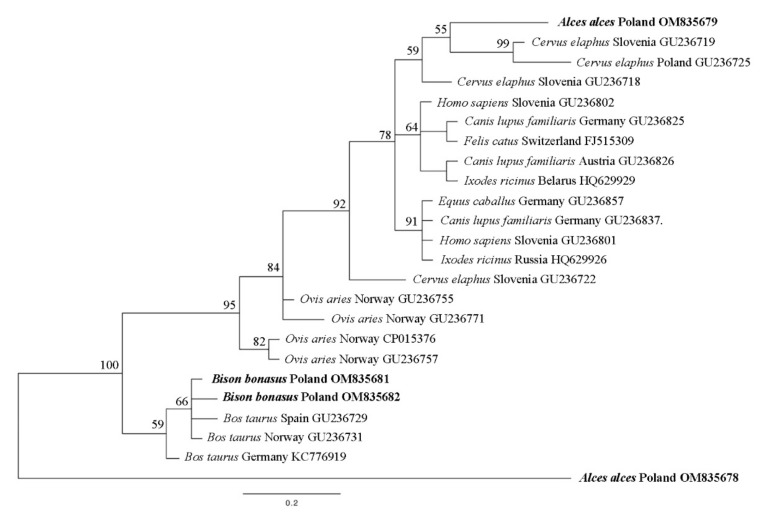
Wild large ungulates, like European bison (Bison bonasus) and Eurasian moose (Alces alces), form an important part of the circulation of Anaplasma phagocytophilum, a Gram-negative, intracellular, tick-transmitted bacterium, in the natural environment. Bison and moose tissue samples were subjected to 16S rDNA, groEL and ankA partial gene marker amplification with specific primers using various variants of PCR. Out of 42 examined individuals, Anaplasma sp. were detected in 4/13 Eurasian moose (31%) and 7/29 European bison (24%). In addition, 12 groEL and 5 ankA partial gene positive samples were obtained from the examined animals. The phylogenetic analysis of the groEL partial gene classified samples from European bison to ecotype I, and samples from Eurasian moose to ecotype I and II; the analysis of the ankA partial gene assigned the samples to clusters I and IV. This study extends knowledge about A. phagocytophilum in wild large ungulates in Poland. This is the first report about the occurrence of Anaplasma sp. in one of the largest populations of free living European bison in the world. Our findings confirm that strains of A. phagocytophilum from Bison bonasus and Alces alces may constitute a natural reservoir of pathogenic HGA Anaplasma strains.
Keywords: 16S rDNA; Alces alces; Anaplasma phagocytophilum; Bison bonasus; ankA; groEL.
Conflict of interest statement
The authors declare no conflict of interest.
Figures
References
-
- Scharf W., Schauer S., Freyburger F., Petrovec M., Schaarschmidt-Kiener D., Liebisch G., Runge M., Ganter M., Kehl A., Dumler J.S., et al. Distinct host species correlate with Anaplasma phagocytophilum ankA gene clusters. J. Clin. Microbiol. 2011;49:790–796. doi: 10.1128/JCM.02051-10. - DOI - PMC - PubMed
-
- Gordon W.S., Brownlee A., Wilson D.R., MacLeod J. Tick-borne fever (a hitherto undescribed disease of sheep) J. Comp. Pathol. 1932;45:301–307. doi: 10.1016/S0368-1742(32)80025-1. - DOI
-
- Dumler J.S., Barbet A.F., Bekker C.P., Dasch G.A., Palmer G.H., Ray S.C., Rikihisa Y., Rurangirwa F.R. Reorganization of genera in the families Rickettsiaceae and Anaplasmataceae in the order Rickettsiales: Unification of some species of Ehrlichia with Anaplasma, Cowdria with Ehrlichia and Ehrlichia with Neorickettsia, descriptions of six new species combinations and designation of Ehrlichia equi and ‘HGE agent’ as subjective synonyms of Ehrlichia phagocytophila. Pt 6Int. J. Syst. Evol. Microbiol. 2001;51:2145–2165. doi: 10.1099/00207713-51-6-2145. - DOI - PubMed
-
- Dzięgiel B., Adaszek Ł., Krzysiak M., Skrzypczak M., Adaszek M., Furmaga B., Winiarczyk S. The occurrence of Anaplasma phagocytophilum in wild bison from the Bialowieza Primeval Forest in Eastern Poland. Berl. Munch. Tierarztl. Wochenschr. 2015;128:310–314. - PubMed
LinkOut - more resources
Full Text Sources
Research Materials
