


Anthocyanins in Red Jasmine Rice (Oryza sativa L.) Extracts and Efficacy on Inhibition of Herpes Simplex Virus, Free Radicals and Cancer Cell
- PMID: 35565872
- PMCID: PMC9101121
- DOI: 10.3390/nu14091905
Anthocyanins in Red Jasmine Rice (Oryza sativa L.) Extracts and Efficacy on Inhibition of Herpes Simplex Virus, Free Radicals and Cancer Cell
Abstract
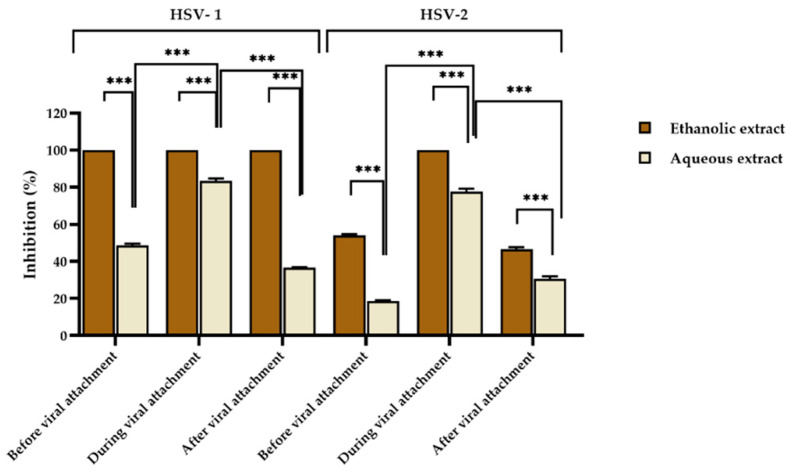
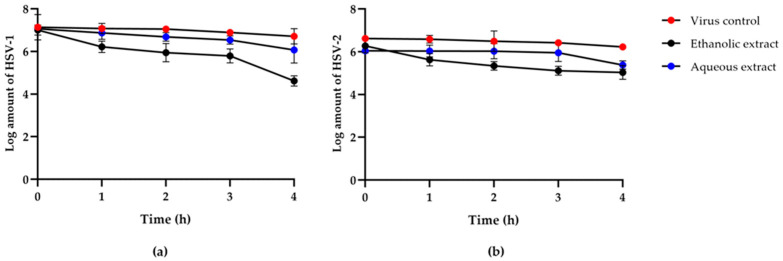
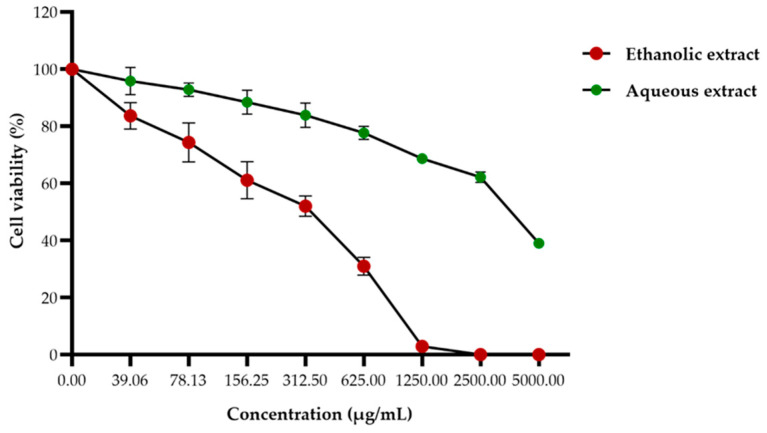
Rice is one of the most important food crops in many countries, with nutritional value and health benefits. In this study, the ethanolic and aqueous extracts of red jasmine rice from Chiang Mai, Thailand were examined for their anthocyanins and phenolic contents. The antioxidant and antiviral activity against herpes simplex virus type 1 (HSV-1) and type 2 (HSV-2), as well as anticancer activity, were investigated. The total anthocyanins content of 708.03 ± 11.56 mg Cy-3-glc equivalent/g extract, determined from the ethanolic extract, was higher than the aqueous extract. However, the aqueous extract showed the highest total phenolic compound of 81.91 ± 0.51 mg GAE/g extract. In addition, the ethanolic extract demonstrated higher antioxidant activity than aqueous extract using DPPH, ABTS, and FRAP assays by 28.91 ± 3.26 mg GAE/g extract, 189.45 ± 11.58 mg 24 TEAC/g extract, and 3292.46 ± 259.64 g FeSO4/g extract, respectively. In the antiviral assay, it was found that the ethanolic extract of red jasmine rice could inhibit HSV-1 more effectively than HSV-2 when treated before, during, and after the viral attachment on Vero cells, with 50% effective doses of 227.53 ± 2.41, 189.59 ± 7.76, and 192.62 ± 2.40 µg/mL, respectively. The extract also demonstrated the highest reduction of HSV-1 particles at 4 h after treatment and the inhibition of HSV-1 replication. The ethanolic extract exhibited a higher toxicity level than the aqueous extract, as well as the potential to induce DNA fragmentation by intrinsic and extrinsic apoptosis pathways on the Caco-2 cells. These findings suggest that red jasmine rice extract demonstrates nutritional value and biological activity on HSV, free radicals, and cancer cell inhibition.
Keywords: anthocyanins; anticancer; antioxidant activity; antiviral activity; herpes simplex virus; red jasmine rice.
Conflict of interest statement
The authors declare no conflict of interest.
Figures

References
-
- Yu W., Liu C., Li X., Yang F., Cheng L., Liu C., Song Y. Inositol hexaphosphate suppresses colorectal cancer cell proliferation via the Akt/GSK-3β/β-catenin signaling cascade in a 1,2-dimethylhydrazine-induced rat model. Eur. J. Pharmacol. 2017;805:67–74. doi: 10.1016/j.ejphar.2017.03.011. - DOI - PubMed
-
- Vargas C.G., da Silva Junior J., Rabelo T.K., Moreira J.C.F., Gelain D.P., Rodrigues E., Augusti P.K., Rios A.O., Flôres S.H. Bioactive compounds and protective effect of red and black rice brans extracts in human neuron-like cells (SH-SY5Y) Food Res. Int. 2018;113:57–64. doi: 10.1016/j.foodres.2018.06.069. - DOI - PubMed
MeSH terms
Substances
LinkOut - more resources
Full Text Sources
Medical
Miscellaneous
