


Nutraceuticals/Drugs Promoting Mitophagy and Mitochondrial Biogenesis May Combat the Mitochondrial Dysfunction Driving Progression of Dry Age-Related Macular Degeneration
- PMID: 35565950
- PMCID: PMC9104458
- DOI: 10.3390/nu14091985
Nutraceuticals/Drugs Promoting Mitophagy and Mitochondrial Biogenesis May Combat the Mitochondrial Dysfunction Driving Progression of Dry Age-Related Macular Degeneration
Abstract
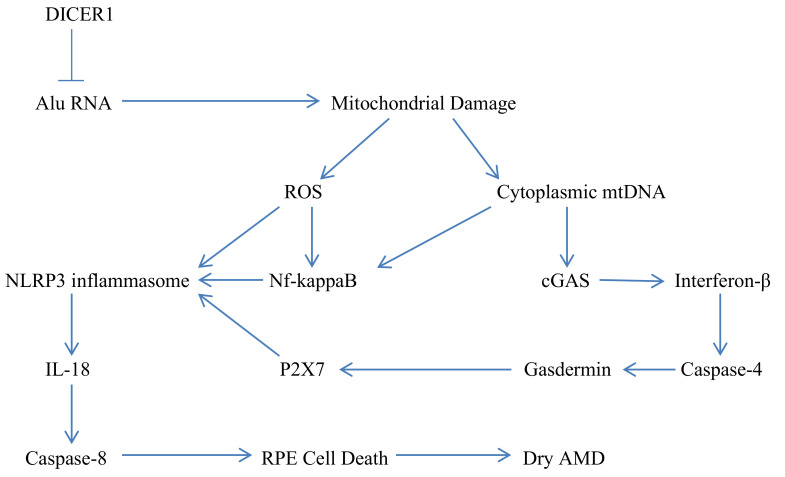
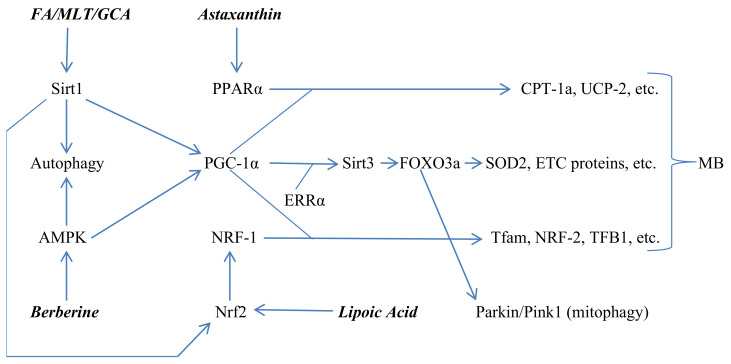
In patients with age-related macular degeneration (AMD), the crucial retinal pigment epithelial (RPE) cells are characterized by mitochondria that are structurally and functionally defective. Moreover, deficient expression of the mRNA-editing enzyme Dicer is noted specifically in these cells. This Dicer deficit up-regulates expression of Alu RNA, which in turn damages mitochondria-inducing the loss of membrane potential, boosting oxidant generation, and causing mitochondrial DNA to translocate to the cytoplasmic region. The cytoplasmic mtDNA, in conjunction with induced oxidative stress, triggers a non-canonical pathway of NLRP3 inflammasome activation, leading to the production of interleukin-18 that acts in an autocrine manner to induce apoptotic death of RPE cells, thereby driving progression of dry AMD. It is proposed that measures which jointly up-regulate mitophagy and mitochondrial biogenesis (MB), by replacing damaged mitochondria with "healthy" new ones, may lessen the adverse impact of Alu RNA on RPE cells, enabling the prevention or control of dry AMD. An analysis of the molecular biology underlying mitophagy/MB and inflammasome activation suggests that nutraceuticals or drugs that can activate Sirt1, AMPK, Nrf2, and PPARα may be useful in this regard. These include ferulic acid, melatonin urolithin A and glucosamine (Sirt1), metformin and berberine (AMPK), lipoic acid and broccoli sprout extract (Nrf2), and fibrate drugs and astaxanthin (PPARα). Hence, nutraceutical regimens providing physiologically meaningful doses of several or all of the: ferulic acid, melatonin, glucosamine, berberine, lipoic acid, and astaxanthin, may have potential for control of dry AMD.
Keywords: AMPK; Nrf2; Sirt1; age-related macular degeneration; astaxanthin; berberine; ferulic acid; melatonin; mitochondrial biogenesis; nutraceuticals.
Conflict of interest statement
The authors declare no conflict of interest.
Figures
References
-
- Tarallo V., Hirano Y., Gelfand B.D., Dridi S., Kerur N., Kim Y., Cho W.G., Kaneko H., Fowler B.J., Bogdanovich S., et al. DICER1 loss and Alu RNA induce age-related macular degeneration via the NLRP3 inflammasome and MyD88. Cell. 2012;149:847–859. doi: 10.1016/j.cell.2012.03.036. - DOI - PMC - PubMed
-
- Kerur N., Hirano Y., Tarallo V., Fowler B.J., Bastos-Carvalho A., Yasuma T., Yasuma R., Kim Y., Hinton D.R., Kirschning C.J., et al. TLR-independent and P2X7-dependent signaling mediate Alu RNA-induced NLRP3 inflammasome activation in geographic atrophy. Investig. Ophthalmol. Vis. Sci. 2013;54:7395–7401. doi: 10.1167/iovs.13-12500. - DOI - PMC - PubMed
-
- Kim Y., Tarallo V., Kerur N., Yasuma T., Gelfand B.D., Bastos-Carvalho A., Hirano Y., Yasuma R., Mizutani T., Fowler B.J., et al. DICER1/Alu RNA dysmetabolism induces Caspase-8-mediated cell death in age-related macular degeneration. Proc. Natl. Acad. Sci. USA. 2014;111:16082–16087. doi: 10.1073/pnas.1403814111. - DOI - PMC - PubMed
-
- Mao X., Fang W., Liu Q. An emerging role of Alu RNA in geographic atrophy pathogenesis: The implication for novel therapeutic strategies. Discov. Med. 2016;22:337–349. - PubMed
Publication types
MeSH terms
Substances
LinkOut - more resources
Full Text Sources
Medical
Miscellaneous
