


The Leading Role of the Immune Microenvironment in Multiple Myeloma: A New Target with a Great Prognostic and Clinical Value
- PMID: 35566637
- PMCID: PMC9105926
- DOI: 10.3390/jcm11092513
The Leading Role of the Immune Microenvironment in Multiple Myeloma: A New Target with a Great Prognostic and Clinical Value
Abstract
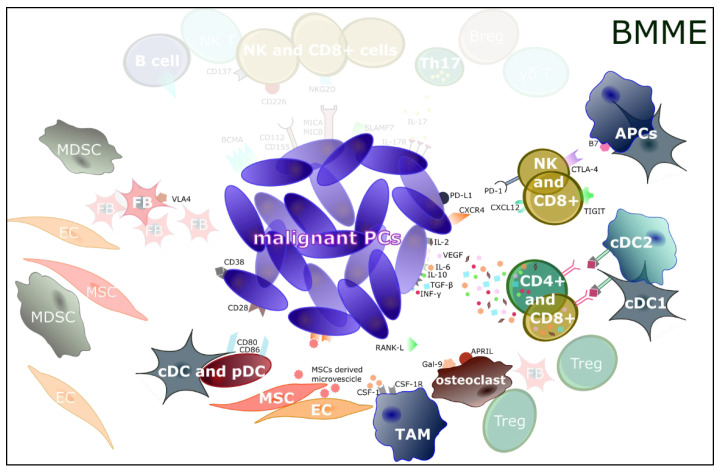
Multiple myeloma (MM) is a plasma cell (PC) malignancy whose development flourishes in the bone marrow microenvironment (BMME). The BMME components' immunoediting may foster MM progression by favoring initial immunotolerance and subsequent tumor cell escape from immune surveillance. In this dynamic process, immune effector cells are silenced and become progressively anergic, thus contributing to explaining the mechanisms of drug resistance in unresponsive and relapsed MM patients. Besides traditional treatments, several new strategies seek to re-establish the immunological balance in the BMME, especially in already-treated MM patients, by targeting key components of the immunoediting process. Immune checkpoints, such as CXCR4, T cell immunoreceptor with immunoglobulin and ITIM domains (TIGIT), PD-1, and CTLA-4, have been identified as common immunotolerance steps for immunotherapy. B-cell maturation antigen (BCMA), expressed on MMPCs, is a target for CAR-T cell therapy, antibody-(Ab) drug conjugates (ADCs), and bispecific mAbs. Approved anti-CD38 (daratumumab, isatuximab), anti-VLA4 (natalizumab), and anti-SLAMF7 (elotuzumab) mAbs interfere with immunoediting pathways. New experimental drugs currently being evaluated (CD137 blockers, MSC-derived microvesicle blockers, CSF-1/CSF-1R system blockers, and Th17/IL-17/IL-17R blockers) or already approved (denosumab and bisphosphonates) may help slow down immune escape and disease progression. Thus, the identification of deregulated mechanisms may identify novel immunotherapeutic approaches to improve MM patients' outcomes.
Keywords: bone marrow niche; immune checkpoint inhibitors; immune escape; immune exhaustion; immune microenvironment; immunotherapy; multiple myeloma.
Conflict of interest statement
The authors declare no conflict of interest.
Figures


References
-
- Alrasheed N., Lee L., Ghorani E., Henry J.Y., Conde L., Chin M., Galas-Filipowicz D., Furness A.J.S., Chavda S.J., Richards H., et al. Marrow-Infiltrating Regulatory T Cells Correlate with the Presence of Dysfunctional CD4+ PD-1+ Cells and Inferior Survival in Patients with Newly Diagnosed Multiple Myeloma. Clin. Cancer Res. 2020;26:3443–3454. doi: 10.1158/1078-0432.CCR-19-1714. - DOI - PubMed
-
- Landgren O., Kyle R.A., Pfeiffer R.M., Katzmann J.A., Caporaso N.E., Hayes R.B., Dispenzieri A., Kumar S., Clark R.J., Baris D., et al. Monoclonal gammopathy of undetermined significance (MGUS) consistently precedes multiple myeloma: A prospective study. Blood. 2009;113:5412–5417. doi: 10.1182/blood-2008-12-194241. - DOI - PMC - PubMed
-
- Oben B., Froyen G., Maclachlan K.H., Leongamornlert D., Abascal F., Zheng-Lin B., Yellapantula V., Derkach A., Geerdens E., Diamond B.T., et al. Whole-genome sequencing reveals progressive versus stable myeloma precursor conditions as two distinct entities. Nat. Commun. 2021;12:1861. doi: 10.1038/s41467-021-22140-0. - DOI - PMC - PubMed
-
- Boyle E.M., Deshpande S., Tytarenko R., Ashby C., Wang Y., Bauer M.A., Johnson S.K., Wardell C.P., Thanendrarajan S., Zangari M., et al. The molecular make up of smoldering myeloma highlights the evolutionary pathways leading to multiple myeloma. Nat. Commun. 2021;12:293. doi: 10.1038/s41467-020-20524-2. - DOI - PMC - PubMed
-
- Laganà A., Perumal D., Melnekoff D., Readhead B., Kidd B.A., Leshchenko V., Kuo P.-Y., Keats J., DeRome M., Yesil J., et al. Integrative network analysis identifies novel drivers of pathogenesis and progression in newly diagnosed multiple myeloma. Leukemia. 2018;32:120–130. doi: 10.1038/leu.2017.197. - DOI - PubMed
Publication types
Grants and funding
- FESR-FSE 2014/2020/"Programma Regionale" - Research for Innovation REFIN - POR Puglia FESR-FSE 2014/2020 to V.D
- FESR-FSE 2014-2020/INNOLABS-POR Puglia FESR-FSE 2014-2020 (CITEL-Telemedicine Reasearch Center) and "Progetto Regione Puglia - Fondo europeo di sviluppo regionale e Fondo sociale europeo (FESR e FSE)
LinkOut - more resources
Full Text Sources
Research Materials
Miscellaneous
