


Is Poor Lithium Response in Individuals with Bipolar Disorder Associated with Increased Degradation of Tryptophan along the Kynurenine Pathway? Results of an Exploratory Study
- PMID: 35566641
- PMCID: PMC9103936
- DOI: 10.3390/jcm11092517
Is Poor Lithium Response in Individuals with Bipolar Disorder Associated with Increased Degradation of Tryptophan along the Kynurenine Pathway? Results of an Exploratory Study
Abstract
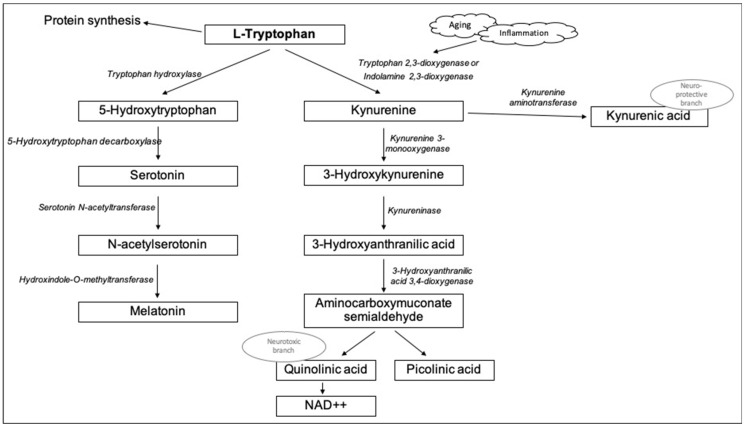
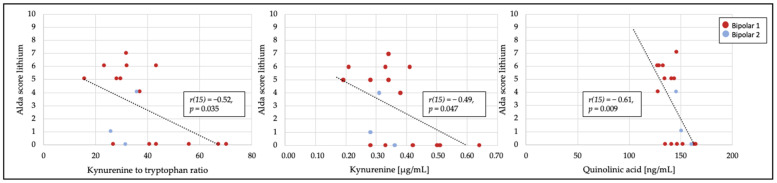
Bipolar disorder is associated with an inflammation-triggered elevated catabolism of tryptophan to the kynurenine pathway, which impacts psychiatric symptoms and outcomes. The data indicate that lithium exerts anti-inflammatory effects by inhibiting indoleamine-2,3-dioxygenase (IDO)-1 activity. This exploratory study aimed to investigate the tryptophan catabolism in individuals with bipolar disorder (n = 48) compared to healthy controls (n = 48), and the associations with the response to mood stabilizers such as lithium, valproate, or lamotrigine rated with the Retrospective Assessment of the Lithium Response Phenotype Scale (or the Alda scale). The results demonstrate an association of a poorer response to lithium with higher levels of kynurenine, kynurenine/tryptophan ratio as a proxy for IDO-1 activity, as well as quinolinic acid, which, overall, indicates a pro-inflammatory state with a higher degradation of tryptophan towards the neurotoxic branch. The treatment response to valproate and lamotrigine was not associated with the levels of the tryptophan metabolites. These findings support the anti-inflammatory properties of lithium. Furthermore, since quinolinic acid has neurotoxic features via the glutamatergic pathway, they also strengthen the assumption that the clinical drug response might be associated with biochemical processes. The relationship between the lithium response and the measurements of the tryptophan to the kynurenine pathway is of clinical relevance and may potentially bring advantages towards a personalized medicine approach to bipolar disorder that allows for the selection of the most effective mood-stabilizing drug.
Keywords: Alda scale; bipolar disorder; indoleamine 2,3 dioxygenase (IDO); kynurenine; lithium response; tryptophan.
Conflict of interest statement
The authors declare no conflict of interest in relation to the present work.
Figures
References
-
- Goodwin F.K., Jamison K.R. Manic-Depressive Illness: Bipolar Disorders and Recurrent Depression. Volume 2 Oxford University Press; Oxford, UK: 2007.
-
- Yatham L.N., Kennedy S.H., Parikh S.V., Schaffer A., Bond D.J., Frey B.N., Sharma V., Goldstein B.I., Rej S., Beaulieu S., et al. Canadian Network for Mood and Anxiety Treatments (CANMAT) and International Society for Bipolar Disorders (ISBD) 2018 guidelines for the management of patients with bipolar disorder. Bipolar Disord. 2018;20:97–170. doi: 10.1111/bdi.12609. - DOI - PMC - PubMed
-
- Scott J., Hidalgo-Mazzei D., Strawbridge R., Young A., Resche-Rigon M., Etain B., Andreassen O.A., Bauer M., Bennabi D., Blamire A.M., et al. Prospective cohort study of early biosignatures of response to lithium in bipolar-I-disorders: Overview of the H2020-funded R-LiNK initiative. Int. J. Bipolar Disord. 2019;7:20. doi: 10.1186/s40345-019-0156-x. - DOI - PMC - PubMed
LinkOut - more resources
Full Text Sources
Research Materials
Miscellaneous
