. 2022 May 2;11(9):2555.
doi: 10.3390/jcm11092555.

Aneurysmal Subarachnoid Hemorrhage during the Shutdown for COVID-19

Affiliations

Aneurysmal Subarachnoid Hemorrhage during the Shutdown for COVID-19

Erdem Güresir et al. J Clin Med. .

Abstract

The aim was to evaluate hospitalization rates for aneurysmal subarachnoid hemorrhage (SAH) within an interdisciplinary multicenter neurovascular network (NVN) during the shutdown for the COVID-19 pandemic along with its modifiable risk factors. In this multicenter study, admission rates for SAH were compared for the period of the shutdown for the COVID-19 pandemic in Germany (calendar weeks (cw) 12 to 16, 2020), the periods before (cw 6-11) and after the shutdown (cw 17-21 and 22-26, 2020), as well as with the corresponding cw in the years 2015-2019. Data on all-cause and pre-hospital mortality within the area of the NVN were retrieved from the Department of Health, and the responsible emergency medical services. Data on known triggers for systemic inflammation, e.g., respiratory viruses and air pollution, were analyzed. Hospitalizations for SAH decreased during the shutdown period to one-tenth within the multicenter NVN. There was a substantial decrease in acute respiratory illness rates, and of air pollution during the shutdown period. The implementation of public health measures, e.g., contact restrictions and increased personal hygiene during the shutdown, might positively influence modifiable risk factors, e.g., systemic inflammation, leading to a decrease in the incidence of SAH.

Keywords: COVID-19; Poisson regression; aneurysm; aneurysmal subarachnoid hemorrhage; inflammation; neurosurgery; stroke.


Conflict of interest statement

The authors declare no conflict of interest.

Figures
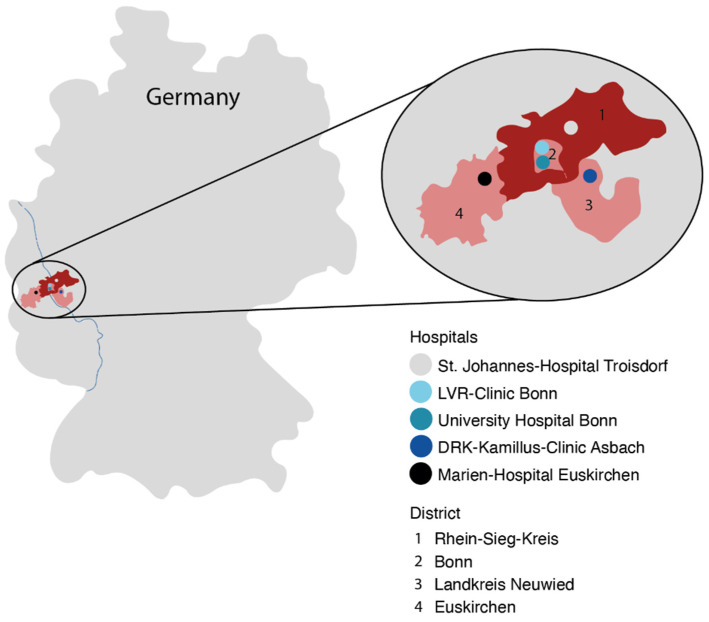
Figure 1
Figure 1
The neurovascular network “NeuroVask Bonn/Rheinland” (NVN) in Germany, consisting of neurology departments with acute stroke units, neuroradiology departments, cardiology departments, vascular surgery departments, and a neurosurgical department for neurosurgical intervention and treatment of patients with SAH in a metropolitan area with approximately 1.1 million inhabitants.
Figure 2
Figure 2
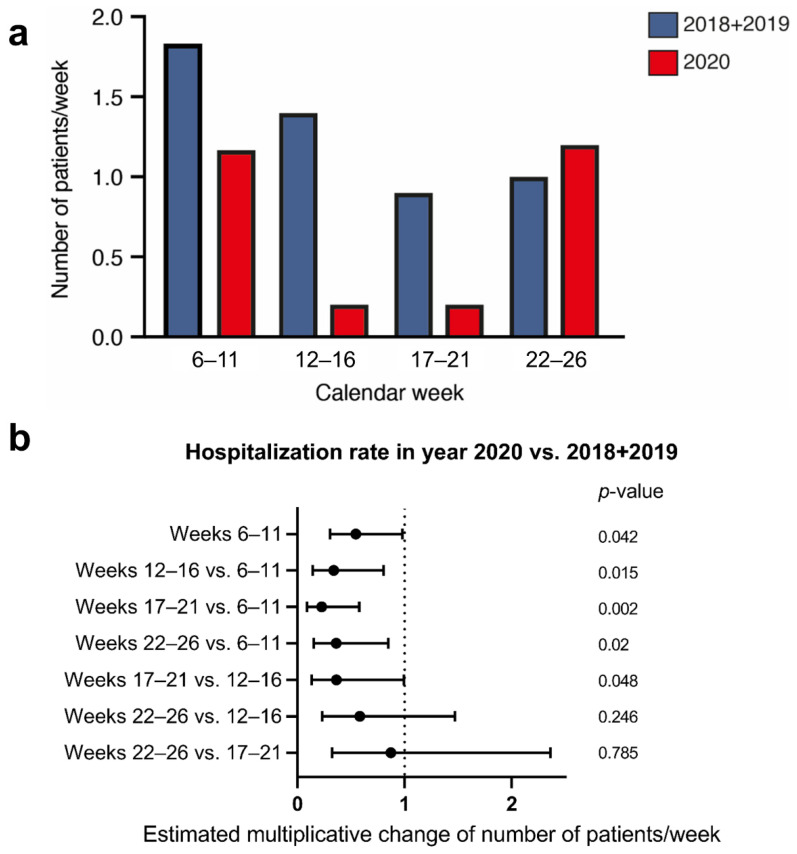
(a) Columns demonstrating hospitalization rates for aneurysmal subarachnoid hemorrhage (SAH) within the calendar weeks 6 to 26 in the years 2018 + 2019 (blue) and in the year 2020 (red). The public shutdown for the COVID-19 pandemic was announced for calendar weeks 12–16. The calendar weeks 6–11 were before, and the weeks 17–21 and 22–26 after, the public shutdown. (b) Forest plot visualizing the Poisson regression. The x-axis represents the multiplicative change of the hospitalization rate of SAH-patients at a given time period. Upper bounds of the confidence intervals below one correspond to p-values < 0.05.
Figure 3
Figure 3
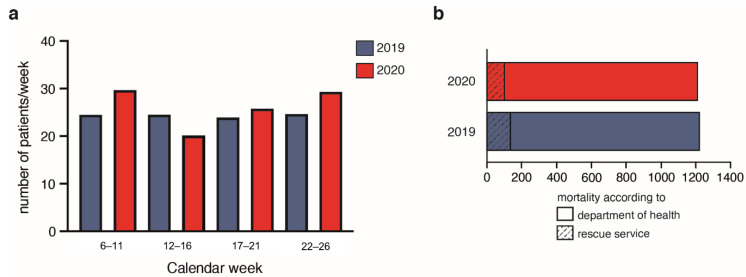
(a) Number of patients in the neuro emergency department (NED) admitted in the years 2019 (blue) and 2020 (red) with Manchester Triage Scale levels red, orange, and yellow (high urgent). (b) Mortality according to the Department of Health for the periods 1 February to April 30 2019 (blue) and 2020 (red). Out-of-hospital mortality is indicated as dashed lines within the columns.
Figure 4
Figure 4
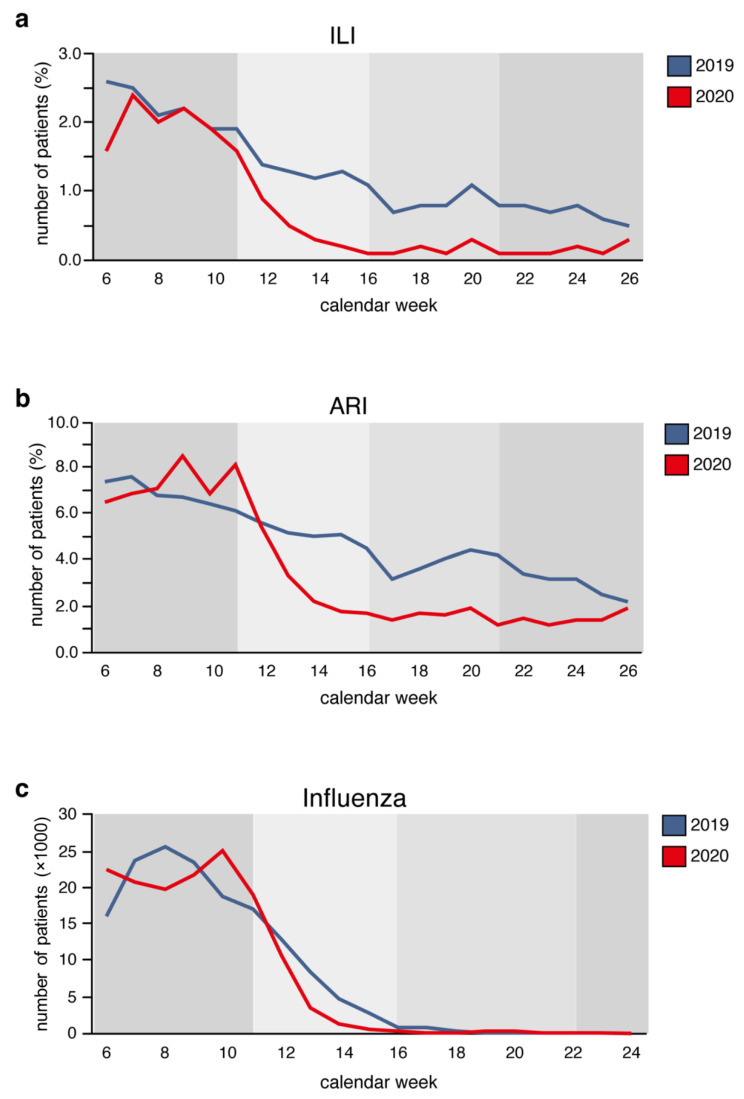
The rate of (a) influenza-like illness (ILI) and (b) acute respiratory illness (ARI) measured by GrippeWeb, excluding SARS-CoV-2 infections, as well as the number of (c) influenza reports submitted to the Robert Koch Institute within the weeks 6–26 in the years 2019 (blue) and 2020 (red). The public shutdown for the COVID-19 pandemic was announced for calendar weeks 12–16. The calendar weeks 6–11 were before, and the weeks 17–21 and 22–26 after, the public shutdown.
Figure 5
Figure 5
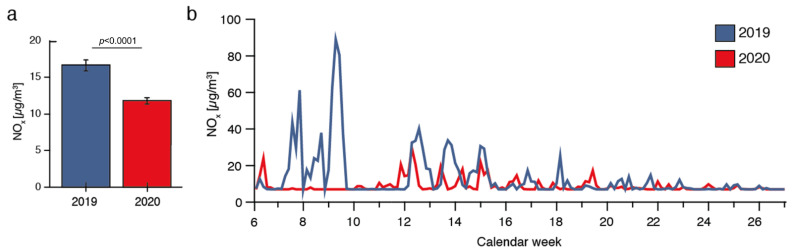
Air pollution within the calendar weeks 6–26 in the years 2019 (blue) and 2020 (red) during the public shutdown, exemplified for NOx of the measuring station within the city of Bonn (data according to the State Agency for Nature, Environment and Consumer Protection of North Rhine Westphalia (LANUV)). Boxplots for mean values (a) and distribution of NOx for the weeks 6–26 in the years 2019 (blue) and 2020 (red) (b).

References

    1. Slagman A., Behringer W., Greiner F., Klein M., Weismann D., Erdmann B., Pigorsch M., Möckel M. Medical Emergencies During the COVID-19 Pandemic. Dtsch. Arztebl. Int. 2020;117:545–552. doi: 10.3238/arztebl.2020.0545. - DOI - PMC - PubMed
    1. De Rosa S., Spaccarotella C., Basso C., Calabrò M.P., Curcio A., Filardi P.P., Mancone M., Mercuro G., Muscoli S., Nodari S., et al. Reduction of hospitalizations for myocardial infarction in Italy in the COVID-19 era. Eur. Heart J. 2020;41:2083–2088. doi: 10.1093/eurheartj/ehaa409. - DOI - PMC - PubMed
    1. Andreasen T.H., Bartek J., Andresen M., Springborg J.B., Romner B. Modifiable risk factors for aneurysmal subarachnoid hemorrhage. Stroke. 2013;44:3607–3612. doi: 10.1161/STROKEAHA.113.001575. - DOI - PubMed
    1. Shao L., Qin X., Liu J., Jian Z., Xiong X., Liu R. Macrophage Polarization in Cerebral Aneurysm: Perspectives and Potential Targets. J. Immunol. Res. 2017;2017:8160589. doi: 10.1155/2017/8160589. - DOI - PMC - PubMed
    1. Güresir E., Coch C., Fimmers R., Ilic I., Hadjiathanasiou A., Kern T., Brandecker S., Güresir Á., Velten M., Vatter H., et al. Initial inflammatory response is an independent predictor of unfavorable outcome in patients with good-grade aneurysmal subarachnoid hemorrhage. J. Crit. Care. 2020;60:45–49. doi: 10.1016/j.jcrc.2020.07.018. - DOI - PubMed

LinkOut - more resources