


Coracoid Impingement and Morphology Is Associated with Fatty Infiltration and Rotator Cuff Tears
- PMID: 35566785
- PMCID: PMC9100979
- DOI: 10.3390/jcm11092661
Coracoid Impingement and Morphology Is Associated with Fatty Infiltration and Rotator Cuff Tears
Abstract
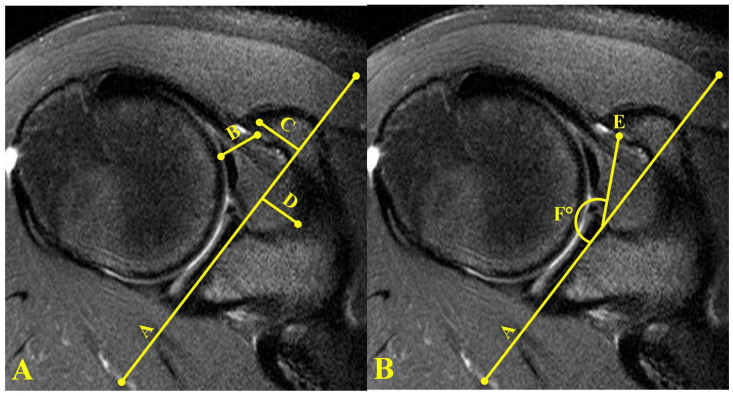
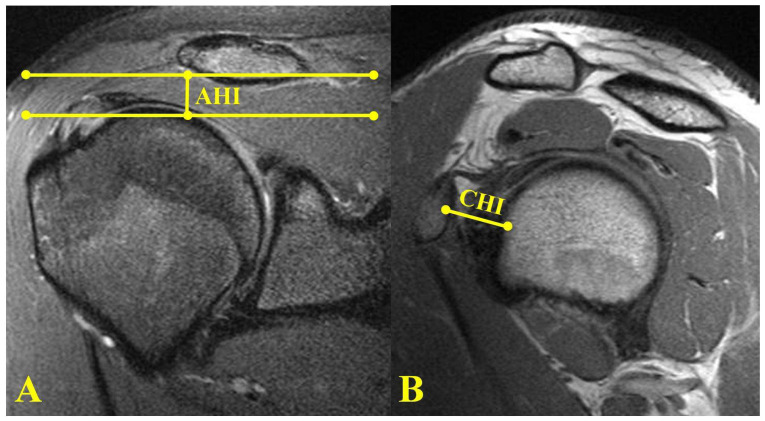
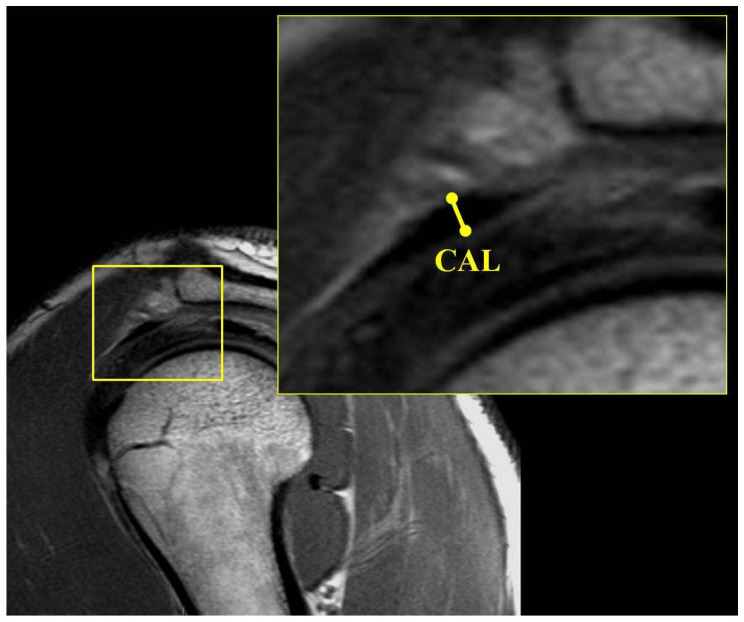
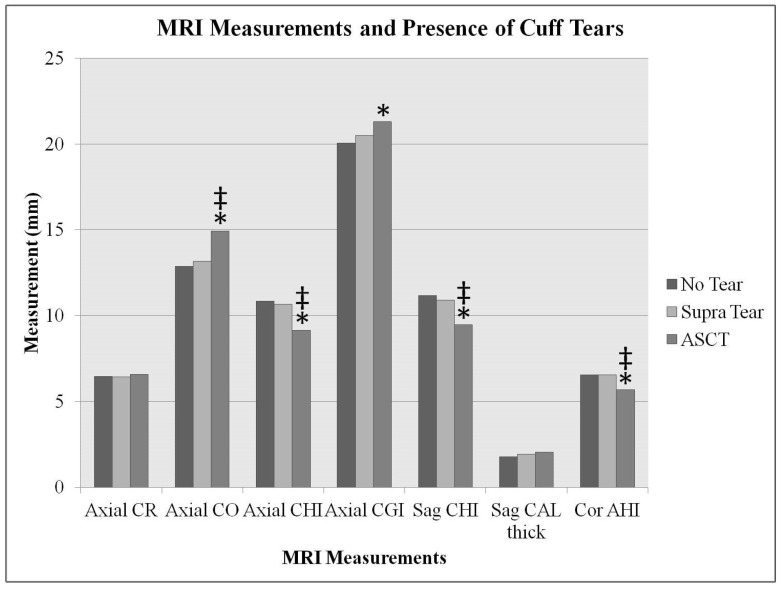
This study describes measurements between the coracoid, glenoid, and humerus; characterizes coracoid shape, rotator cuff fatty infiltration, and quantitatively evaluates coracoid impingement and its association with anterosuperior rotator cuff tears (ASCT). 193 shoulder magnetic resonance imaging (MRI) scans demonstrating: rotator cuff tear; isolated tear of the supraspinatus; tear of supraspinatus and subscapularis, were included. MRI measurements included coracohumeral interval (CHI), coracoid overlap (CO), coracoid recess (CR), coracoglenoid angle (CGA), and coracoglenoid interval (CGI) on axial slices; acromiohumeral interval (AHI) on coronal slices; and coracohumeral interval (CHI) and coracoacromial ligament (CAL) thickness on sagittal slices. The coracoid shape was classified as flat, curved, or hooked. An Independent T-test was used to compare the MRI measurements and the different rotator cuff tear groups. In 79% of the patients with ASCT tears, the coracoid was curved. Axial CHI, CGA, sagittal CHI, and AHI were decreased in ASCT when compared to no tears and isolated supraspinatus tears (p < 0.05). CO was increased in ASCT compared to no tears and isolated supraspinatus tears (p < 0.05). Patients with an ASCT had a significantly increased subscapularis and supraspinatus Goutallier fatty infiltration score when compared to no tear and isolated supraspinatus tears (p < 0.05). These quantitative measurements may be useful in identifying patients at risk for ASCT. Level of Evidence III.
Keywords: anterosuperior cuff tear; coracoid impingement; coracoid morphology; magnetic resonance imaging; rotator cuff fatty infiltration; supraspinatus tear.
Conflict of interest statement
S.F.E.-A.III and A.G. have industrial affiliations, however, there are no conflicts of interest with the work presented in this manuscript. Thus, S.F.E.-A.III and A.G. declare no conflicts of interest. Other authors declare no conflicts of interest.
Figures



References
-
- Goldthwait J. An anatomic and mechanical study of the shoulder joint, explaining many of the cases of painful shoulder, many of the recurrent dislocations and many of the cases of brachial neuralgias or neuritis. J. Bone Jt. Surg. 1909;6:579–606.
Grants and funding
LinkOut - more resources
Full Text Sources
Research Materials
