


Cyano-Phycocyanin: Mechanisms of Action on Human Skin and Future Perspectives in Medicine
- PMID: 35567250
- PMCID: PMC9101960
- DOI: 10.3390/plants11091249
Cyano-Phycocyanin: Mechanisms of Action on Human Skin and Future Perspectives in Medicine
Abstract
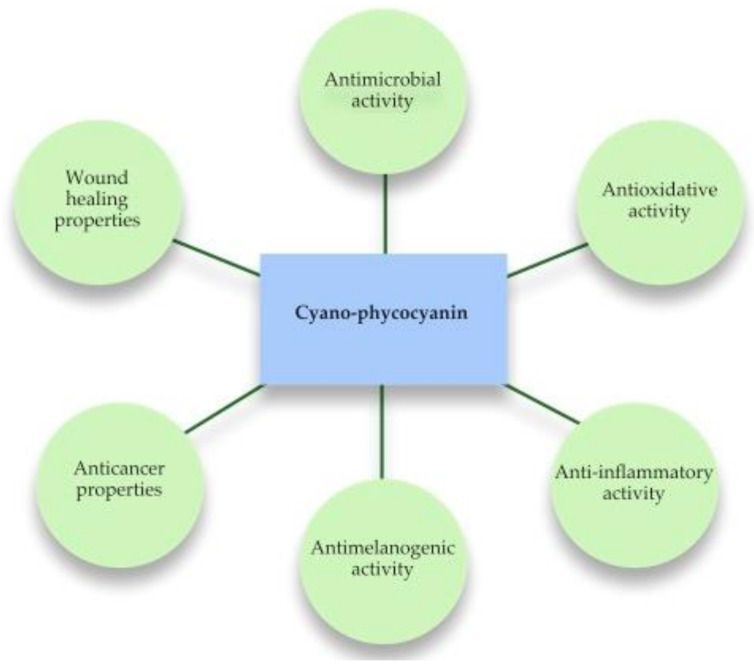
Cyano-phycocyanin is one of the active pigments of the blue-green algae and is usually isolated from the filamentous cyanobacteria Arthrospira platensis Gomont (Spirulina). Due to its multiple physiological functions and non-toxicity, cyano-phycocyanin may be a potential substance for the topical treatment of various skin diseases. Considering that the conventional medicine faces drug resistance, insufficient efficacy and side effects, the plant origin compounds can act as an alternative option. Thus, the aim of this paper was to review the wound healing, antimicrobial, antioxidative, anti-inflammatory, antimelanogenic and anticancer properties and mechanisms of cyano-phycocyanin topical activities on human skin. Moreover, possible applications and biotechnological requirements for pharmaceutical forms of cyano-phycocyanin for the treatment of various skin diseases are discussed in this review.
Keywords: anti-inflammatory effect; anticancer effect; antimelanogenic effect; antimicrobial effect; antioxidative activity; cyano-phycocyanin; cyanobacteria; skin diseases; wound healing.
Conflict of interest statement
The authors declare that there is no conflict of interest regarding the publication of the present article.
Figures
References
-
- Ragusa I., Nardone G.N., Zanatta S., Bertin W., Amadio E. Spirulina for skin care: A bright blue future. Cosmetics. 2021;8:7. doi: 10.3390/cosmetics8010007. - DOI
-
- Safaei M., Maleki H., Soleimanpour H., Norouzy A., Zahiri H.S., Vali H., Noghabi K.A. Development of a novel method for the purification of C-phycocyanin pigment from a local cyanobacterial strain Limnothrix sp. NS01 and evaluation of its anticancer properties. Sci. Rep. 2019;9:9474. doi: 10.1038/s41598-019-45905-6. - DOI - PMC - PubMed
-
- Osman A., Salama A., Ghany A.A., Sitohy M. Antibacterial activity and mechanism of action of phycocyanin extracted from an Egyptian strain of Anabaena oryzae SOS13. Zagazig J. Agric. Biochem. Appl. 2015;42:30–321.
-
- Wang L., Qu Y., Fu X., Zhao M., Wang S. Isolation, Purification and Properties of an R-Phycocyanin from the Phycobilisomes of a Marine Red Macroalga Polysiphonia urceolata. [(accessed on 28 December 2021)];PLoS ONE. 2014 9:e87833. doi: 10.1371/journal.pone.0087833. Available online: https://journals.plos.org/plosone/article/file?id=10.1371/journal.pone.0.... - DOI - PMC - PubMed
Publication types
LinkOut - more resources
Full Text Sources
Other Literature Sources
