


Cognitive Dysfunction and Prefrontal Cortical Circuit Alterations in Schizophrenia: Developmental Trajectories
- PMID: 35568522
- PMCID: PMC9420748
- DOI: 10.1016/j.biopsych.2022.03.002
Cognitive Dysfunction and Prefrontal Cortical Circuit Alterations in Schizophrenia: Developmental Trajectories
Abstract
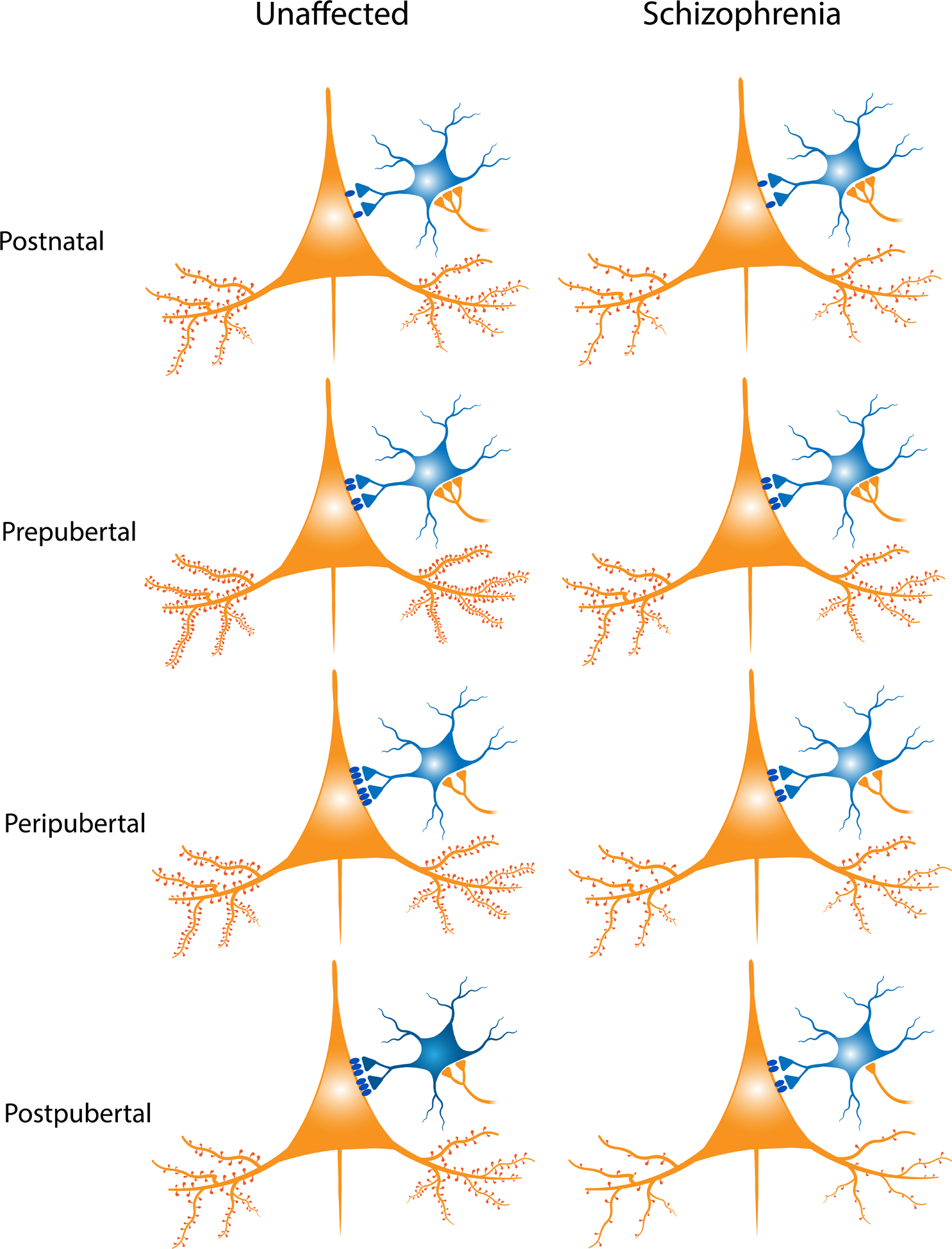
Individuals with schizophrenia (SZ) exhibit cognitive performance below expected levels based on familial cognitive aptitude. One such cognitive process, working memory (WM), is robustly impaired in SZ. These WM impairments, which emerge over development during the premorbid and prodromal stages of SZ, appear to reflect alterations in the neural circuitry of the dorsolateral prefrontal cortex. Within the dorsolateral prefrontal cortex, a microcircuit formed by reciprocal connections between excitatory layer 3 pyramidal neurons and inhibitory parvalbumin basket cells (PVBCs) appears to be a key neural substrate for WM. Postmortem human studies indicate that both layer 3 pyramidal neurons and PVBCs are altered in SZ, suggesting that levels of excitation and inhibition are lower in the microcircuit. Studies in monkeys indicate that features of both cell types exhibit distinctive postnatal developmental trajectories. Together, the results of these studies suggest a model in which 1) genetic and/or early environmental insults to excitatory signaling in layer 3 pyramidal neurons give rise to cognitive impairments during the prodromal phase of SZ and evoke compensatory changes in inhibition that alter the developmental trajectories of PVBCs, and 2) synaptic pruning during adolescence further lowers excitatory activity to a level that exceeds the compensatory capacity of PVBC inhibition, leading to a failure of the normal maturational improvements in WM during the prodromal and early clinical stages of SZ. Findings that support as well as challenge this model are discussed.
Keywords: Cognition; GABA; Gamma oscillations; Glutamate; Schizophrenia; Working memory.
Copyright © 2022 Society of Biological Psychiatry. Published by Elsevier Inc. All rights reserved.
Figures
References
-
- Kahn RS, Keefe RS (2013): Schizophrenia is a cognitive illness: time for a change in focus. JAMA Psychiatry. 70:1107–1112. - PubMed
-
- Keefe RSE, Kahn RS (2017): Cognitive Decline and Disrupted Cognitive Trajectory in Schizophrenia. JAMA Psychiatry. 74:535–536. - PubMed
-
- Kendler KS, Ohlsson H, Mezuk B, Sundquist JO, Sundquist K (2016): Observed Cognitive Performance and Deviation From Familial Cognitive Aptitude at Age 16 Years and Ages 18 to 20 Years and Risk for Schizophrenia and Bipolar Illness in a Swedish National Sample. JAMA Psychiatry. 73:465–471. - PubMed
-
- Green MF (1996): What are the functional consequences of neurocognitive deficits in schizophrenia? Am J Psychiatry. 153:321–330. - PubMed
-
- Baddeley A (1992): Working memory. Science. 255:556–559. - PubMed
Publication types
MeSH terms
Substances
Grants and funding
LinkOut - more resources
Full Text Sources
Medical
