


Daily Relations Between Stress and Electroencephalography-Assessed Sleep: A 15-Day Intensive Longitudinal Design With Ecological Momentary Assessments
- PMID: 35568984
- PMCID: PMC9635997
- DOI: 10.1093/abm/kaac017
Daily Relations Between Stress and Electroencephalography-Assessed Sleep: A 15-Day Intensive Longitudinal Design With Ecological Momentary Assessments
Abstract
Background: Recent studies have found bi-directional relations between stress and sleep. However, few studies have examined the daily associations between stress and electroencephalography (EEG) measured sleep.
Purpose: This study examined the temporal associations between repeated ecological momentary assessments of stress and EEG-estimated sleep.
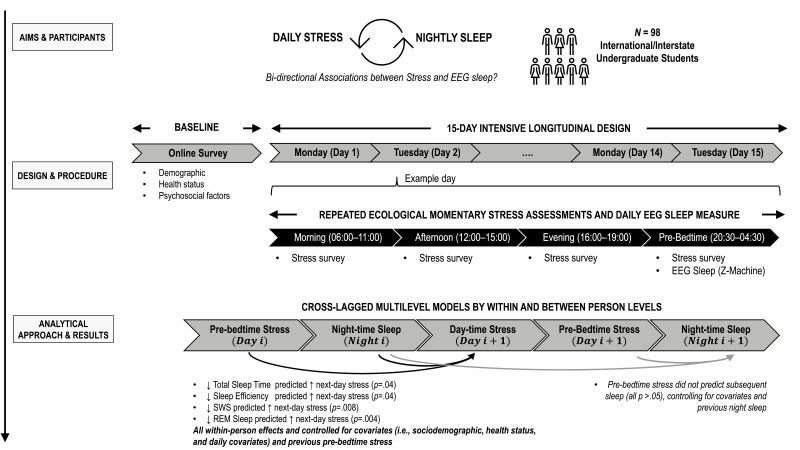
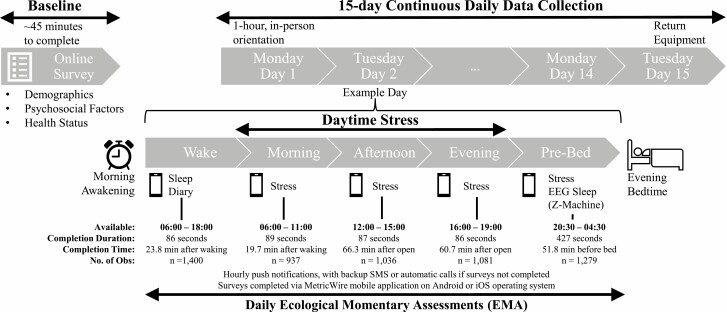
Methods: Ninety-eight international or interstate undergraduate students (Mage = 20.54 ± 1.64, 76.5% female, 84.7% Asian) reported their stress levels four times daily at morning awakening, afternoon, evening, and pre-bedtime across 15 consecutive days (>4,000 total observations). Next-day stress was coded as an average of morning, afternoon, and evening stress. Z-Machine Insight+ recorded over 1,000 nights EEG total sleep time (TST), sleep onset latency, wake after sleep onset, sleep efficiency (SE), slow-wave sleep (SWS), and rapid eye movement (REM) sleep duration. Multilevel models, adjusted for covariates (i.e., sociodemographic, health factors, and daily covariates) and lagged outcomes, tested the daily within- and between-level stress-sleep associations.
Results: After adjusting for covariates, within-person shorter TST (b = -0.11 [-0.21, -0.01], p = .04), lower SE (b = -0.02 [-0.03, 0.00], p = .04), less SWS (b = -0.38 [-0.66, -0.10], p = .008), and less REM sleep (b = -0.32 [-0.53, -0.10], p = .004) predicted higher next-day stress. Pre-bedtime stress did not predict same-night sleep. No significant results emerged at the between-person level.
Conclusions: These findings demonstrate that poor or short sleep, measured by EEG, is predictive of higher next-day stress. Results for sleep architecture support the role of SWS and REM sleep in regulating the perception of stress. Given that only within-person effects were significant, these findings highlight the importance of examining night-to-night fluctuations in sleep affecting next-day stress and its impact on daytime functioning.
Keywords: Daily; EEG; EMA; International students; Sleep; Stress.
© The Author(s) 2022. Published by Oxford University Press on behalf of the Society of Behavioral Medicine.
Figures

References
-
- Kendler KS, Hettema JM, Butera F, Gardner CO, Prescott CA. Life event dimensions of loss, humiliation, entrapment, and danger in the prediction of onsets of major depression and generalized anxiety. Arch Gen Psychiatry. 2003;60(8):789–796. - PubMed
-
- Cappuccio FP, Cooper D, D’Elia L, Strazzullo P, Miller MA. Sleep duration predicts cardiovascular outcomes: A systematic review and meta-analysis of prospective studies. Eur Heart J. 2011;32(12):1484–1492. - PubMed
Publication types
MeSH terms
LinkOut - more resources
Full Text Sources
Research Materials
