


Kinematic analysis of speed transitions within walking in younger and older adults
- PMID: 35569430
- PMCID: PMC9284670
- DOI: 10.1016/j.jbiomech.2022.111130
Kinematic analysis of speed transitions within walking in younger and older adults
Abstract
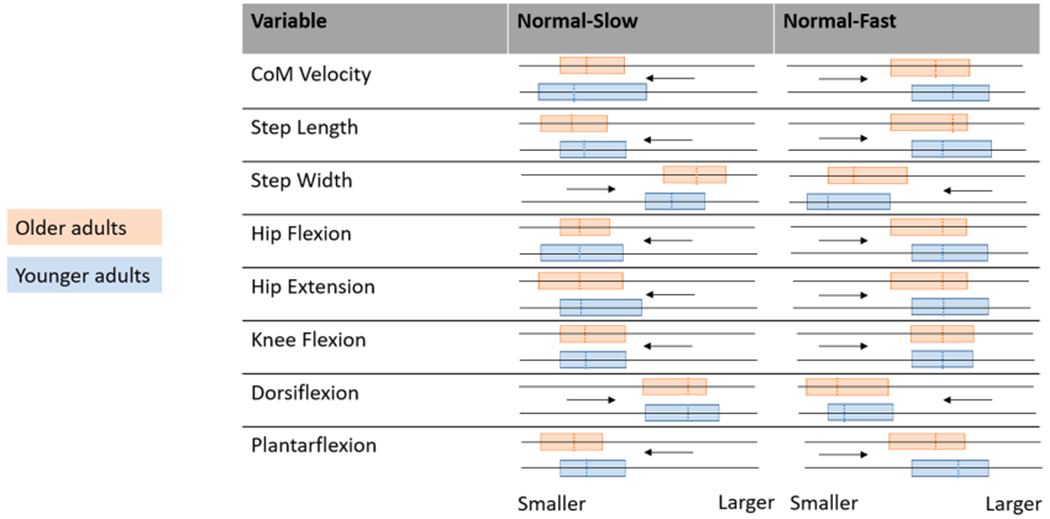
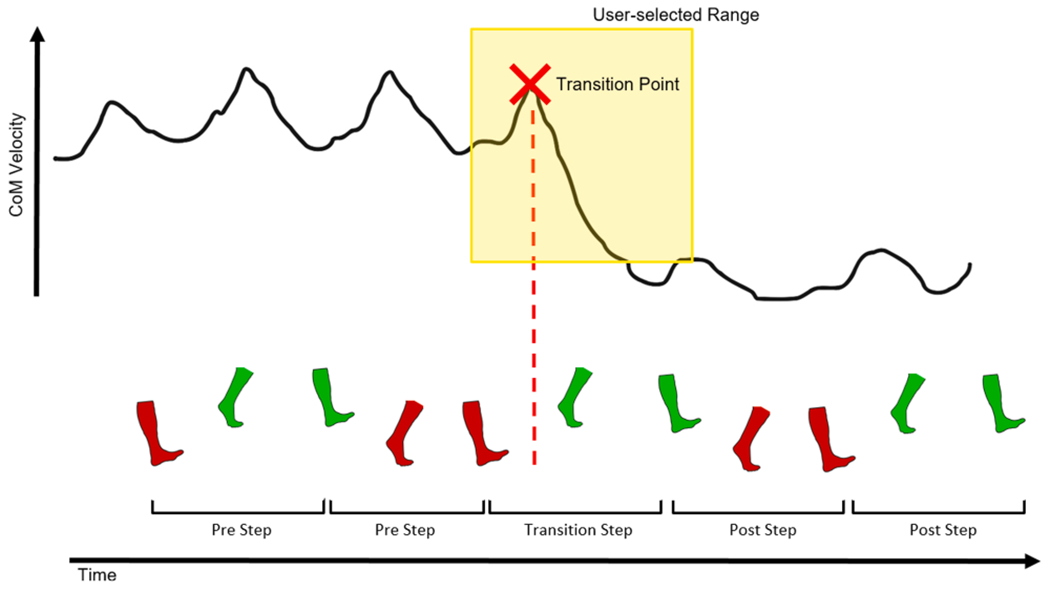
The ability to adapt to environmental and task demands while walking is critical to independent mobility outside the home and this ability wanes with age. Such adaptability requires individuals to acutely change their walking speed. Regardless of age, changes between walking speeds are common in daily life, and are a frequent type of walking adaptability. Here, we report on older and younger adults when transitioning from preferred walking speed overground to either slower or faster walking. Specifically, we evaluated biomechanical parameters prior to, during, and post transition. Individuals approached the walking speed transition similarly, independent of whether the transition was to slower or faster walking. Regardless of age or walking speed, the step during which a walking speed transition occurred was distinct from those prior- and post- transition, with on average 0.15 m shorter step lengths, 3.6° more hip flexion, and 3.3° more dorsiflexion during stance. We also found that peak hip flexion occurred 22% later, and peak hip extension (39%), knee flexion (26%), and dorsiflexion (44%) occurred earlier in stance for both typical to slower and typical to faster walking. Older adults had altered timing of peak joint angles compared with younger adults across both acceleration and deceleration conditions, indicating age-dependent responses to changing walking speed. Our findings are an important first step in establishing values for kinematics during walking speed transitions in younger and typical older adults.
Keywords: Aging; Gait; Kinematics; Mobility; Speed transition.
Copyright © 2022. Published by Elsevier Ltd.
Conflict of interest statement
Declaration of Competing Interest
The authors declare that they have no known competing financial interests or personal relationships that could have appeared to influence the work reported in this paper.
Figures
References
-
- Cohen J, 1988. Statistical Power Analysis for the Behavioral Sciences. Routledge Academic, New York, NY.
Publication types
MeSH terms
Grants and funding
LinkOut - more resources
Full Text Sources
