


Learning to Cycle: A Cross-Cultural and Cross-Generational Comparison
- PMID: 35570950
- PMCID: PMC9096157
- DOI: 10.3389/fpubh.2022.861390
Learning to Cycle: A Cross-Cultural and Cross-Generational Comparison
Abstract
Background: Learning to cycle is an important milestone for children, but the popularity of cycling and the environmental factors that promote the development and practice of this foundational movement skill vary among cultures and across time. This present study aimed to investigate if country of residence and the generation in which a person was born influence the age at which people learn to cycle.
Methods: Data were collected through an online survey between November 2019 and December 2020. For this study, a total of 9,589 responses were obtained for adults (self-report) and children (parental report) living in 10 countries (Portugal, Italy, Brazil, Finland, Spain, Belgium, United Kingdom, Mexico, Croatia, and the Netherlands). Participants were grouped according to their year of birth with 20-year periods approximately corresponding to 3 generations: 1960-79 (generation X; n = 2,214); 1980-99 (generation Y; n = 3,994); 2000-2019 (generation Z; n = 3,381).
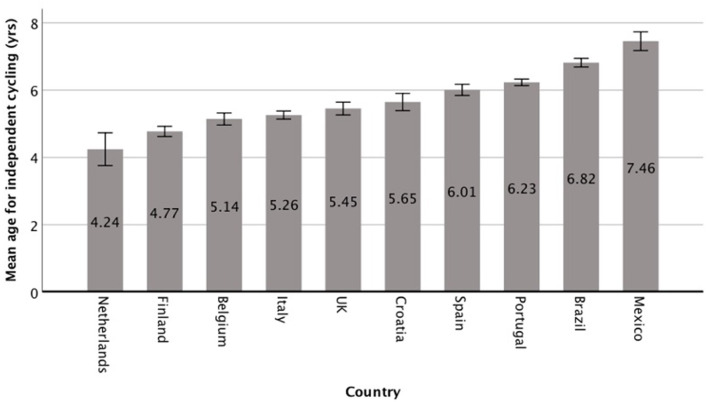
Results: A two-way ANOVA showed a significant effect of country, F(9,8628) = 90.17, p < 0.001, = 0.086, and generation, F(2,8628) = 47.21, p < 0.001, = 0.122, on the age at which individuals learn to cycle. Countries with the lowest learning age were the Netherlands, Finland and Belgium and countries with the highest learning age were Brazil and Mexico. Furthermore, the age at which one learns to cycle has decreased across generations. There was also a significant country x generation interaction effect on learning age, F(18,8628) = 2.90, p < 0.001; however, this effect was negligible ( = 0.006).
Conclusions: These findings support the socio-ecological perspective that learning to cycle is a process affected by both proximal and distal influences, including individual, environment and time.
Keywords: active travel; children; country; cycling; generation.
Copyright © 2022 Cordovil, Mercê, Branco, Lopes, Catela, Hasanen, Laukkanen, Tortella, Fumagalli, Sá, Jidovtseff, Zeuwts, De Meester, Bardid, Fujikawa, Veldman, Zlatar and Estevan.
Conflict of interest statement
The authors declare that the research was conducted in the absence of any commercial or financial relationships that could be construed as a potential conflict of interest.
Figures


References
-
- Haubenstricker J, Seefeldt V. Acquisition of motor skills during childhood. In: Seefeldt V. editor. Physical Activity and Well-being. Waldorf, MD.: American Alliance for Health, Physical Education, Recreation and Dance Publications; (1986). p. 41–92.
-
- Malone K, Rudner J. Global perspectives on children's independent mobility: a socio-cultural comparison and theoretical discussion of children's lives in four countries in Asia and Africa. Glob Stud Child. (2011) 1:243–59. 10.2304/gsch.2011.1.3.243 - DOI
Publication types
MeSH terms
LinkOut - more resources
Full Text Sources
Miscellaneous
