


Exploring the Relationship Between Deficits in Social Cognition and Neurodegenerative Dementia: A Systematic Review
- PMID: 35572150
- PMCID: PMC9093607
- DOI: 10.3389/fnagi.2022.778093
Exploring the Relationship Between Deficits in Social Cognition and Neurodegenerative Dementia: A Systematic Review
Erratum in
-
Corrigendum: Exploring the relationship between deficits in social cognition and neurodegenerative dementia: A systematic review.Front Aging Neurosci. 2022 Sep 26;14:1031955. doi: 10.3389/fnagi.2022.1031955. eCollection 2022. Front Aging Neurosci. 2022. PMID: 36225890 Free PMC article.
Abstract
Background: Neurodegenerative diseases might affect social cognition in various ways depending on their components (theory of mind, emotional processing, attribution bias, and social perception) and the subtype of dementia they cause. This review aims to explore this difference in cognitive function among individuals with different aetiologies of dementia.
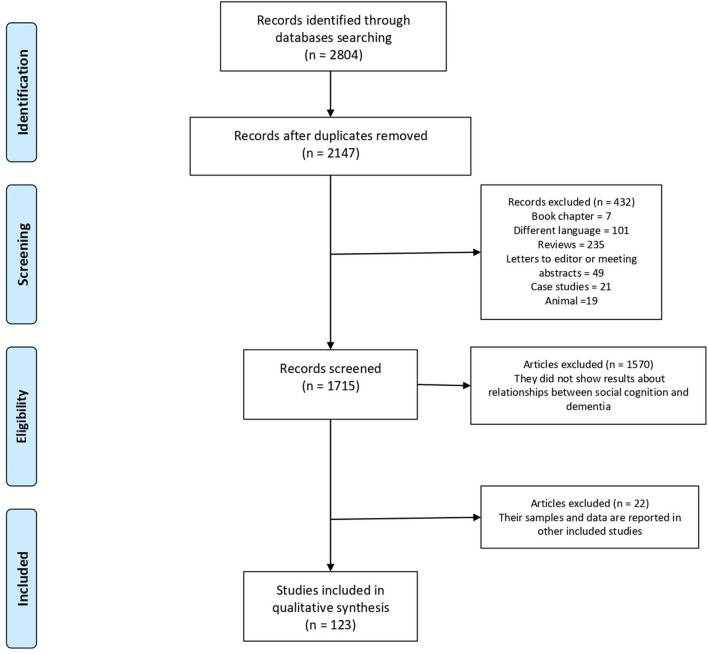
Methods: The following databases were explored: MEDLINE via PubMed, Cochrane Library, Lilacs, Web of Science, and PsycINFO. We selected studies examining social cognition in individuals with neurodegenerative diseases in which dementia was the primary symptom that was studied. The neurodegenerative diseases included Alzheimer's disease, Lewy body disease and frontotemporal lobar degeneration. The search yielded 2,803 articles.
Results: One hundred twenty-two articles were included in the present review. The summarised results indicate that people with neurodegenerative diseases indeed have deficits in social cognitive performance. Both in populations with Alzheimer's disease and in populations with frontotemporal dementia, we found that emotional processing was strongly affected. However, although theory of mind impairment could also be observed in the initial stages of frontotemporal dementia, in Alzheimer's disease it was only appreciated when performing highly complex task or in advanced stages of the disease.
Conclusions: Each type of dementia has a differential profile of social cognition deterioration. This review could provide a useful reference for clinicians to improve detection and diagnosis, which would undoubtedly guarantee better interventions.
Systematic review registration: https://www.crd.york.ac.uk/prospero/display_record.php?ID=CRD42020152562, PROSPERO, identifier: CRD42020152562.
Keywords: attribution bias; dementia; emotional processing; neurodegenerative disease; social cognition; social perception; theory of mind.
Copyright © 2022 Setién-Suero, Murillo-García, Sevilla-Ramos, Abreu-Fernández, Pozueta and Ayesa-Arriola.
Conflict of interest statement
The authors declare that the research was conducted in the absence of any commercial or financial relationships that could be construed as a potential conflict of interest.
Figures
References
-
- American Psychiatric Association (2013). Diagnostic and Statistical Manual of Mental Disorders (DSM 5®). Arlington: American Psychiatric Pub.
-
- Antonio Garcia-Casal J., Martinez-Abad F., Cid-Bartolome T., Smith S. J., Llano-Ordonez K., Victoria Perea-Bartolome M. (2019). Usability study and pilot validation of a computer-based emotion recognition test for older adults with Alzheimer's disease and amnestic mild cognitive impairment. Aging Ment. Health. 23, 365–375. 10.1080/13607863.2017.1423033 - DOI - PubMed
Publication types
LinkOut - more resources
Full Text Sources
