


Development of a New Genus-Specific Quantitative Real-Time PCR Assay for the Diagnosis of Scrub Typhus in South America
- PMID: 35573006
- PMCID: PMC9095740
- DOI: 10.3389/fmed.2022.831045
Development of a New Genus-Specific Quantitative Real-Time PCR Assay for the Diagnosis of Scrub Typhus in South America
Abstract
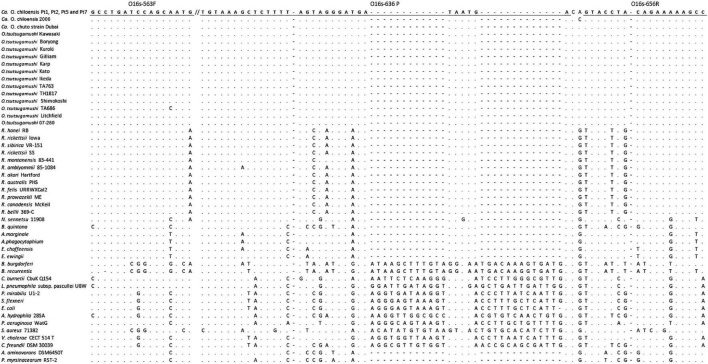
Scrub typhus is a potentially severe rickettsiosis, caused by Orientia tsutsugamushi in the Asia-Pacific region. Recently, however, two distinct pathogens, "Candidatus Orientia chuto" and "Candidatus Orientia chiloensis", have been discovered in the Middle East and South America, respectively. Since the novel pathogens differ significantly from O. tsutsugamushi, many established diagnostic methods are unreliable. This work describes the development and validation of a new quantitative real-time PCR (qPCR) assay (Orien16S) for the detection of all known Orientia species. Based on a 94 bp sequence of the 16S rRNA gene (rrs), Orien16S recognized DNA samples from O. tsutsugamushi (n = 41), Ca. O. chiloensis (n = 5), and Ca. O. chuto (n = 1), but was negative for DNA preparations from closely related rickettsiae and other members of the order Rickettsiales (n = 22) as well as unrelated bacterial species (n = 11). After its implementation in Chile, the assay was verified, correctly identifying all tested eschar and buffy coat samples (n = 28) of clinical suspected cases. Furthermore, Orien16S detected Orientia DNA in trombiculid mites collected in endemic regions in southern Chile. The presented novel qPCR assay provides a useful tool for detecting Orientia and diagnosing scrub typhus from all geographical regions.
Keywords: Candidatus Orientia chiloensis; Chile; Orien16S; Orientia; South America; molecular diagnostic techniques; quantitative real-time PCR (qPCR); scrub typhus.
Copyright © 2022 Jiang, Martínez-Valdebenito, Weitzel, Farris, Acosta-Jamett, Abarca and Richards.
Conflict of interest statement
JJ and AR are employed by the Henry M. Jackson Foundation for the Advancement of Military Medicine, Inc. The remaining authors declare that the research was conducted in the absence of any commercial or financial relationships that could be construed as a potential conflict of interest.
Figures
References
LinkOut - more resources
Full Text Sources
