


doi: 10.4103/picr.picr_55_22.
Epub 2022 Apr 6.
Equivalence trials
Affiliations
- PMID: 35573452
- PMCID: PMC9106130
- DOI: 10.4103/picr.picr_55_22
Item in Clipboard
Equivalence trials
Perspect Clin Res.
2022 Apr-Jun.
Abstract
In an equivalence trial, researchers aim to show that a new intervention is more or less similar to an existing standard of care, i.e., the two are "equivalent". In this article, we discuss some aspects of the design, analysis, interpretation and reporting of equivalence trials.
Keywords: Randomized Controlled Trials as Topic; Research Methodology; Research design.
Copyright: © 2022 Perspectives in Clinical Research.
Conflict of interest statement
There are no conflicts of interest.
Figures
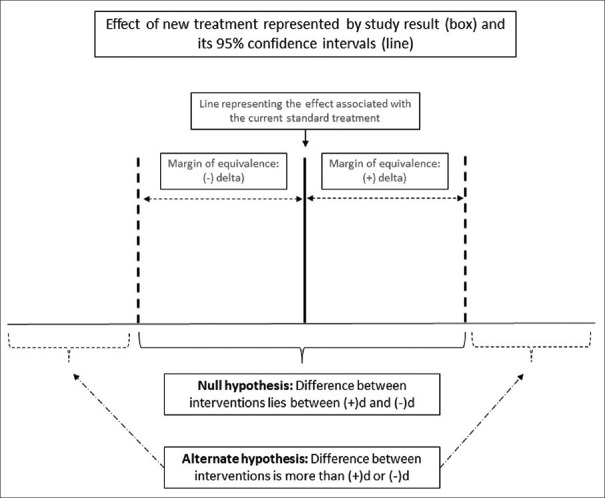
Null and alternate hypotheses in an equivalence trial
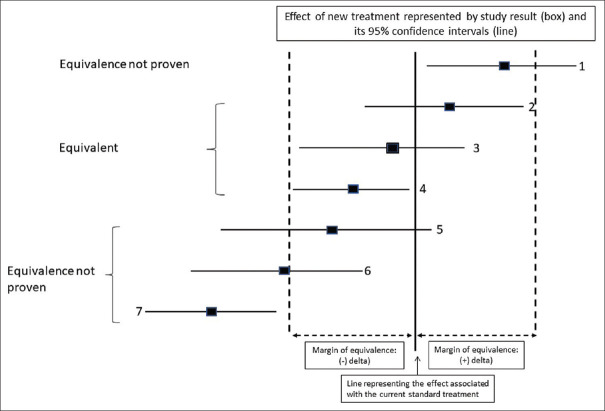
Interpretation of results of an equivalence trial
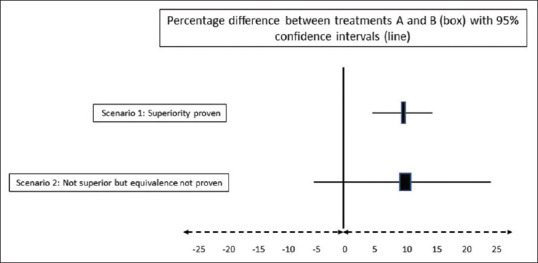
Negative results in superiority trials do not imply equivalence
References
-
- Lesaffre E. Superiority, equivalence, and non-inferiority trials. Bull NYU Hosp Jt Dis. 2008;66:150–4. - PubMed
-
- McCann ME, de Graaff JC, Dorris L, Disma N, Withington D, Bell G, et al. Neurodevelopmental outcome at 5 years of age after general anaesthesia or awake-regional anaesthesia in infancy (GAS): An international, multicentre, randomised, controlled equivalence trial. Lancet. 2019;393:664–77. - PMC - PubMed
-
- Marzocchi A, Manari A, Piovaccari G, Marrozzini C, Marra S, Magnavacchi P, et al. Randomized comparison between tirofiban and abciximab to promote complete ST-resolution in primary angioplasty: Results of the facilitated angioplasty with tirofiban or abciximab (FATA) in ST-elevation myocardial infarction trial. Eur Heart J. 2008;29:2972–80. - PubMed
-
- Klasen M, Sopka S. Demonstrating equivalence and non-inferiority of medical education concepts. Med Educ. 2021;55:455–61. - PubMed
LinkOut - more resources
Full Text Sources