


Epitranscriptomic mapping of RNA modifications at single-nucleotide resolution using rhodamine sequencing (Rho-seq)
- PMID: 35573476
- PMCID: PMC9092995
- DOI: 10.1016/j.xpro.2022.101369
Epitranscriptomic mapping of RNA modifications at single-nucleotide resolution using rhodamine sequencing (Rho-seq)
Abstract
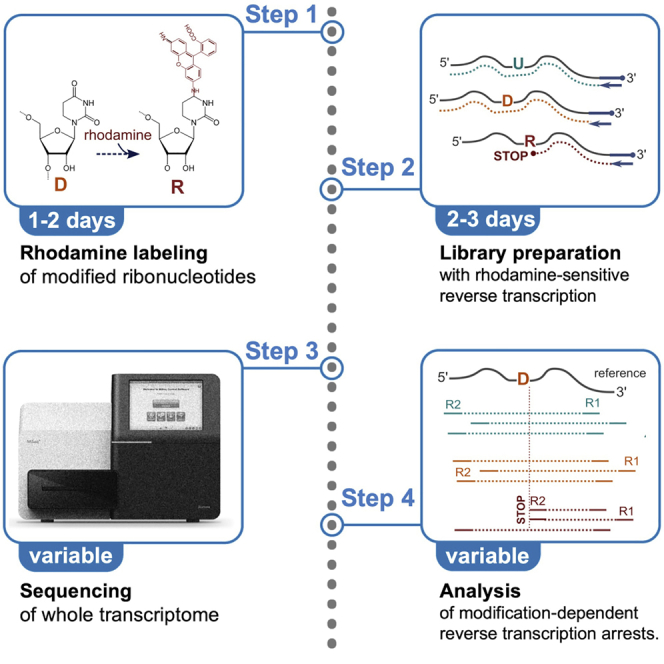
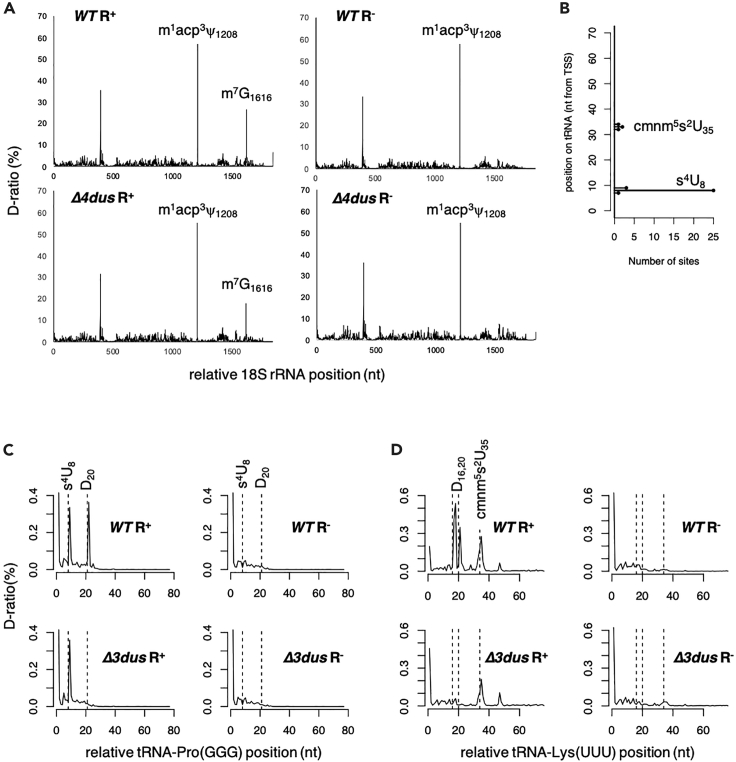
The recent development of epitranscriptomics revealed a new fundamental layer of gene expression, but the mapping of most RNA modifications remains technically challenging. Here, we describe our protocol for Rho-Seq, which enables the mapping of dihydrouridine RNA modification at single-nucleotide resolution. Rho-Seq relies on specific rhodamine-labeling of a subset of modified nucleotides that hinders reverse transcription. Although Rho-Seq was initially applied to the detection of dihydrouridine, we show here that it is applicable to other modifications including 7-methylguanosine or 4-thiouridine. For complete details on the use and execution of this protocol, please refer to Finet et al. (2022).
Keywords: Gene Expression; Molecular Biology; RNAseq; Sequence analysis.
© 2022 The Authors.
Conflict of interest statement
The authors declare no competing interests.
Figures



References
-
- Beltchev B., Grunberg-Manago M. Preparation of a pG-fragment from tRNAPhe yeast by chemical scission at the dihydrouracil, and inhibition of tRNAPhe yeast charging by this fragment when combined with the -CCA half of this tRNA. FEBS Lett. 1970;12:24–26. doi: 10.1016/0014-5793(70)80585-3. - DOI - PubMed
-
- Benjamini Y., Hochberg Y. Controlling the false discovery rate: a practical and powerful approach to multiple testing. J. R. Stat. Soc. Ser. B. 1995;57:289–300. doi: 10.1111/J.2517-6161.1995.TB02031.X. - DOI
Publication types
MeSH terms
Substances
LinkOut - more resources
Full Text Sources
Molecular Biology Databases
