. 2022 Jun 29;10(3):e0207621.
doi: 10.1128/spectrum.02076-21. Epub 2022 May 16.

Raffinose Inhibits Streptococcus mutans Biofilm Formation by Targeting Glucosyltransferase

Affiliations

Raffinose Inhibits Streptococcus mutans Biofilm Formation by Targeting Glucosyltransferase

So-Young Ham et al. Microbiol Spectr. .

Abstract

Streptococcus mutans is a representative biofilm-forming bacterium that causes dental caries through glucosyltransferase (GTF) activity. Glucans are synthesized from sucrose by GTFs and provide binding sites for S. mutans to adhere tightly to the tooth enamel. Therefore, if a novel compound that interferes with GTF function is developed, biofilm formation control in S. mutans would be possible. We discovered that raffinose, an oligosaccharide from natural products, strongly inhibited biofilm formation, GTF-related gene expression, and glucan production. Furthermore, biofilm inhibition on saliva-coated hydroxyapatite discs through the reduction of bacterial adhesion indicated the applicability of raffinose in oral health. These effects of raffinose appear to be due to its ability to modulate GTF activity in S. mutans. Hence, raffinose may be considered an antibiofilm agent for use as a substance for oral supplies and dental materials to prevent dental caries. IMPORTANCE Dental caries is the most prevalent infectious disease and is expensive to manage. Dental biofilms can be eliminated via mechanical treatment or inhibited using antibiotics. However, bacteria that are not entirely removed or are resistant to antibiotics can still form biofilms. In this study, we found that raffinose inhibited biofilm formation by S. mutans, a causative agent of dental caries, possibly through binding to GtfC. Our findings support the notion that biofilm inhibition by raffinose can be exerted by interference with GTF function, compensating for the shortcomings of existing commercialized antibiofilm methods. Furthermore, raffinose is an ingredient derived from natural products and can be safely utilized in humans; it has no smell and tastes sweet. Therefore, raffinose, which can control S. mutans biofilm formation, has been suggested as a substance for oral supplies and dental materials to prevent dental caries.

Keywords: Streptococcus mutans; biofilm; glucosyltransferase; raffinose.


Conflict of interest statement

The authors declare no conflict of interest.

Figures
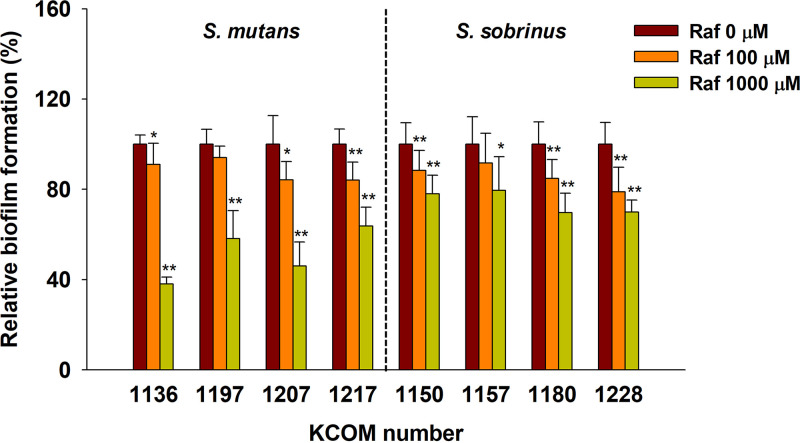
FIG 1
FIG 1
Biofilm formation of Streptococcus species following raffinose treatment for 24 h. Biofilms of S. mutans and S. sobrinus were formed following raffinose treatment (0 to 1,000 μM) under static conditions. Error bars indicate the standard deviations of five measurements. **, P < 0.005; *, P < 0.05, versus the control. Raf, raffinose.
FIG 2
FIG 2
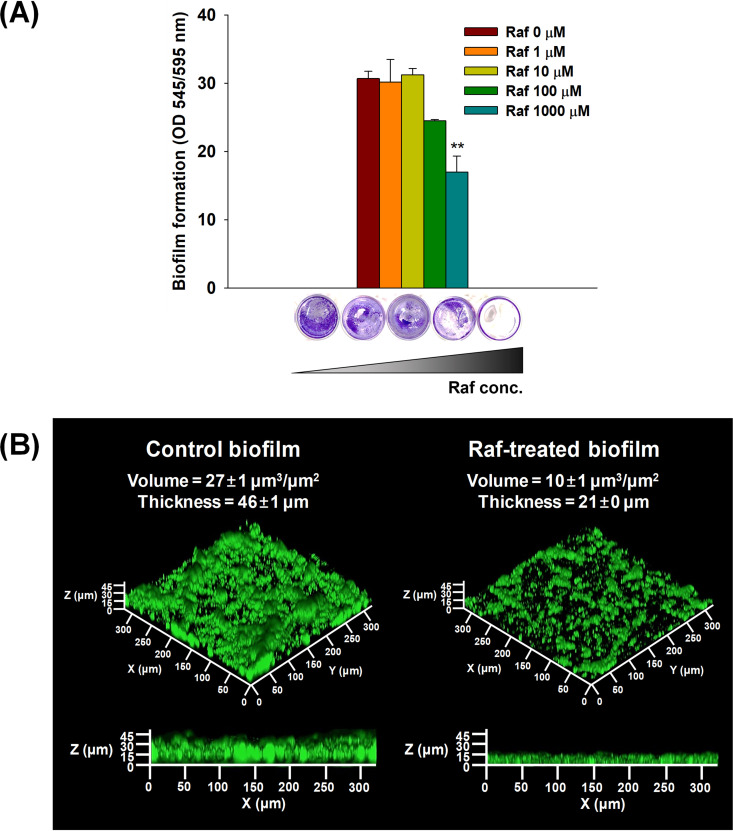
Streptococcus mutans biofilm formation following raffinose treatment under static and flow conditions. (A) CV-stained biofilm following raffinose treatment (0 to 1,000 μM). Quantification was performed by measuring the OD under static conditions (OD545/OD595). Error bars indicate the standard deviations of five measurements. **, P < 0.005, versus the control. Raf, raffinose. (B) Volume and thickness of DAPI-stained biofilm based on CLSM images; 1,000 μM raffinose was added to the S. mutans biofilm for 48 h under flow conditions. Raf, Raffinose.
FIG 3
FIG 3
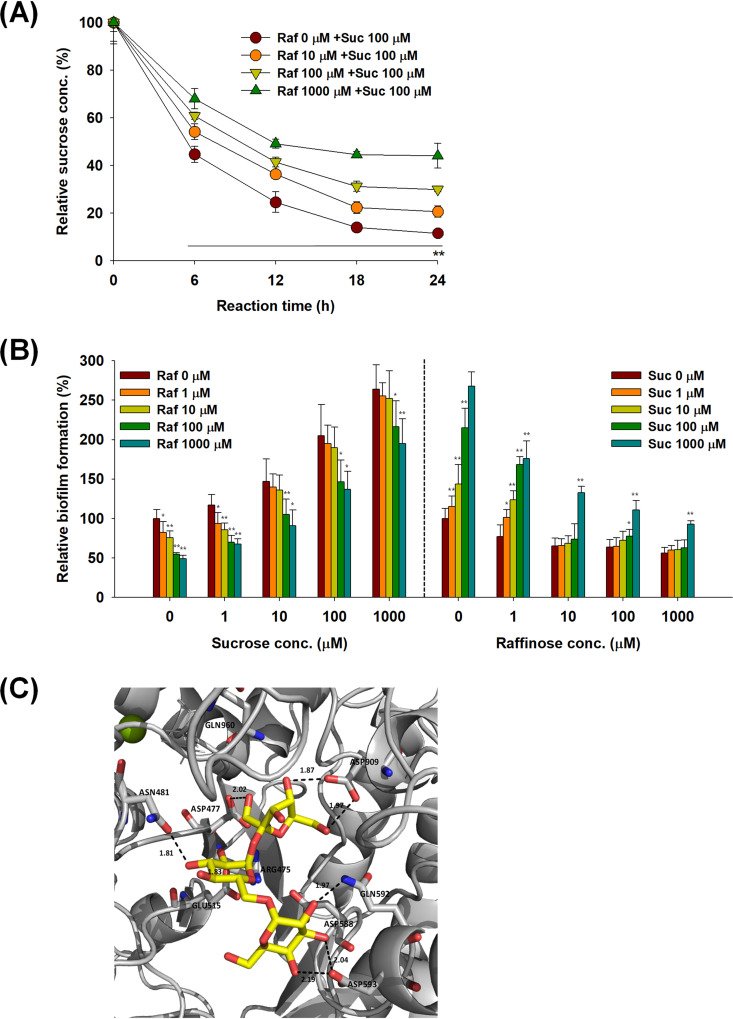
Possible mechanisms underlying the inhibition of Streptococcus mutans biofilm formation following raffinose treatment. (A) Sucrose consumption in S. mutans biofilm cells treated with raffinose. Streptococcus mutans biofilm was formed following sucrose (100 μM) and raffinose (0 to 1,000 μM) treatments under static conditions for 24 h. Error bars indicate the standard deviations of three measurements. **, P < 0.005, versus the control. Raf, raffinose; Suc, sucrose. (B) Competitive biofilm formation tests between raffinose and sucrose. Streptococcus mutans biofilm was formed following treatment with raffinose and sucrose at concentrations of 0 to 1,000 μM. Error bars indicate the standard deviations of five measurements. **, P < 0.005; *, P < 0.05, versus the control. (C) Best-docked poses of raffinose in S. mutans glucansucrase (GtfC [PDB code 3AIC]).
FIG 4
FIG 4
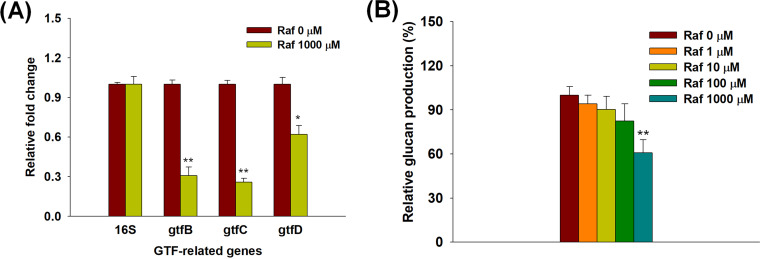
GTF-related changes in Streptococcus mutans following raffinose treatment. (A) GTF gene expression levels in S. mutans biofilm cells. Streptococcus mutans biofilm was formed following raffinose treatment (1,000 μM) under static conditions for 24 h. Relative fold changes were evaluated by RT-qPCR analysis. Error bars indicate the standard deviations of five measurements. **, P < 0.005; *, P < 0.05, versus the control. Raf, raffinose. (B) Relative glucan production of S. mutans following raffinose treatment. Extracted insoluble glucan was reacted with raffinose (0 to 1,000 μM). Glucan production was evaluated using the colorimetric method. Error bars indicate the standard deviations of three measurements. **, P < 0.005, versus the control. Raf, raffinose.
FIG 5
FIG 5
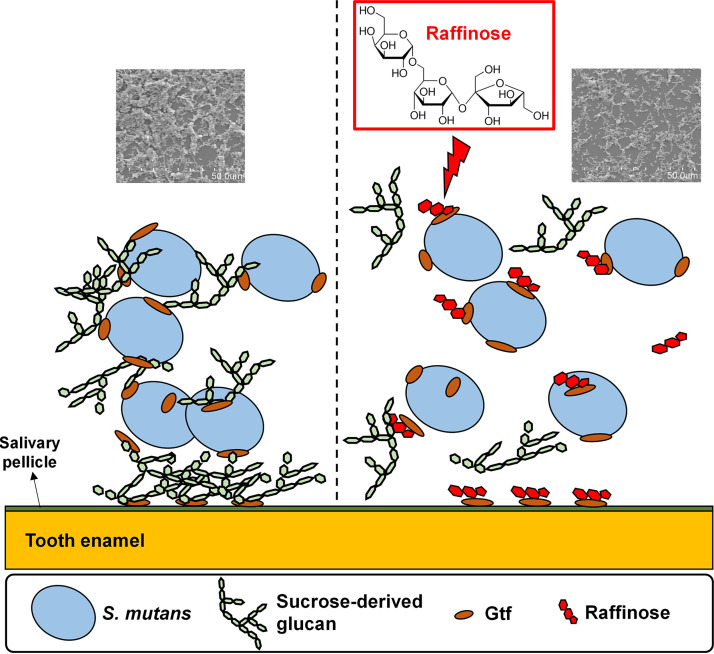
GTF-mediated biofilm inhibition in Streptococcus mutans following raffinose treatment. GTFs secreted by S. mutans are adsorbed on the pellicle and bacterial surfaces. The adsorbed GTFs bind to sucrose-derived glucan. Glucan provides binding sites on the surfaces for S. mutans, mediating adherence to the tooth enamel and tight bacterial clustering and eventually promoting biofilm formation. However, if the S. mutans biofilm is treated with raffinose, then the raffinose is expected to prevent sucrose-derived glucan from binding to GTFs. Therefore, the activity of glucan production in S. mutans is reduced, which may retard biofilm formation.
FIG 6
FIG 6
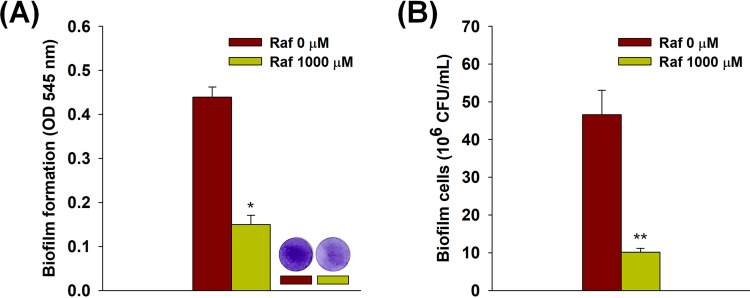
Adhesion of Streptococcus mutans to artificial-saliva-coated HA discs following raffinose treatment (1,000 μM). (A) Bacterial adhesion evaluation using CV staining. Streptococcus mutans biofilm was formed on HA discs for 24 h under static conditions, and OD545 was assessed. Error bars indicate the standard deviations of three measurements. *, P < 0.05, versus the control. Raf, raffinose. (B) Bacterial adhesion evaluation using the cell-counting method. The number of colonies of separated biofilm cells that formed on the HA discs was calculated using the standard plate culture method. Error bars indicate the standard deviations of three measurements. **, P < 0.005, versus the control.
FIG 7
FIG 7
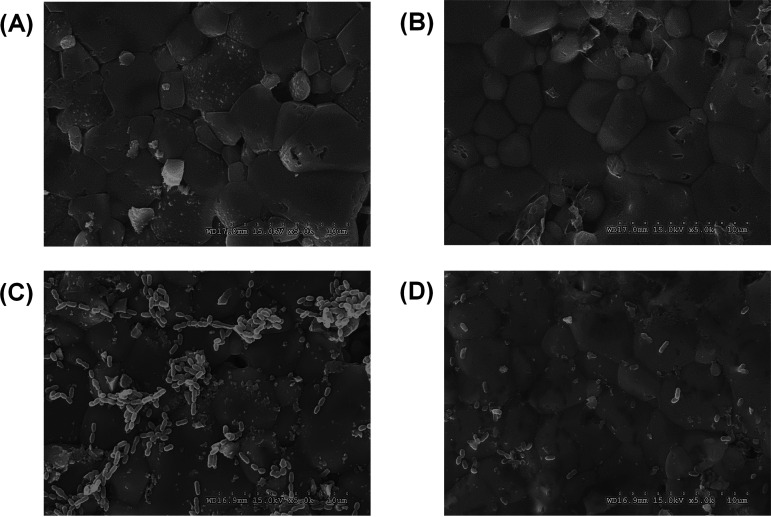
SEM images of Streptococcus mutans biofilm cells following raffinose treatment (1,000 μM) on artificial-saliva-coated HA discs. (A) HA discs. (B) Artificial-saliva-coated HA discs. (C) Streptococcus mutans biofilm cells on artificial-saliva-coated HA discs. (D) Raffinose-treated S. mutans biofilm cells on artificial-saliva-coated HA discs.

References

    1. Kolenbrander PE, Andersen RN, Blehert DS, Egland PG, Foster JS, Palmer RJ, Jr.. 2002. Communication among oral bacteria. Microbiol Mol Biol Rev 66:486–505. doi: 10.1128/MMBR.66.3.486-505.2002. - DOI - PMC - PubMed
    1. Marsh PD. 2003. Are dental diseases examples of ecological catastrophes? Microbiology (Reading) 149:279–294. doi: 10.1099/mic.0.26082-0. - DOI - PubMed
    1. Laudenbach JM, Simon Z. 2014. Common dental and periodontal diseases: evaluation and management. Med Clin North Am 98:1239–1260. doi: 10.1016/j.mcna.2014.08.002. - DOI - PubMed
    1. Scheie AA, Petersen FC. 2004. The biofilm concept: consequences for future prophylaxis of oral diseases? Crit Rev Oral Biol Med 15:4–12. doi: 10.1177/154411130401500102. - DOI - PubMed
    1. Marsh PD. 2006. Dental plaque as a biofilm and a microbial community: implications for health and disease. BMC Oral Health 6:S14. doi: 10.1186/1472-6831-6-S1-S14. - DOI - PMC - PubMed

Publication types