


Effects of vitamin C supplementation on gout risk: results from the Physicians' Health Study II trial
- PMID: 35575611
- PMCID: PMC9437983
- DOI: 10.1093/ajcn/nqac140
Effects of vitamin C supplementation on gout risk: results from the Physicians' Health Study II trial
Abstract
Background: Short-term randomized trials suggest that a 500 mg/d vitamin C supplement reduces serum urate, whereas observational studies show vitamin E is inversely associated with gout risk.
Objectives: We evaluated the effect of supplemental vitamin C (prespecified primary exposure) and vitamin E (prespecified secondary exposure) on new diagnoses of gout.
Methods: We performed a post hoc analysis of data from the Physicians' Health Study II, a randomized, double-blind, placebo-controlled factorial trial of randomized vitamin C (500 mg/d) and vitamin E (400 IU every other day). The primary outcome was new gout diagnoses, self-reported at baseline and throughout the follow-up period of ≤10 y.
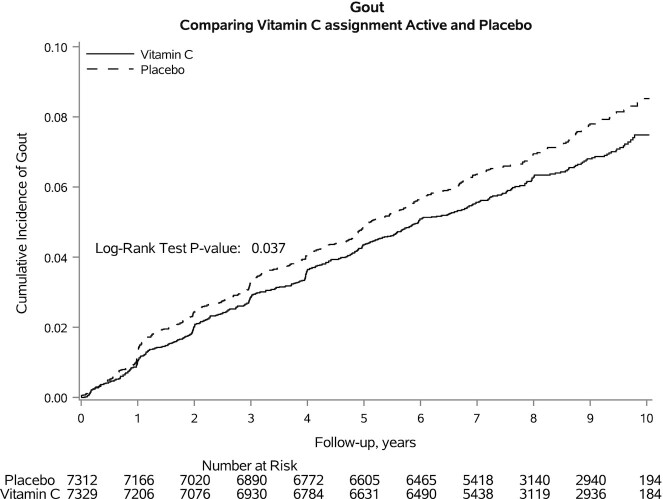
Results: Of 14,641 randomly assigned male physicians in our analysis, the mean age was 64 ± 9 y; 1% were Black, and 6.5% had gout prior to randomization. The incidence rate of new gout diagnoses during follow-up was 8.0 per 1000 person-years among those assigned vitamin C compared with 9.1 per 1000 person-years among those assigned placebo. The vitamin C assignment reduced new gout diagnoses by 12% (HR: 0.88; 95% CI: 0.77, 0.99; P = 0.04). These effects were greatest among those with a BMI <25 kg/m 2 (P-interaction = 0.01). Vitamin E was not associated with new gout diagnoses (HR: 1.05; 95% CI: 0.92, 1.19; P = 0.48).
Conclusions: Vitamin C modestly reduced the risk of new gout diagnoses in middle-aged male physicians. Additional research is needed to determine the effects of higher doses of vitamin C supplementation on serum urate and gout flares in adults with established gout.The Physicians' Health Study II is registered at clinicaltrials.gov (identifier: NCT00270647).
Keywords: gout; randomized trial; uric acid; vitamin C; vitamin E.
© The Author(s) 2022. Published by Oxford University Press on behalf of the American Society for Nutrition.
Figures
References
Publication types
MeSH terms
Substances
Associated data
Grants and funding
LinkOut - more resources
Full Text Sources
Medical
