


Can polygenic risk scores contribute to cost-effective cancer screening? A systematic review
- PMID: 35575786
- PMCID: PMC7614235
- DOI: 10.1016/j.gim.2022.04.020
Can polygenic risk scores contribute to cost-effective cancer screening? A systematic review
Abstract
Purpose: Polygenic risk influences susceptibility to cancer. We assessed whether polygenic risk scores could be used in conjunction with other predictors of future disease status in cost-effective risk-stratified screening for cancer.
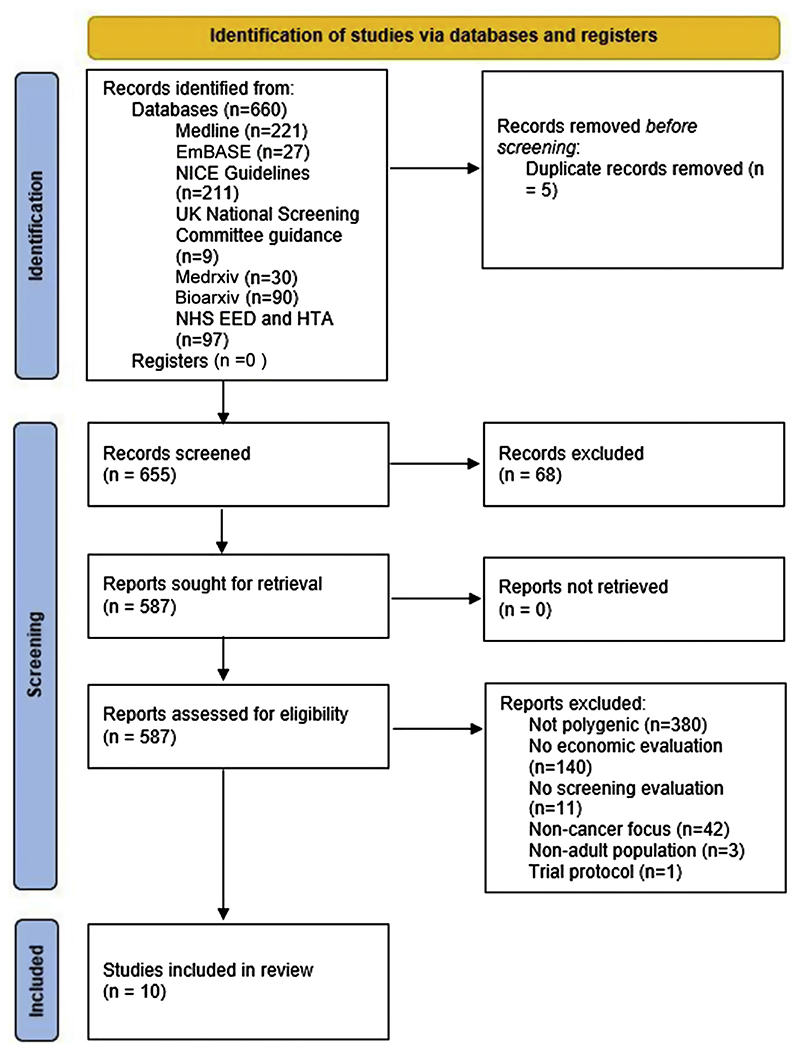
Methods: We undertook a systematic review of papers that evaluated the cost-effectiveness of screening interventions informed by polygenic risk scores compared with more conventional screening modalities. We included papers reporting cost-effectiveness outcomes with no restriction on type of cancer or form of polygenic risk modeled. We evaluated studies using the Quality of Health Economic Studies checklist.
Results: A total of 10 studies were included in the review, which investigated 3 cancers: prostate (n = 5), colorectal (n = 3), and breast (n = 2). Of the 10 papers, 9 scored highly (score >75 on a 0-100 scale) when assessed using the quality checklist. Of the 10 studies, 8 concluded that polygenic risk-informed cancer screening was likely to be more cost-effective than alternatives.
Conclusion: Despite the positive conclusions of the included studies, it is unclear if polygenic risk stratification will contribute to cost-effective cancer screening given the absence of robust evidence on the costs of polygenic risk stratification, the effects of differential ancestry, potential downstream economic sequalae, and how large volumes of polygenic risk data would be collected and used.
Keywords: Cancer; Cost-effectiveness; Polygenic risk scores; Screening; Systematic review.
Copyright © 2022 The Authors. Published by Elsevier Inc. All rights reserved.
Conflict of interest statement
Conflict of Interest E.K. reports personal fees from Novartis Pharma AG, Roche, Pfizer Inc, and Bristol-Myers Squibb outside the submitted work. R.M.M. has received other funding from Cancer Research UK to evaluate the long-term effectiveness and cost-effectiveness of population-based screening and treatment for prostate cancer: the CAP (Cluster randomised trial of PSA testing for prostate cancer) and ProtecT randomized controlled trials. He has also received funding from National Institute for Health Research Bristol Biomedical Research Centre at University Hospitals Bristol and Weston NHS Foundation Trust and the University of Bristol outside the submitted work. All other authors declare no conflicts of interest.
Figures
References
-
- Easton D, Pashayan N, Pharoah P. In: Annual Report of the Chief Medical Officer 2017—Generation Genome. Davies S, editor. Department of Health; 2017. Risk-stratified cancer screening.
Publication types
MeSH terms
Grants and funding
LinkOut - more resources
Full Text Sources
Medical
