Review
. 2022 Aug;17(5):1267-1276.
doi: 10.1007/s11739-022-02994-y. Epub 2022 May 16.

Sex differences at the platelet-vascular interface

Affiliations
Review

Sex differences at the platelet-vascular interface

Annamaria Sabetta et al. Intern Emerg Med. 2022 Aug.

Abstract

Platelets are multifunctional cells that ensure the integrity of the vascular wall and modulate the immune response at the blood/vascular interface. Their pathological activation results in both thrombosis and inflammation and implicates them in the pathogenesis of vascular disease. Vascular diseases are sexually dimorphic in terms of incidence, clinical presentation, outcome, and efficacy of anti-platelet therapy. We here provide an overview of what is known about the role of platelets in the initiation and progression of vascular diseases and summarize what is known about the sex differences in platelet reactivity and in the thromboinflammatory mechanisms that drive these diseases, with a particular focus on atherosclerosis, obstructive and non-obstructive coronary artery disease, and ischemic stroke. Understanding the sex differences at the platelet-vascular interface is clinically relevant as it will enable: (1) to design new therapeutic strategies that prevent the detrimental effects of the immune-modulatory function of platelets taking sex into account, and (2) to evaluate if sex-specific anti-platelet drug regimens should be used to reduce the risk not only of thrombosis but also of vascular disease progression.

Keywords: Platelets; Sex; Thromboinflammation; Vascular disease.


Conflict of interest statement

The authors declare that they have no conflict of interest.

Figures

Fig. 1
Fig. 1
Platelets are multifunctional cells that ensure the integrity of the vascular wall and modulate the immune response at the blood/vascular interface. Platelets are always the first cells to sense any vascular anomaly and bind to activated endothelial cells (yellow). Once recruited, platelets regulate vascular inflammation by controlling deposition of chemokines, vascular permeability, leukocyte recruitment and activation, and inflammation-mediated hemostasis. They can also modify the phenotype and function of vascular smooth muscle cells, endothelial cells and leukocytes through extracellular vesicle (EV)-mediated communication
Fig. 2
Fig. 2
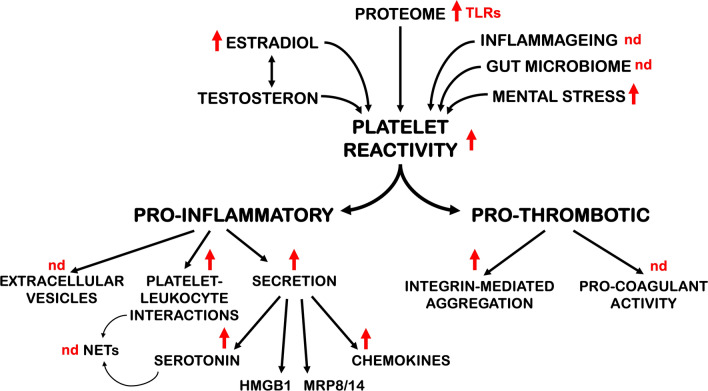
Mechanisms and consequences of sex differences in platelet reactivity. The increased platelet reactivity of women (indicated with red arrows, nd: not determined) is caused by intrinsic and extrinsic differences between males and females and determines the upregulation of both the pro-thrombotic and the pro-inflammatory functions of platelets

References

    1. Koupenova M, Livada AC, Morrell CN. Platelet and megakaryocyte roles in innate and adaptive immunity. Circ Res. 2022;130:288–308. doi: 10.1161/circresaha.121.319821. - DOI - PMC - PubMed
    1. Rayes J, Bourne JH, Brill A, Watson SP. The dual role of platelet-innate immune cell interactions in thrombo-inflammation. Res Practice Thromb Haemost. 2019;4:23–35. doi: 10.1002/rth2.12266. - DOI - PMC - PubMed
    1. Noé BHT, Boulaftali Y, Camerer E. Platelets and vascular integrity: how platelets prevent bleeding in inflammation. Blood. 2018;131:277–288. doi: 10.1182/blood-2017-06-742676. - DOI - PubMed
    1. Kitchens C, Weiss L. Ultrastructural changes of endothelium associated with thrombocytopenia. Blood. 1975;46:567–578. doi: 10.1182/blood.v46.4.567.567. - DOI - PubMed
    1. Gupta S, Konradt C, Corken A, et al. Hemostasis vs. homeostasis: Platelets are essential for preserving vascular barrier function in the absence of injury or inflammation. Proc Natl Acad Sci. 2020;117:24316–24325. doi: 10.1073/pnas.2007642117. - DOI - PMC - PubMed

Publication types