Clinical Trial
. 2022 Nov 10;140(19):2053-2062.
doi: 10.1182/blood.2022015403.

A phase 1 dose escalation study of the pyruvate kinase activator mitapivat (AG-348) in sickle cell disease

Affiliations
Clinical Trial

A phase 1 dose escalation study of the pyruvate kinase activator mitapivat (AG-348) in sickle cell disease

Julia Z Xu et al. Blood. .

Abstract

Polymerization of deoxygenated hemoglobin S underlies the pathophysiology of sickle cell disease (SCD). In activating red blood cell pyruvate kinase and glycolysis, mitapivat (AG-348) increases adenosine triphosphate (ATP) levels and decreases the 2,3-diphosphoglycerate (2,3-DPG) concentration, an upstream precursor in glycolysis. Both changes have therapeutic potential for patients with SCD. Here, we evaluated the safety and tolerability of multiple ascending doses of mitapivat in adults with SCD with no recent blood transfusions or changes in hydroxyurea or l-glutamine therapy. Seventeen subjects were enrolled; 1 subject was withdrawn shortly after starting the study. Sixteen subjects completed 3 ascending dose levels of mitapivat (5, 20, and 50 mg, twice daily [BID]) for 2 weeks each; following a protocol amendment, the dose was escalated to 100 mg BID in 9 subjects. Mitapivat was well tolerated at all dose levels, with the most common treatment-emergent adverse events (AEs) being insomnia, headache, and hypertension. Six serious AEs (SAEs) included 4 vaso-occlusive crises (VOCs), non-VOC-related shoulder pain, and a preexisting pulmonary embolism. Two VOCs occurred during drug taper and were possibly drug related; no other SAEs were drug related. Mean hemoglobin increase at the 50 mg BID dose level was 1.2 g/dL, with 9 of 16 (56.3%) patients achieving a hemoglobin response of a ≥1 g/dL increase compared with baseline. Mean reductions in hemolytic markers and dose-dependent decreases in 2,3-DPG and increases in ATP were also observed. This study provides proof of concept that mitapivat has disease-modifying potential in patients with SCD. This trial was registered at www.clinicaltrials.gov as #NCT04000165.


Conflict of interest statement

Conflict-of-interest disclosure: V.I., H.M., C.K., L.D., P.A.K., and P.H. are employed by and are stockholders in Agios. H.M. and P.H. are stockholders in Bristol-Myers Squibb. V.I. is a stockholder in Novartis. The remaining authors declare no competing financial interests.

Figures
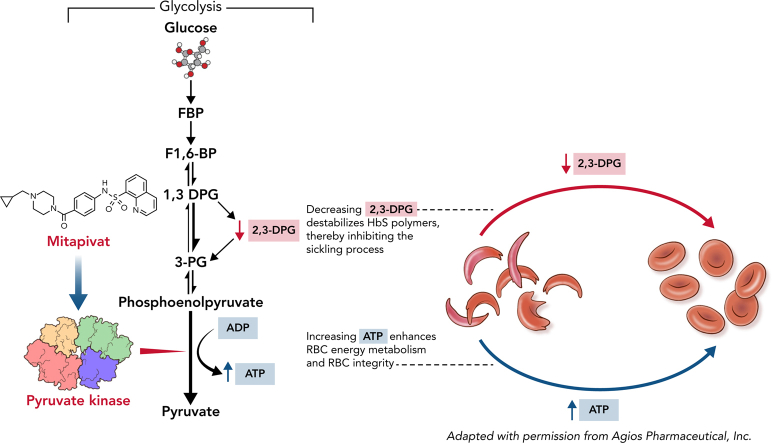
Image 1
Graphical abstract
Figure 1.
Figure 1.
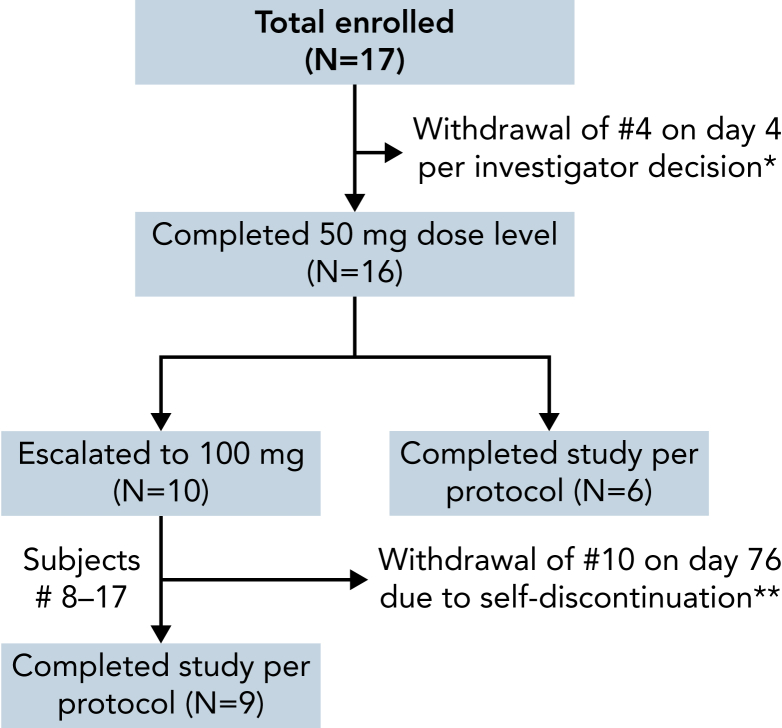
Flowchart for the dose escalation study of mitapivat in SCD. ∗Subject 4 was withdrawn because of the need for medical intervention for pulmonary embolism present unknowingly at enrollment and unrelated to drug; the subject was lost to follow-up and not evaluable for laboratory response. ∗∗Subject 10 self-discontinued therapy before completing the 100-mg dose level because of an AE unrelated to the drug; analyzed with the 50-mg dose cohort.
Figure 2.
Figure 2.
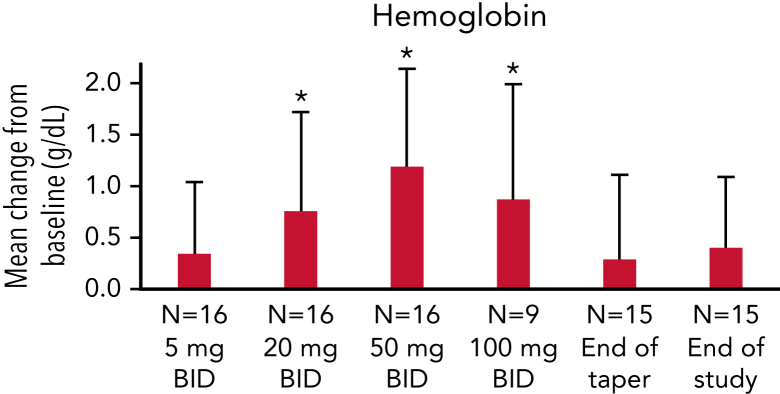
Hemoglobin response in study subjects. Mean hemoglobin response in all 16 patients completing the 50-mg BID dose level, and 9 of 10 subjects completing the 100-mg BID dose level. Error bars correspond to SDs. ∗A linear mixed effects model of hemoglobin change at different dose levels with age and sex as covariates showed a significant change in hemoglobin level compared with baseline at the 20-, 50-, and 100-mg BID dose levels of mitapivat (P = .0007, <.0001, and .0007, respectively).
Figure 3.
Figure 3.
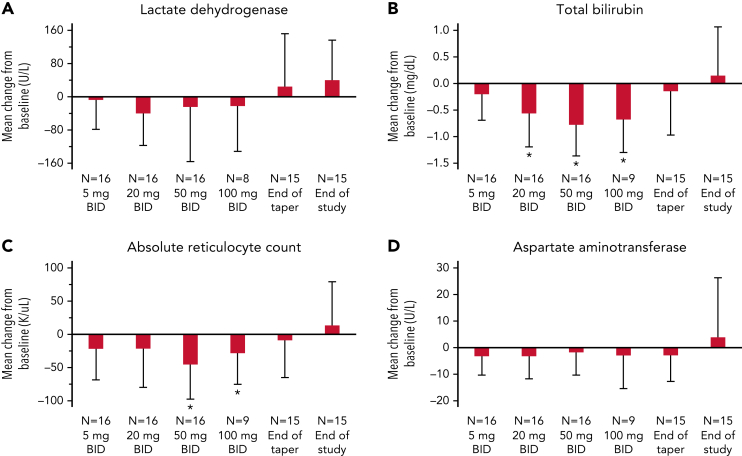
Change in hemolysis markers from baseline in study subjects. Hemolysis markers, (A) LDH, (B) total bilirubin, (C) ARC, and (D) AST, were measured at steady state (baseline); after 14 ± 3 days of treatment on 5 mg BID, 20 mg BID, 50 mg BID, and 100 mg BID of mitapivat; at the end of taper (1 ± 3 days after the last dose of mitapivat); and at EOS (4 weeks ± 3 days after the last dose of mitapivat). A total of 16 subjects escalated to the 50-mg BID dose, and 9 of 10 subjects completed up to the 100-mg BID dose level. End of taper data were unavailable for 1 subject who self-discontinued treatment without undergoing a taper; EOS data were excluded for 1 subject because of intervening blood transfusion. Mean change was calculated from baseline, defined as the most recent measurement prior to start of study drug and reported as absolute change. Error bars correspond to SDs. A linear mixed effects model using age and sex as covariates was created for each variable (referred to as the basic model; supplemental Materials). No significant changes from baseline were identified for LDH (A) and AST (D). ∗There was a significant absolute reduction in (B) total bilirubin level compared with baseline at the 20-, 50-, and 100-mg BID dose levels of mitapivat (P = .001, <.0001, and <.0001, respectively). (C) Reduction in ARC compared with baseline was significant at the 50- and 100-mg BID dose levels of mitapivat (P = .002 and .05, respectively), as denoted by ∗.
Figure 4.
Figure 4.
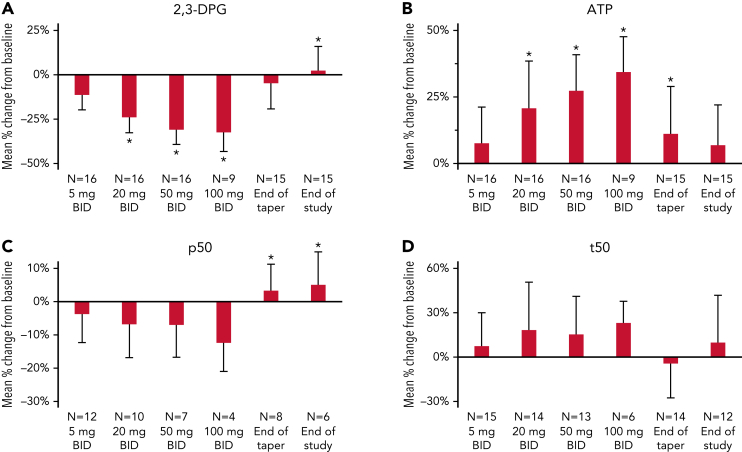
Change in 2,3-DPG, ATP, p50, and t50 from baseline in study subjects. Measures of PD, (A) 2,3-DPG, (B) ATP, (C) p50, and (D) t50, were assessed at steady state (baseline); after 14 ± 3 days of treatment on 5 mg BID, 20 mg BID, 50 mg BID, and 100 mg BID of mitapivat; at the end of taper (1 ± 3 days after the last dose of mitapivat); and at EOS (4 weeks ± 3 days after the last dose of mitapivat). A total of 16 subjects escalated to the 50-mg BID dose, and 9 of 10 subjects completed up to the 100-mg BID dose level. End of taper data were unavailable for 1 subject who self-discontinued treatment without undergoing a taper; EOS data were excluded for 1 subject because of intervening blood transfusion. Missing data reflected in the sample sizes shown (in particular, for p50) were largely the result of disruptions related to the COVID-19 pandemic. Mean change was calculated from baseline, defined as the most recent measurement prior to start of study drug, and reported as percentage change for ease of clinical interpretation. Error bars correspond to SDs. A linear mixed effects model using age and sex as covariates was created for each variable (referred to as the basic model; supplemental Materials), and statistical significance within this model is denoted in the figures by ∗. (A-B) There was a significant mean percentage decrease in 2,3-DPG levels and mean percentage increase in ATP levels compared with baseline at the 20-, 50-, and 100-mg BID dose levels of mitapivat (P < .0001 for all). (C-D) No significant changes from baseline were identified for p50 and t50 values in the basic model, except for a percentage increase p50 at the end-of-taper and end-of-study timepoints (P = .02 and .003, respectively).

Comment in

References

    1. Xu JZ, Conrey A, Frey I, et al. Phase 1 multiple ascending dose study of safety, tolerability, and pharmacokinetics/pharmacodynamics of mitapivat (AG-348) in subjects with sickle cell disease. Blood. 2020;136(suppl 1):21–22.
    1. Xu JZ, Conrey A, Frey I, et al. Mitapivat (AG-348) demonstrates safety, tolerability, and improvements in anemia, hemolysis, oxygen affinity, and hemoglobin s polymerization kinetics in adults with sickle cell disease: a phase 1 dose escalation study. Blood. 2021;138(suppl 1):10.
    1. Williams TN, Thein SL. Sickle cell anemia and its phenotypes. Annu Rev Genomics Hum Genet. 2018;19(1):113–147. - PMC - PubMed
    1. DeBaun MR, Ghafuri DL, Rodeghier M, et al. Decreased median survival of adults with sickle cell disease after adjusting for left truncation bias: a pooled analysis. Blood. 2019;133(6):615–617. - PMC - PubMed
    1. Barabino GA, Platt MO, Kaul DK. Sickle cell biomechanics. Annu Rev Biomed Eng. 2010;12(1):345–367. - PubMed

Publication types

Associated data