


Using population-based data to evaluate the impact of adherence to endocrine therapy on survival in breast cancer through the web-application BreCanSurvPred
- PMID: 35577853
- PMCID: PMC9110408
- DOI: 10.1038/s41598-022-12228-y
Using population-based data to evaluate the impact of adherence to endocrine therapy on survival in breast cancer through the web-application BreCanSurvPred
Abstract
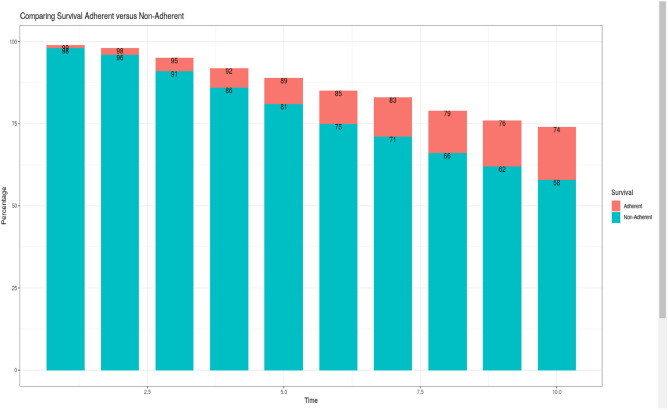
We show how the use and interpretation of population-based cancer survival indicators can help oncologists talk with breast cancer (BC) patients about the relationship between their prognosis and their adherence to endocrine therapy (ET). The study population comprised a population-based cohort of estrogen receptor positive BC patients (N = 1268) diagnosed in Girona and Tarragona (Northeastern Spain) and classified according to HER2 status (+ / -), stage at diagnosis (I/II/III) and five-year cumulative adherence rate (adherent > 80%; non-adherent ≤ 80%). Cox regression analysis was performed to identify significant prognostic factors for overall survival, whereas relative survival (RS) was used to estimate the crude probability of death due to BC (PBC). Stage and adherence to ET were the significant factors for predicting all-cause mortality. Compared to stage I, risk of death increased in stage II (hazard ratio [HR] 2.24, 95% confidence interval [CI]: 1.51-3.30) and stage III (HR 5.11, 95% CI 3.46-7.51), and it decreased with adherence to ET (HR 0.57, 95% CI 0.41-0.59). PBC differences were higher in non-adherent patients compared to adherent ones and increased across stages: stage I: 6.61% (95% CI 0.05-13.20); stage II: 9.77% (95% CI 0.59-19.01), and stage III: 22.31% (95% CI 6.34-38.45). The age-adjusted survival curves derived from this modeling were implemented in the web application BreCanSurvPred ( https://pdocomputation.snpstats.net/BreCanSurvPred ). Web applications like BreCanSurvPred can help oncologists discuss the consequences of non-adherence to prescribed ET with patients.
© 2022. The Author(s).
Conflict of interest statement
The authors declare no competing interests.
Figures
References
-
- Coates AS, Winer EP, Goldhirsch A, Gelber RD, Gnant M, Piccart-Gebhart M, et al. Tailoring therapies — improving the management of early breast cancer : St Gallen International Expert Consensus on the Primary Therapy of Early Breast Cancer 2015. Ann. Oncol. 2015;26:1533–1546. doi: 10.1093/annonc/mdv221. - DOI - PMC - PubMed
-
- Puig-Vives M, Sánchez MJ, Sánchez-Cantalejo J, Torrella-Ramos A, Martos C, Ardanaz E, et al. Distribution and prognosis of molecular breast cancer subtypes defined by immunohistochemical biomarkers in a Spanish population-based study. Gynecol. Oncol. 2013;130(3):609–614. doi: 10.1016/j.ygyno.2013.05.039. - DOI - PubMed
Publication types
MeSH terms
Substances
LinkOut - more resources
Full Text Sources
Medical
Research Materials
Miscellaneous
