


Algometry for the assessment of central sensitisation to pain in fibromyalgia patients: a systematic review
- PMID: 35579545
- PMCID: PMC9122375
- DOI: 10.1080/07853890.2022.2075560
Algometry for the assessment of central sensitisation to pain in fibromyalgia patients: a systematic review
Abstract
Introduction: The pathophysiology of fibromyalgia (FM) is related to central sensitisation (CS) to pain. Algometry allows assessing CS based on dynamic evoked pain. However, current algometrýs protocols require optimising, unifying and updating.
Objectives: 1) identify the dynamic pain measures used most frequently to effectively assess CS processes in FM, and 2) consider the future of the algometry assessing CS in these patients.
Methods: Cochrane Collaboration guidelines and PRISMA statements were followed. The protocol was registered in PROSPERO database (ID: CRD42021270135). The selected articles were evaluated using the Cochrane risk of bias (ROB) assessment tool. The PubMed, Scopus, and Web of Science databases were searched.
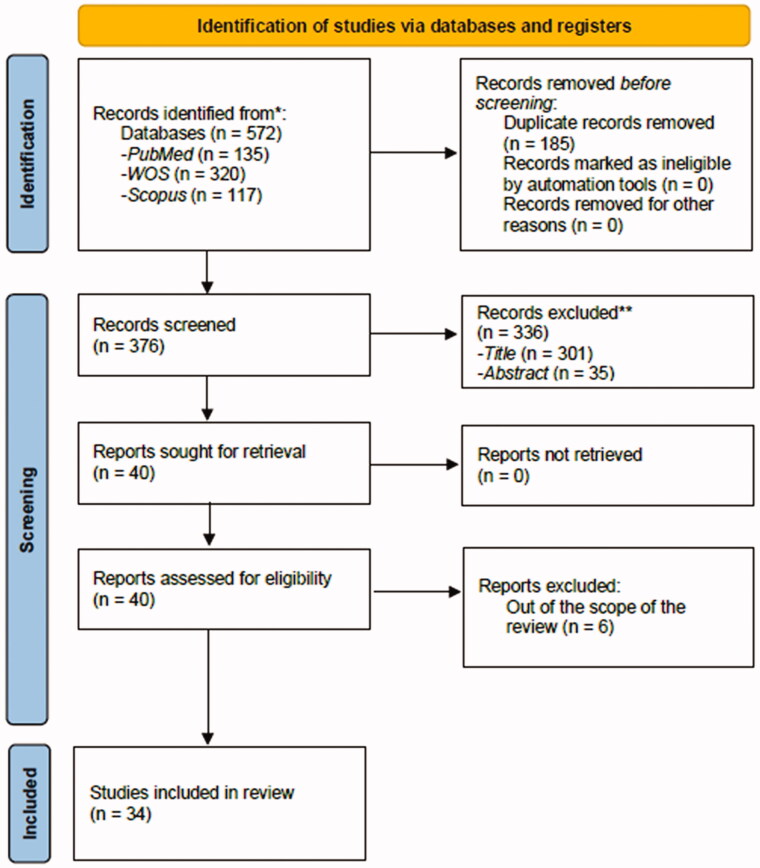
Results: Thirty-four studies were selected, including measures such as temporal summation of pain (TSP), aftersensations (AS), spatial summation of pain (SSP), the noxious flexion reflex (NFR) threshold, conditioned pain modulation (CPM), cutaneous silent period (CuSP), and slowly repeated evoked pain (SREP); and evoked pain combined with neuroimaging. Each measure offered various advantages and limitations. According to ROB, 28 studies were of low quality, 3 of moderate quality, and 3 of high quality.
Conclusions: Several pain indicators have been demonstrated to successfully examine CS involvement in FM in the last years. Algometry, especially when it involves diverse body sites and tissues, might provide further insight into (1) the evaluation of psychological factors known to influence pain experience, (2) new dynamic pain indicators, and (3) the simultaneous use of certain neuroimaging techniques. Further research clarifying the mechanisms underlying some of these measures, and homogenisation and optimisation of the algometrýs protocols, are needed. KEY MESSAGESAlgometry allows for assessing Central Sensitisation by applying dynamic evoked pain.The future of algometry could relapse in its combination with neuroimaging.Recently-emerged pain indicators should be considered for algometrýs new protocols.
Keywords: Algometry; central sensitisation; dolorimetry; evoked pain; fibromyalgia.
Conflict of interest statement
All authors declare that there is no conflict of interest.
Figures
References
-
- Wolfe F, Smythe HA, Yunus MB, et al. The American College of Rheumatology 1990 criteria for the classification of fibromyalgia. Report of the Multicenter Criteria Committee. Arthritis Rheum. 1990;33(2):160–172. - PubMed
-
- Wolfe F, Clauw DJ, Fitzcharles MA, et al. The American College of Rheumatology Preliminary diagnostic criteria for fibromyalgia and measurement of symptom severity. Arthritis Care Res. 2010;62(5):600–610. - PubMed
-
- Lautenbacher S, Rollman GB, McCain GA.. Multi-method assessment of experimental and clinical pain in patients with fibromyalgia. Pain. 1994;59(1):45–53. - PubMed
Publication types
MeSH terms
LinkOut - more resources
Full Text Sources
Medical
Research Materials
Miscellaneous
