. 2022 Oct 1;151(7):1033-1046.
doi: 10.1002/ijc.34116. Epub 2022 Jun 7.

Circulating free testosterone and risk of aggressive prostate cancer: Prospective and Mendelian randomisation analyses in international consortia

Eleanor L Watts  1 Aurora Perez-Cornago  1 Georgina K Fensom  1 Karl Smith-Byrne  2 Urwah Noor  1 Colm D Andrews  1 Marc J Gunter  3 Michael V Holmes  4   5 Richard M Martin  6   7   8 Konstantinos K Tsilidis  9   10 Demetrius Albanes  11 Aurelio Barricarte  12   13   14 Bas Bueno-de-Mesquita  15 Chu Chen  16   17   18 Barbara A Cohn  19 Niki L Dimou  3 Luigi Ferrucci  20 Leon Flicker  21   22 Neal D Freedman  11 Graham G Giles  23   24   25 Edward L Giovannucci  26   27   28 Gary E Goodman  16 Christopher A Haiman  29 Graeme J Hankey  21 Jiaqi Huang  11   30 Wen-Yi Huang  11 Lauren M Hurwitz  11 Rudolf Kaaks  31 Paul Knekt  32 Tatsuhiko Kubo  33 Hilde Langseth  9   34 Gail Laughlin  35 Loic Le Marchand  36 Tapio Luostarinen  37 Robert J MacInnis  23   24 Hanna O Mäenpää  38 Satu Männistö  39 E Jeffrey Metter  40 Kazuya Mikami  41 Lorelei A Mucci  26 Anja W Olsen  42   43 Kotaro Ozasa  44 Domenico Palli  45 Kathryn L Penney  26   27 Elizabeth A Platz  46 Harri Rissanen  32 Norie Sawada  47 Jeannette M Schenk  48 Pär Stattin  49 Akiko Tamakoshi  50 Elin Thysell  51 Chiaojung Jillian Tsai  52 Shoichiro Tsugane  47 Lars Vatten  53 Elisabete Weiderpass  54 Stephanie J Weinstein  11 Lynne R Wilkens  36 Bu B Yeap  21   55 PRACTICAL ConsortiumCRUKBPC3CAPSPEGASUSNaomi E Allen  4   56 Timothy J Key  1 Ruth C Travis  1
Affiliations

Circulating free testosterone and risk of aggressive prostate cancer: Prospective and Mendelian randomisation analyses in international consortia

Eleanor L Watts et al. Int J Cancer. .

Abstract

Previous studies had limited power to assess the associations of testosterone with aggressive disease as a primary endpoint. Further, the association of genetically predicted testosterone with aggressive disease is not known. We investigated the associations of calculated free and measured total testosterone and sex hormone-binding globulin (SHBG) with aggressive, overall and early-onset prostate cancer. In blood-based analyses, odds ratios (OR) and 95% confidence intervals (CI) for prostate cancer were estimated using conditional logistic regression from prospective analysis of biomarker concentrations in the Endogenous Hormones, Nutritional Biomarkers and Prostate Cancer Collaborative Group (up to 25 studies, 14 944 cases and 36 752 controls, including 1870 aggressive prostate cancers). In Mendelian randomisation (MR) analyses, using instruments identified using UK Biobank (up to 194 453 men) and outcome data from PRACTICAL (up to 79 148 cases and 61 106 controls, including 15 167 aggressive cancers), ORs were estimated using the inverse-variance weighted method. Free testosterone was associated with aggressive disease in MR analyses (OR per 1 SD = 1.23, 95% CI = 1.08-1.40). In blood-based analyses there was no association with aggressive disease overall, but there was heterogeneity by age at blood collection (OR for men aged <60 years 1.14, CI = 1.02-1.28; Phet = .0003: inverse association for older ages). Associations for free testosterone were positive for overall prostate cancer (MR: 1.20, 1.08-1.34; blood-based: 1.03, 1.01-1.05) and early-onset prostate cancer (MR: 1.37, 1.09-1.73; blood-based: 1.08, 0.98-1.19). SHBG and total testosterone were inversely associated with overall prostate cancer in blood-based analyses, with null associations in MR analysis. Our results support free testosterone, rather than total testosterone, in the development of prostate cancer, including aggressive subgroups.

Keywords: Mendelian randomisation; SHBG; aggressive prostate cancer; prostate cancer; testosterone.


Conflict of interest statement

Dr Michael V. Holmes declares unpaid consultancy for Boehringer Ingelheim. The other authors have no conflicts to disclose.

Figures
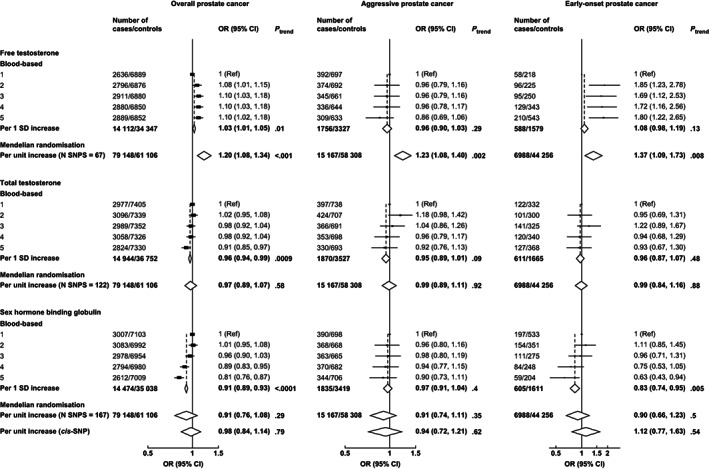
FIGURE 1
FIGURE 1
Risks of overall, aggressive* and early‐onset prostate cancer in by study‐specific fifths of hormone concentrations (blood‐based only) and unit increment (blood‐based and MR). Blood‐based estimates are from logistic regression conditioned on the matching variables and adjusted for age, BMI, height, alcohol intake, smoking status, marital status, education status, racial/ethnic group and diabetes status. The position of each square indicates the magnitude of the odds ratio, and the area of the square is proportional to the inverse of the variance of the logarithm of the OR. The length of the horizontal line through the square indicates the 95% CI. MR risk estimates are estimated using the inverse variance weighted method for the full instrument methods and the Wald ratio in the cis‐SNP analyses (where applicable). In MR analyses, biomarker transformations are outlined in the Supplementary Methods (Appendix S2). *Aggressive cancer defined as Gleason grade 8+, or prostate cancer death or metastases or PSA >100 ng/mL. Early‐onset defined as diagnosed ≤55 years. BMI, body mass index; CI, confidence interval; OR, odds ratio; PSA, prostate‐specific antigen; SNP, single nucleotide polymorphism
FIGURE 2
FIGURE 2
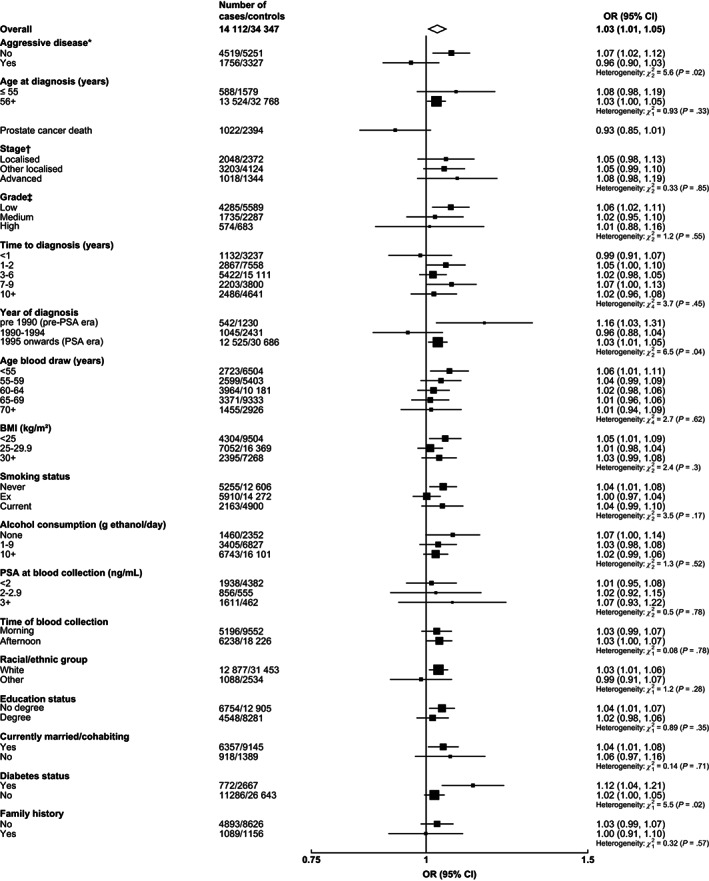
Odds ratio (95% CIs) for overall prostate cancer per study‐specific 1 SD increment of free testosterone concentration by subgroup. Estimates are from logistic regression conditioned on the matching variables and adjusted for age, BMI, height, alcohol intake, smoking status, marital status, education status, racial/ethnic group and diabetes status. The position of each square indicates the magnitude of the OR, and the area of the square is proportional to the inverse of the variance of the logarithm of the OR). The length of the horizontal line through the square indicates the 95% CI. Tests for heterogeneity for case‐defined factors were obtained by fitting separate models for each subgroup and assuming independence of the ORs using a method analogous to a metaanalysis. Tests for heterogeneity for non‐case‐defined factors were assessed with a χ 2 test of interaction between subgroup and the binary variable. *Aggressive cancer defined as Gleason grade 8+, or prostate cancer death or metastases or PSA >100 ng/mL. Localised defined as TNM stage <T2 with no reported lymph node involvement or metastases or stage I; other localised stage if TNM stage T2 with no reported lymph node involvement or metastases, stage II or equivalent; advanced stage if they were TNM stage T3 or T4 and/or N1+ and/or M1, stage III‐IV or equivalent. Low grade defined as Gleason score was <7 or equivalent (ie, extent of differentiation good, moderate); medium grade if Gleason score was 7 (ie, poorly differentiated); high grade if the Gleason score was ≥8 or equivalent (ie, undifferentiated). BMI, body mass index; CI, confidence interval; OR, odds ratio; PSA, prostate‐specific antigen
FIGURE 3
FIGURE 3
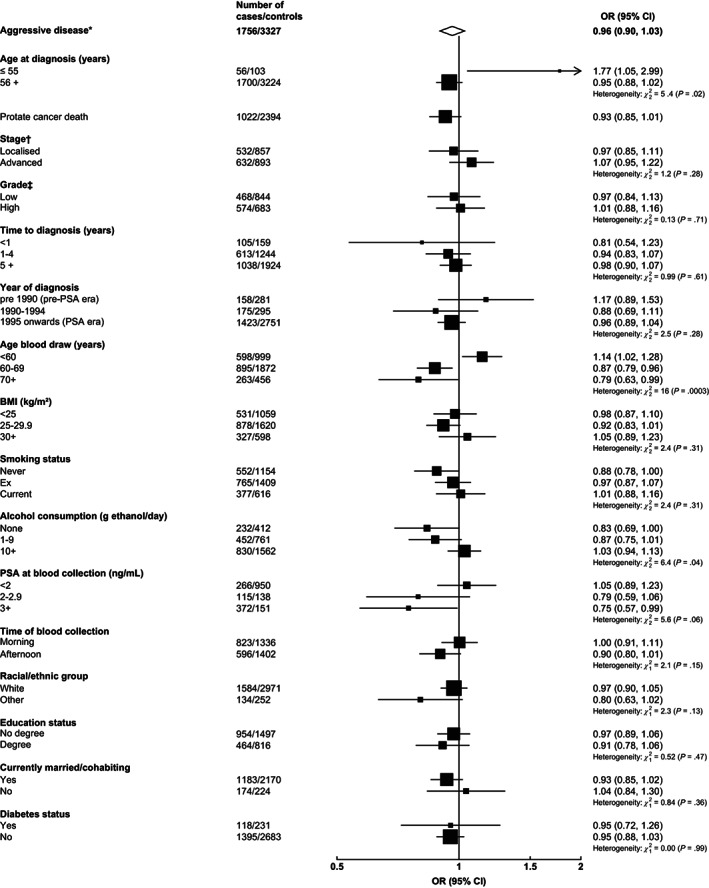
Odds ratio (95% CIs) for aggressive* prostate cancer per study‐specific 1 SD increment of free testosterone concentration by subgroup. Estimates are from logistic regression conditioned on the matching variables and adjusted for age, BMI, height, alcohol intake, smoking status, marital status, education status, racial/ethnic group and diabetes status. The position of each square indicates the magnitude of the OR, and the area of the square is proportional to theinverse of the variance of the logarithm of the OR). The length of the horizontal line through the square indicates the 95% CI. Tests for heterogeneity for case‐defined factors were obtained by fitting separate models for each subgroup and assuming independence of the ORs using a method analogous to a metaanalysis. Tests for heterogeneity for non‐case‐defined factors were assessed with a χ 2 test of interaction between subgroup and the binary variable. *Aggressive cancer defined as Gleason grade 8+, or prostate cancer death, or metastases or PSA >100 ng/mL. Localised defined as TNM stage <T2 with no reported lymph node involvement or metastases or stage I, or TNM stage T2 with no reported lymph node involvement or metastases, stage II, or equivalent; advanced stage if they were TNM stage T3 or T4 and/or N1+ and/or M1, stage III‐IV or equivalent. Low grade defined as Gleason score was <8 or equivalent (ie, extent of differentiation good, moderate, poor); high grade if the Gleason score was ≥8 or equivalent (ie, undifferentiated). BMI, body mass index; CI, confidence interval; OR, odds ratio; PSA, prostate‐specific antigen

References

    1. Ferlay J, Ervik M, Lam F, et al. Global Cancer Observatory: Cancer Today. Lyon, France: International Agency for Research on Cancer; 2018.
    1. Watts EL, Appleby PN, Perez‐Cornago A, et al. Low free testosterone and prostate cancer risk: a collaborative analysis of 20 prospective studies. Eur Urol. 2018;74:585‐594. - PMC - PubMed
    1. Watts EL, Fensom GK, Smith Byrne K, et al. Circulating insulin‐like growth factor‐I, total and free testosterone concentrations and prostate cancer risk in 200 000 men in UK Biobank. Int J Cancer. 2020; 148:2274‐2288. - PMC - PubMed
    1. Ruth KS, Day FR, Tyrrell J, et al. Using human genetics to understand the disease impacts of testosterone in men and women. Nat Med. 2020;26:252‐258. - PMC - PubMed
    1. Travis RC, Appleby PN, Martin RM, et al. A meta‐analysis of individual participant data reveals an association between circulating levels of IGF‐I and prostate cancer risk. Cancer Res. 2016;76:2288‐2300. - PMC - PubMed

Publication types