


Sleep-disordered breathing was associated with lower health-related quality of life and cognitive function in a cross-sectional study of older adults
- PMID: 35580042
- PMCID: PMC9540665
- DOI: 10.1111/resp.14279
Sleep-disordered breathing was associated with lower health-related quality of life and cognitive function in a cross-sectional study of older adults
Abstract
Background and objective: The clinical significance of sleep-disordered breathing (SDB) in older age is uncertain. This study determined the prevalence and associations of SDB with mood, daytime sleepiness, quality of life (QOL) and cognition in a relatively healthy older Australian cohort.
Methods: A cross-sectional analysis was conducted from the Study of Neurocognitive Outcomes, Radiological and retinal Effects of Aspirin in Sleep Apnoea. Participants completed an unattended limited channel sleep study to measure the oxygen desaturation index (ODI) to define mild (ODI 5-15) and moderate/severe (ODI ≥ 15) SDB, the Centre for Epidemiological Studies Scale, the Epworth Sleepiness Scale, the 12-item Short-Form for QOL and neuropsychological tests.
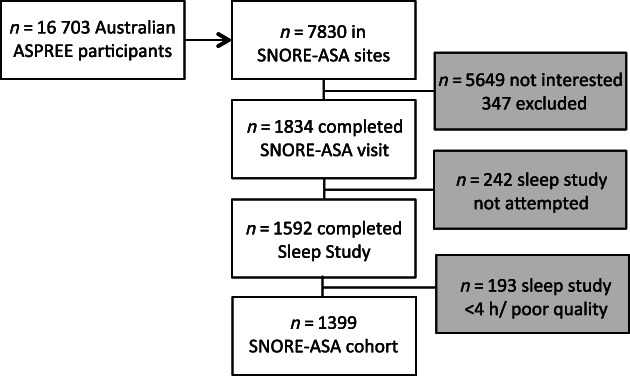
Results: Of the 1399 participants (mean age 74.0 years), 36% (273 of 753) of men and 25% (164 of 646) of women had moderate/severe SDB. SDB was associated with lower physical health-related QOL (mild SDB: beta coefficient [β] -2.5, 95% CI -3.6 to -1.3, p < 0.001; moderate/severe SDB: β -1.8, 95% CI -3.0 to -0.6, p = 0.005) and with lower global composite cognition (mild SDB: β -0.1, 95% CI -0.2 to 0.0, p = 0.022; moderate/severe SDB: β -0.1, 95% CI -0.2 to 0.0, p = 0.032) compared to no SDB. SDB was not associated with daytime sleepiness nor depression.
Conclusion: SDB was associated with lower physical health-related quality of life and cognitive function. Given the high prevalence of SDB in older age, assessing QOL and cognition may better delineate subgroups requiring further management, and provide useful treatment target measures for this age group.
Keywords: ageing; cognition; dementia; quality of life; sleep-disordered breathing.
© 2022 The Authors. Respirology published by John Wiley & Sons Australia, Ltd on behalf of Asian Pacific Society of Respirology.
Conflict of interest statement
Resmed leased some of the ApneaLink Plus devices used in the study and provided the nasal cannula for the devices free of cost. Garun S. Hamilton and Matthew T. Naughton have both received equipment free of charge for use in research from Resmed, and Garun S. Hamilton from Phillips Respironics and Air Liquide Healthcare for the same purpose. Fergal J. O'Donoghue has received a grant from Resmed for research purposes and also received equipment free of charge to conduct research from Resmed and Phillips Respironics.
Figures
Comment in
-
The role of obstructive sleep apnoea in cognitive dysfunction of the elderly: A therapeutic target or Pandora's box?Respirology. 2022 Sep;27(9):684-685. doi: 10.1111/resp.14299. Epub 2022 Jun 7. Respirology. 2022. PMID: 35672269 No abstract available.
References
-
- Yaggi HK, Concato J, Kernan WN, Lichtman JH, Brass LM, Mohsenin V. Obstructive sleep apnea as a risk factor for stroke and death. N Engl J Med. 2005;353:2034–41. - PubMed
-
- Edwards C, Almeida OP, Ford AH. Obstructive sleep apnea and depression: a systematic review and meta‐analysis. Maturitas. 2020;142:45–54. - PubMed
Publication types
MeSH terms
Substances
Grants and funding
LinkOut - more resources
Full Text Sources
Medical
