


Utility of Polymerase Chain Reaction in Nasopharyngeal Swabs for Identifying Respiratory Bacteria Causing Community-Acquired Pneumonia
- PMID: 35583335
- PMCID: PMC9241648
- DOI: 10.1128/spectrum.00379-22
Utility of Polymerase Chain Reaction in Nasopharyngeal Swabs for Identifying Respiratory Bacteria Causing Community-Acquired Pneumonia
Abstract
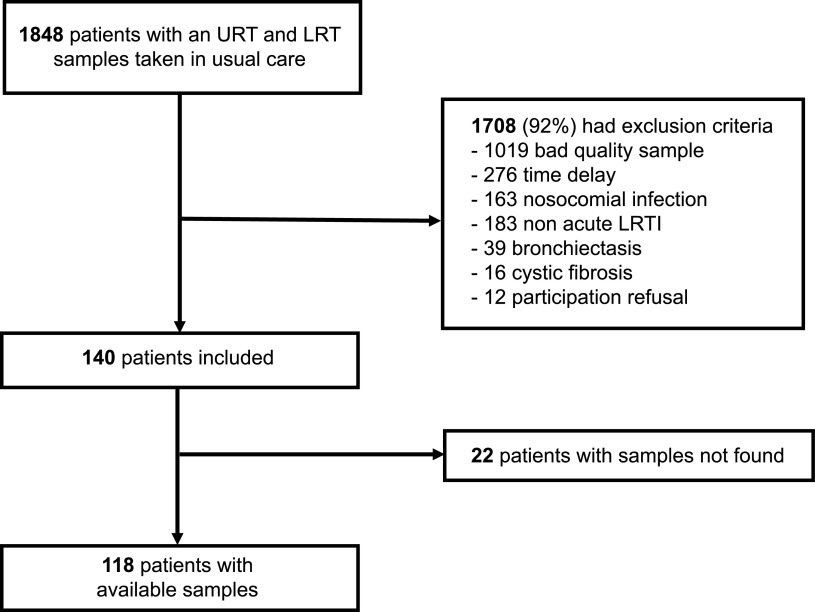
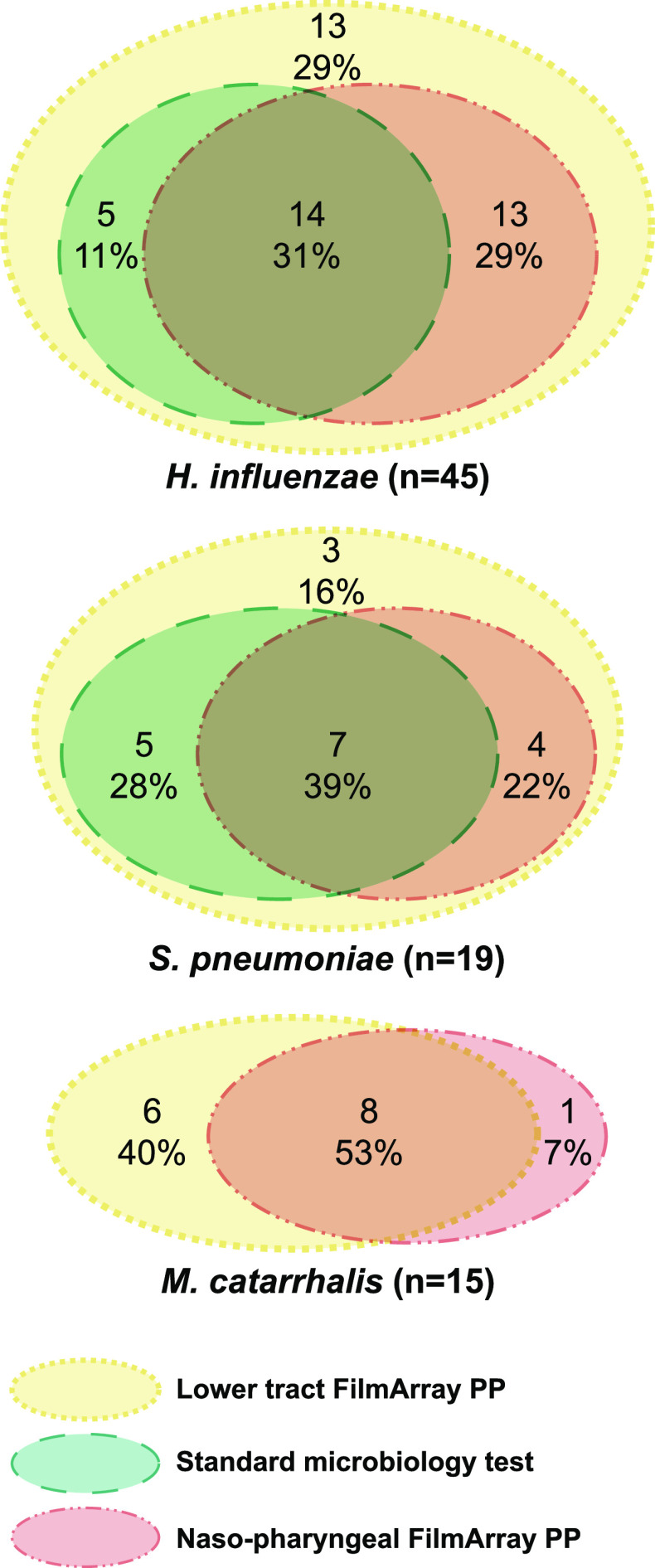
Timely identification of a pathogen in lower respiratory tract infections (LRTI) can support appropriate antibiotics use. The difficulty of obtaining lower respiratory tract (LRT) samples limits the utility of point-of-care syndromic molecular assays. We assessed the performance of the FilmArray Pneumonia plus panel (FilmArray PP) in nasopharyngeal (NP) swab for detection of Streptococcus pneumoniae, Haemophilus influenzae, and Moraxella catarrhalis. Patients in the study included retrospectively consenting adults who attended the emergency department of Lausanne University Hospital between February 2019 and August 2020 for a community-acquired LRTI, with available NP swab and a high-quality LRT sample. These samples were tested with the FilmArray PP (cutoff of ≥104 copies/mL). Positive (PPA) and negative percent agreement (NPA) of FilmArray PP in NP swab were calculated, using (i) FilmArray PP in LRT sample and (ii) standard microbiological tests as reference standards. To assess the performance of a lower detection cutoff, NP samples were also tested with an in-house PCR (cutoff of ≥10 copies/mL) for S. pneumoniae and H. influenzae. Overall, 118 patients were included. FilmArray PP in LRT sample and standard microbiology tests detected S. pneumoniae in 19/118 and 12/118, H. influenzae in 44/118 and 19/118, and M. catarrhalis in 14/118 and 0/118, respectively. Using LRT FilmArray PP as reference, PPA and NPA of FilmArray PP on NP were 58% and 100% for S. pneumoniae, 61% and 100% for H. influenzae, and 57% and 99% for M. catarrhalis. Using standard diagnostic tests as reference, PPA and NPA were 58% and 96% for S. pneumoniae, 74% and 87% for H. influenzae, and indefinite and 92% for M. catarrhalis. Using a lower cutoff on NP (≥102 copies/mL), PPA was 68% for S. pneumoniae and 77% for H. influenzae with LRT FilmArray PP as reference. FilmArray PP in NP swabs has a limited PPA for identifying the most common etiologies of community-acquired LRTI irrespective of the reference standard, preventing its use for withholding antibiotics. The PCR detection cutoff does not explain the low PPA. The excellent NPA suggests the use of NP PCR results for rapidly targeted antimicrobial therapy. IMPORTANCE Timely identification of a pathogen in patients with lower respiratory tract infections is of paramount importance to avoid inappropriate antibiotic prescription. We aimed to evaluate the performance of a rapid syndromic molecular assay in nasopharyngeal swabs for identifying the most common bacterial causes of lower respiratory tract infections in adults (Streptococcus pneumoniae, Haemophilus influenzae, and Moraxella catarrhalis). Our data show that nasopharyngeal molecular assay has a good concordance with lower respiratory tract sample when positive but not when negative. A positive result is therefore concordant with a lower respiratory tract infection and can be used to target antibiotics. Nevertheless, a negative result does not have a good concordance, so it cannot be used to withhold antibiotics. Our findings illustrate the potential utility of these easily collected samples for the management of patients with lower respiratory tract infections.
Keywords: FilmArray; Haemophilus influenzae; Moraxella catarrhalis; NP; PCR; POCT; Streptococcus pneumoniae; diagnostics; molecular diagnostics; pneumonia.
Conflict of interest statement
The authors declare no conflict of interest.
Figures
References
-
- Federal Office of Public Health and Federal Food Safety and Veterinary Office. 2020. Swiss antibiotic resistance report 2020. Usage of antibiotics and occurrence of antibiotic resistance in Switzerland. Federal Office of Public Health and Federal Food Safety and Veterinary Office, Bern, Switzerland.
-
- Carugati M, Aliberti S, Sotgiu G, Blasi F, Gori A, Menendez R, Encheva M, Gallego M, Leuschner P, Ruiz-Buitrago S, Battaglia S, Fantini R, Pascual-Guardia S, Marin-Corral J, Restrepo MI, GLIMP Collaborators . 2020. Bacterial etiology of community-acquired pneumonia in immunocompetent hospitalized patients and appropriateness of empirical treatment recommendations: an international point-prevalence study. Eur J Clin Microbiol Infect Dis 39:1513–1525. doi: 10.1007/s10096-020-03870-3. - DOI - PMC - PubMed
-
- Jain S, Self WH, Wunderink RG, Fakhran S, Balk R, Bramley AM, Reed C, Grijalva CG, Anderson EJ, Courtney DM, Chappell JD, Qi C, Hart EM, Carroll F, Trabue C, Donnelly HK, Williams DJ, Zhu Y, Arnold SR, Ampofo K, Waterer GW, Levine M, Lindstrom S, Winchell JM, Katz JM, Erdman D, Schneider E, Hicks LA, McCullers JA, Pavia AT, Edwards KM, Finelli L, CDC EPIC Study Team . 2015. Community-acquired pneumonia requiring hospitalization among U.S. adults. N Engl J Med 373:415–427. doi: 10.1056/NEJMoa1500245. - DOI - PMC - PubMed
-
- Woodhead M, Blasi F, Ewig S, Garau J, Huchon G, Ieven M, Ortqvist A, Schaberg T, Torres A, van der Heijden G, Read R, Verheij TJM, Joint Taskforce of the European Respiratory Society and European Society for Clinical Microbiology and Infectious Diseases . 2011. Guidelines for the management of adult lower respiratory tract infections–full version. Clin Microbiol Infect 17 Suppl 6:E1–E59. doi: 10.1111/j.1469-0691.2011.03672.x. - DOI - PMC - PubMed
Publication types
MeSH terms
Substances
LinkOut - more resources
Full Text Sources
Medical
Miscellaneous
