


Impacts of artificial light at night in marine ecosystems-A review
- PMID: 35583661
- PMCID: PMC9540822
- DOI: 10.1111/gcb.16264
Impacts of artificial light at night in marine ecosystems-A review
Abstract
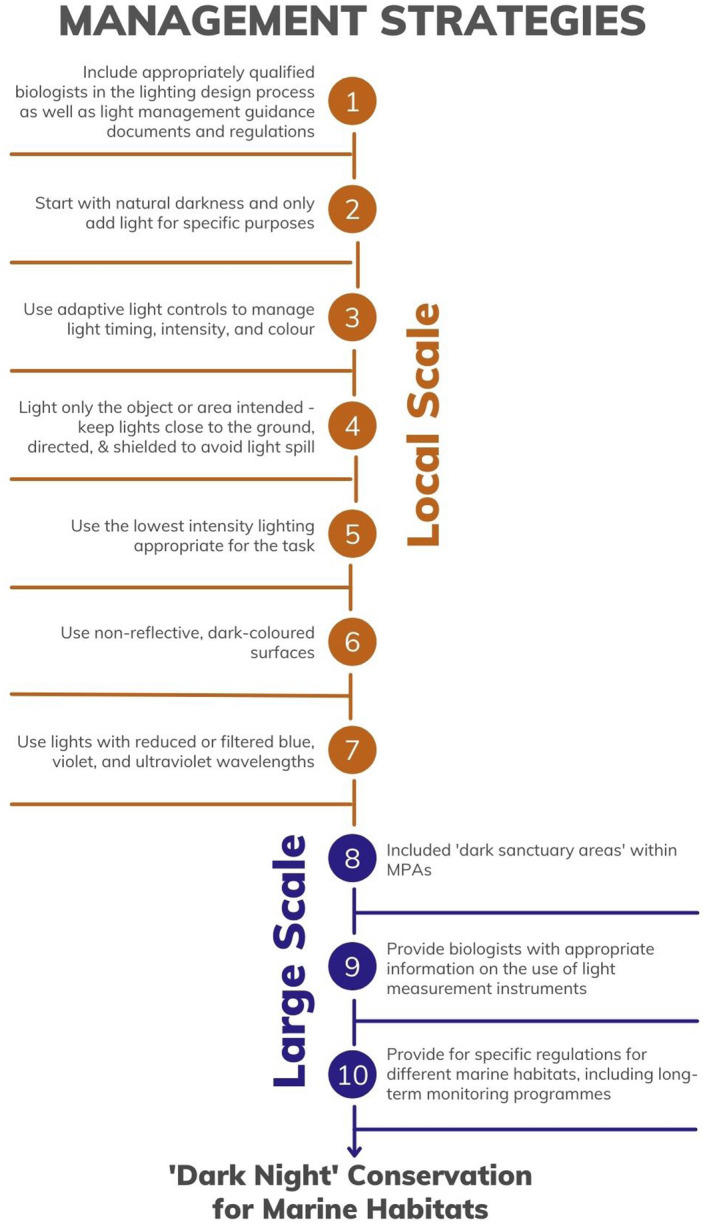
The globally widespread adoption of Artificial Light at Night (ALAN) began in the mid-20th century. Yet, it is only in the last decade that a renewed research focus has emerged into its impacts on ecological and biological processes in the marine environment that are guided by natural intensities, moon phase, natural light and dark cycles and daily light spectra alterations. The field has diversified rapidly from one restricted to impacts on a handful of vertebrates, to one in which impacts have been quantified across a broad array of marine and coastal habitats and species. Here, we review the current understanding of ALAN impacts in diverse marine ecosystems. The review presents the current state of knowledge across key marine and coastal ecosystems (sandy and rocky shores, coral reefs and pelagic) and taxa (birds and sea turtles), introducing how ALAN can mask seabird and sea turtle navigation, cause changes in animals predation patterns and failure of coral spawning synchronization, as well as inhibition of zooplankton Diel Vertical Migration. Mitigation measures are recommended, however, while strategies for mitigation were easily identified, barriers to implementation are poorly understood. Finally, we point out knowledge gaps that if addressed would aid in the prediction and mitigation of ALAN impacts in the marine realm.
Keywords: artificial light at night (ALAN); conservation guidelines; coral reefs; marine ecosystem; pelagic organisms; rocky intertidal shores; sandy beach; sea-turtles; seabirds.
© 2022 The Authors. Global Change Biology published by John Wiley & Sons Ltd.
Conflict of interest statement
Authors declare that they have no competing interests.
Figures
References
-
- ADSA . (2021). Retrieved from https://www.australasiandarkskyalliance.org/best‐practice‐lighting
-
- AS/NZS 4282:2019 . (2019). Control of the obtrusive effects of outdoor lighting. Standards Australia. Retrieved from https://infostore.saiglobal.com/en‐us/standards/as‐nzs‐4282‐2019‐1141358...
-
- Ainley, D. G. , Podolsky, R. , Deforest, L. , & Spencer, G. (2001). The status and population trends of the Newell's Shearwater on Kaua'i: Insights from modeling. Studies in Avian Biology, 22, 108–123.
-
- Arcos, J. M. , & Oro, D. (2002). Significance of nocturnal purse seine fisheries for seabirds: A case study off the Ebro Delta (NW Mediterranean). Marine Biology, 141, 277–286.
-
- Atchoi, E. , Mitkus, M. , & Rodríguez, A. (2020). Is seabird light‐induced mortality explained by the visual system development? Conservation Science and Practice, 2, e195. 10.1111/csp2.195 - DOI
Publication types
MeSH terms
LinkOut - more resources
Full Text Sources
