


The assembled and annotated genome of the masked palm civet (Paguma larvata)
- PMID: 35583674
- PMCID: PMC9116208
- DOI: 10.1093/gigascience/giac041
The assembled and annotated genome of the masked palm civet (Paguma larvata)
Abstract
Background: The masked palm civet (Paguma larvata) acts as an intermediate host of severe acute respiratory syndrome coronavirus (SARS-CoV), which caused SARS, and transfered this virus from bats to humans. Additionally, P. larvata has the potential to carry a variety of zoonotic viruses that may threaten human health. However, genome resources for P. larvata have not been reported to date.
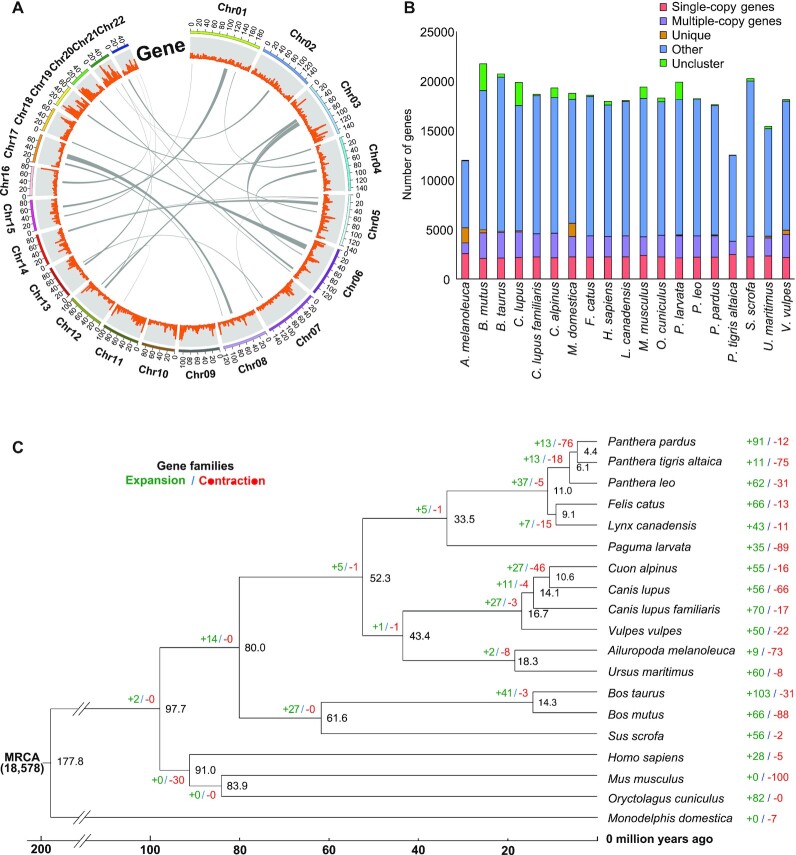
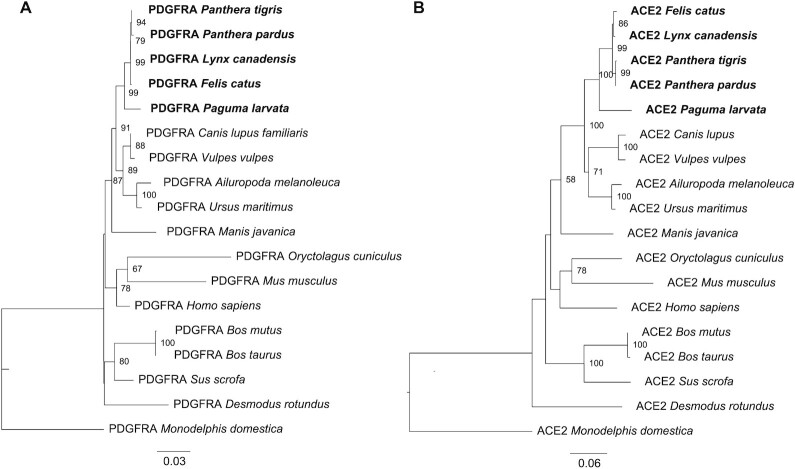
Findings: A chromosome-level genome assembly of P. larvata was generated using PacBio sequencing, Illumina sequencing, and Hi-C technology. The genome assembly was 2.44 Gb in size, of which 95.32% could be grouped into 22 pseudochromosomes, with contig N50 and scaffold N50 values of 12.97 Mb and 111.81 Mb, respectively. A total of 21,582 protein-coding genes were predicted, and 95.20% of the predicted genes were functionally annotated. Phylogenetic analysis of 19 animal species confirmed the close genetic relationship between P. larvata and species belonging to the Felidae family. Gene family clustering revealed 119 unique, 243 significantly expanded, and 58 significantly contracted genes in the P. larvata genome. We identified 971 positively selected genes in P. larvata, and one known human viral receptor gene PDGFRA is positively selected in P. larvata, which is required for human cytomegalovirus infection.
Conclusions: This high-quality genome assembly provides a valuable genomic resource for exploring virus-host interactions. It will also provide a reliable reference for studying the genetic bases of the morphologic characteristics, adaptive evolution, and evolutionary history of this species.
Keywords: Hi-C proximity mapping; gene family evolution; genome assembly; masked palm civet; phylogeny; positive selection.
© The Author(s) 2022. Published by Oxford University Press GigaScience.
Conflict of interest statement
The authors declare that the research described herein was conducted in the absence of any commercial or financial relationships that could be construed as a potential conflict of interest.
Figures
Similar articles
-
Chromosome-Scale Genome of Masked Palm Civet (Paguma larvata) Shows Genomic Signatures of Its Biological Characteristics and Evolution.Front Genet. 2022 Jan 21;12:819493. doi: 10.3389/fgene.2021.819493. eCollection 2021. Front Genet. 2022. PMID: 35126472 Free PMC article.
-
The complete mitochondrial genome of the masked palm civet (Paguma larvata, Mammalia, Carnivora).Mitochondrial DNA A DNA Mapp Seq Anal. 2016 Sep;27(5):3764-5. doi: 10.3109/19401736.2015.1079895. Epub 2015 Sep 25. Mitochondrial DNA A DNA Mapp Seq Anal. 2016. PMID: 26403137
-
Isolation and characterization of polymorphic microsatellite markers for the masked palm civet (Paguma larvata).Biochem Genet. 2008 Aug;46(7-8):392-7. doi: 10.1007/s10528-008-9157-7. Epub 2008 Mar 9. Biochem Genet. 2008. PMID: 18327669 Free PMC article.
-
Low genetic diversity in the masked palm civet Paguma larvata (Viverridae).J Zool (1987). 2009 Jul;278(3):218-230. doi: 10.1111/j.1469-7998.2009.00570.x. Epub 2009 Apr 17. J Zool (1987). 2009. PMID: 32336891 Free PMC article.
-
Origins and founder effects on the Japanese masked palm civet Paguma larvata (Viverridae, Carnivora), revealed from a comparison with its molecular phylogeography in Taiwan.Zoolog Sci. 2010 Jun;27(6):499-505. doi: 10.2108/zsj.27.499. Zoolog Sci. 2010. PMID: 20528157
Cited by
-
Multiomics and bioinformatics identify differentially expressed effectors in the brain of Toxoplasma gondii infected masked palm civet.Front Cell Infect Microbiol. 2023 Sep 25;13:1267629. doi: 10.3389/fcimb.2023.1267629. eCollection 2023. Front Cell Infect Microbiol. 2023. PMID: 37818043 Free PMC article.
References
-
- Iwami S, Takeuchi Y, Liu X. Avian flu pandemic: can we prevent it?. J Theor Biol. 2009;257(1):181–90. - PubMed
-
- Siddiqui AA. The global threat of bird (avian) flu its treatment methods and public health preventive measures. SOJ Vet Sci. 2018; 4(3):1–4.
-
- Dixon L K, Sun H, Roberts H. African swine fever. Antiviral Res. 2019;165:34–41. - PubMed
-
- Rota PA, Oberste MS, Monroe SS et al. Characterization of a novel coronavirus associated with severe acute respiratory syndrome. Science. 2003;300(5624):1394–9. - PubMed
Publication types
MeSH terms
LinkOut - more resources
Full Text Sources
Miscellaneous
