doi: 10.1056/NEJMc2202879.
Epub 2022 May 18.
Omicron BA.1/1.1 SARS-CoV-2 Infection among Vaccinated Canadian Adults
Collaborators,
Affiliations
- PMID: 35584302
- PMCID: PMC9165561
- DOI: 10.1056/NEJMc2202879
Item in Clipboard
Omicron BA.1/1.1 SARS-CoV-2 Infection among Vaccinated Canadian Adults
N Engl J Med.
.
No abstract available
Figures
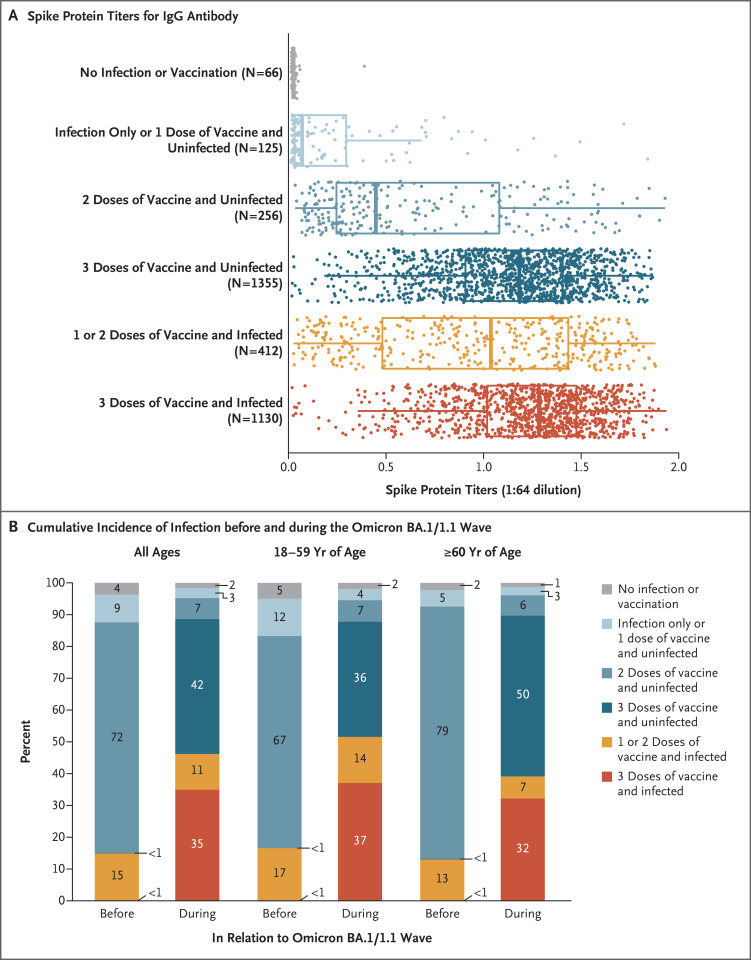
Shown are spike titers, which represent the relative ratios of IgG antibody values against the spike protein to the control samples (Section S1 in the Supplementary Appendix), with stratification according to infection and vaccination status in Canadian adults (Panel A) and the age-specific cumulative incidence of infection in each stratum of previous infection and vaccination before and during the omicron BA.1/1.1 variant wave (Panel B). Dots represent participants who received their last dose of vaccine (or were unvaccinated) at least 1 month before dried-blood-spot samples were obtained. (A total of 3344 participants had complete information available as of the time of analyses after the exclusion of 21 low-quality samples.) In the box-and-whisker plots, the solid line represents the median, the box represents the interquartile range, and the whiskers represent 1.5 times the interquartile range. Results with the use of the receptor-binding domain antigen were similar to those with the spike protein (Fig. S3). The cumulative incidences of Canadian adults in each category of vaccination and infection (assessed on the basis of nucleocapsid protein positivity or molecular or antigen rapid testing) were drawn from the groups of 3481 participants in phase 3 (before the omicron BA.1/1.1 wave) and 4032 participants in phase 4 (during the omicron BA.1/1.1 wave, with a reference period starting December 1, 2021) for whom complete testing, vaccination, and antibody data were available by the time of the analyses. The first column in the overall and age-specific sets represents the antibody and viral test positivity for the entire period before the omicron BA.1/1.1 wave, and the second column represents the values during the omicron BA.1/1.1 wave. Percentages may not total 100 because of rounding.
References
-
- Ritchie H, Mathieu E, Rodés-Guirao L, et al. Coronavirus pandemic (COVID-19). Our World In Data, 2022. (https://ourworldindata.org/coronavirus).
-
- Colwill K, Galipeau Y, Stuible M, et al. A “made-in-Canada” serology solution for profiling humoral immune responses to SARS-CoV-2 infection and vaccination. October 26, 2021. (https://www.medrxiv.org/content/10.1101/2021.10.25.21265476v1). preprint. - PMC - PubMed
Publication types
MeSH terms
Substances
Supplementary concepts
Grants and funding
LinkOut - more resources
Full Text Sources
Medical
Miscellaneous