


Effect of sedative premedication with oral midazolam on postanesthesia care unit delirium in older adults: a secondary analysis following an uncontrolled before-after design
- PMID: 35585564
- PMCID: PMC9118741
- DOI: 10.1186/s13741-022-00253-4
Effect of sedative premedication with oral midazolam on postanesthesia care unit delirium in older adults: a secondary analysis following an uncontrolled before-after design
Abstract
Background: Sedative premedication with benzodiazepines has been linked with prolonged recovery and inadequate emergence during the immediate postoperative period. We aimed to analyze the association between postanesthesia care unit (PACU) delirium and sedative premedication with oral midazolam.
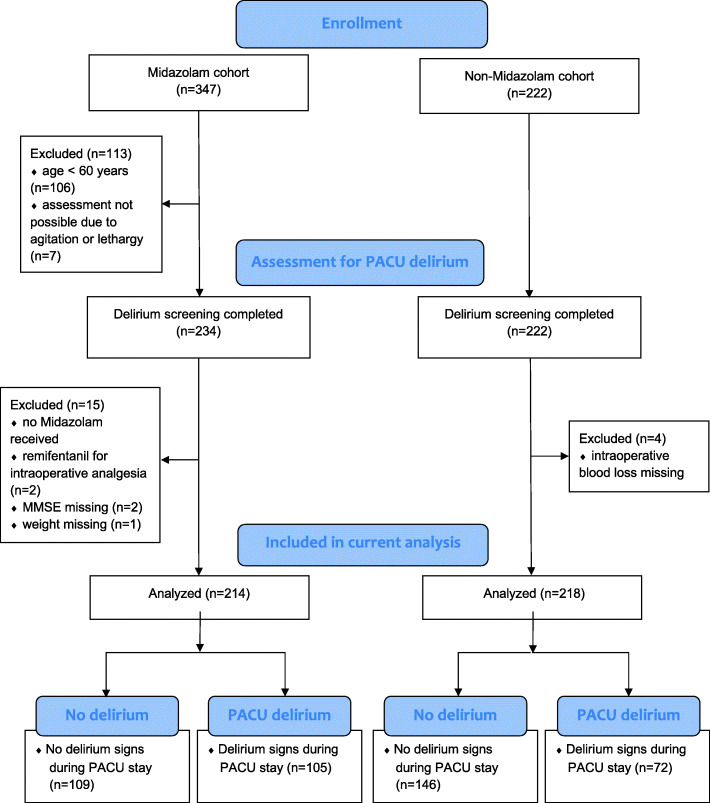
Methods: We performed a secondary analysis of prospectively collected data before (midazolam cohort) and after (non-midazolam cohort) implementation of a restrictive strategy for oral premedication with midazolam. From March 2015 until July 2018, we included patients 60 years and older, who underwent elective radical prostatectomy for prostate cancer. Exclusion criteria were contraindications to premedication with midazolam, preoperative anxiety, and a history of neurological disorders. Patients, who were scheduled for postoperative admission to the intensive care unit, were excluded. Between 2015 and 2016, patients received 7.5 mg oral midazolam preoperatively (midazolam cohort). Patients included between 2017 and 2018 did not receive any sedative medication preoperatively (non-midazolam cohort). The primary endpoint was the incidence of PACU delirium.
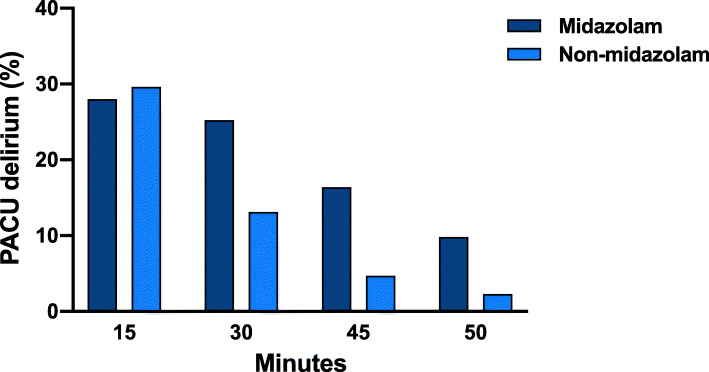
Results: PACU delirium rates were 49% in the midazolam cohort (n = 214) and 33% in the non-midazolam cohort (n = 218). This difference was not statistically significant on multivariable logistic regression analysis (OR 0.847 [95% CI 0.164; 4.367]; P = 0.842). Age (OR 1.102 [95% CI 1.050; 1.156]; P < 0.001), the cumulative dose of sufentanil (OR 1.014 [95% CI 1.005; 1.024]; P = 0.005), and propofol-sufentanil for anesthesia maintenance (OR 2.805 [95% CI 1.497; 5.256]; P = 0.001) were significantly associated with PACU delirium.
Conclusion: Midazolam for sedative premedication was not significantly associated with PACU delirium. The reduction in the incidence of PACU delirium throughout the study period may be attributable to improvements in perioperative management other than a more restrictive preoperative benzodiazepine administration.
Keywords: Anesthesia; Benzodiazepines; Delirium; Perioperative care; Premedication.
© 2022. The Author(s).
Conflict of interest statement
The authors declare that they have no competing interests.
Figures
References
-
- American Psychiatric Association. Diagnostic and Statistical Manual of Mental Disorders [Internet]. Fifth Edition. American Psychiatric Association; 2013. Available from: https://psychiatryonline.org/doi/book/10.1176/appi.books.9780890425596. Cited 2020 Sep 24. - DOI
-
- Beck S, Hoop D, Ragab H, Rademacher C, Meßner-Schmitt A, von Breunig F, et al. Postanesthesia care unit delirium following robot-assisted vs open retropubic radical prostatectomy: A prospective observational study. Int J Med Robot Comput Assist Surg. 2020;16(3):e2094. doi: 10.1002/rcs.2094. - DOI - PubMed
-
- Beck S, Zins L, Holthusen C, Rademacher C, von Breunig F, Tennstedt P, et al. Comparison of cognitive function after robot-assisted prostatectomy and open retropubic radical prostatectomy: a prospective observational single-center study. Urology. 2020;1(139):110–117. doi: 10.1016/j.urology.2019.12.045. - DOI - PubMed
Grants and funding
LinkOut - more resources
Full Text Sources
