


The efficacy and safety of fingolimod plus standardized treatment versus standardized treatment alone for acute ischemic stroke: A systematic review and meta-analysis
- PMID: 35585652
- PMCID: PMC9117458
- DOI: 10.1002/prp2.972
The efficacy and safety of fingolimod plus standardized treatment versus standardized treatment alone for acute ischemic stroke: A systematic review and meta-analysis
Abstract
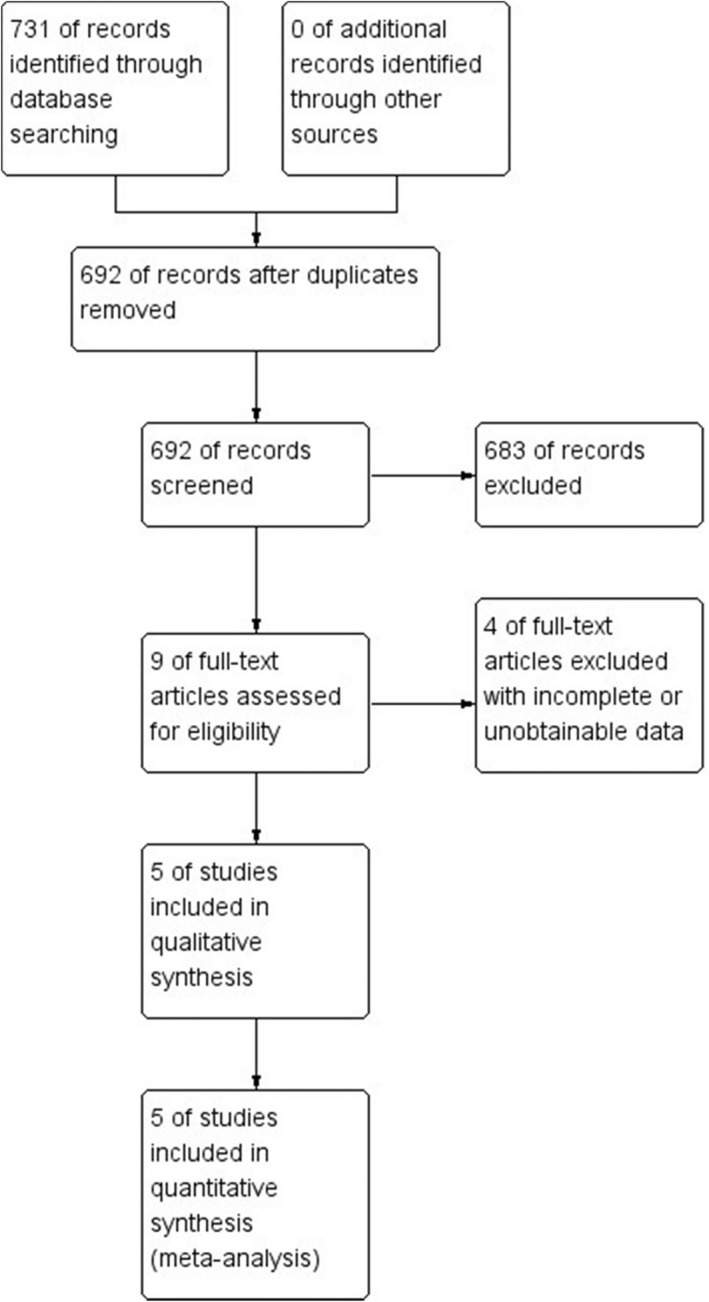
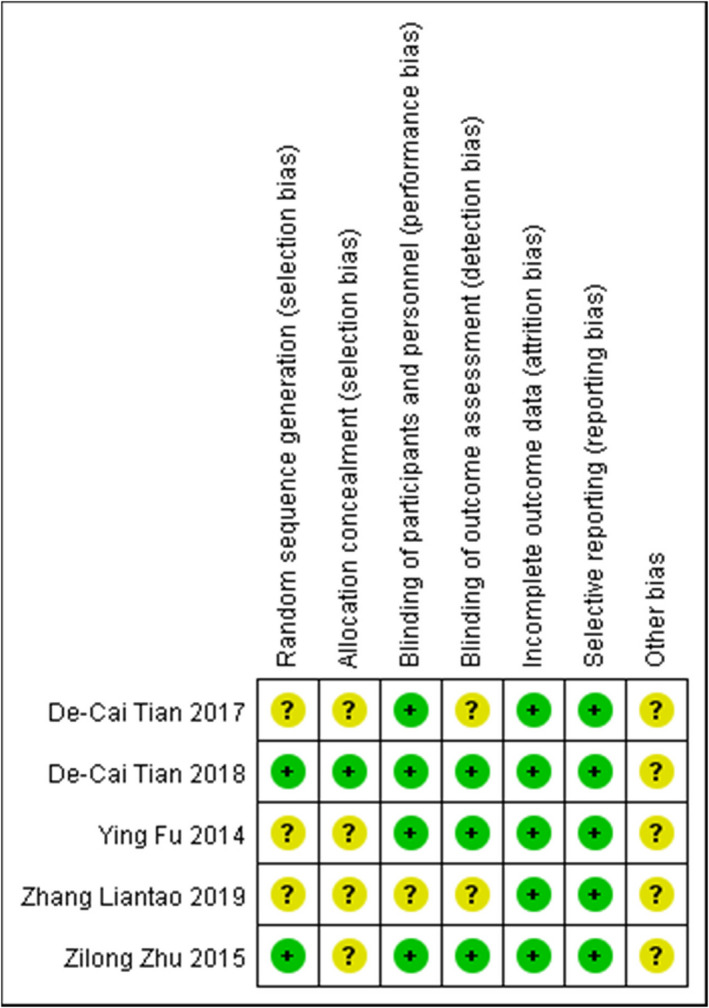
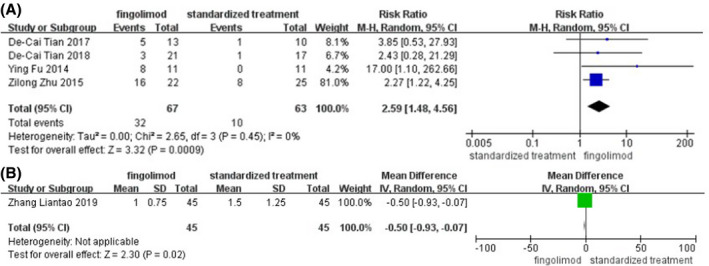
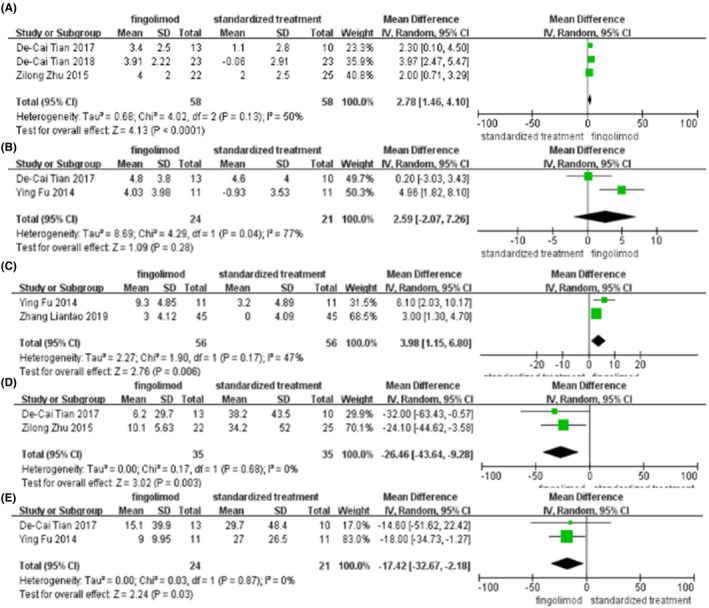
Acute ischemic stroke (AIS) is the most common type of stroke. Fingolimod is a sphingosine analog that acts on sphingosine-1-phosphate receptors (S1PR). Recently, the safety and efficacy of fingolimod in both patients with intracerebral hemorrhage and patients with AIS have been investigated in proof-of-concept trials. In this review, we performed a meta-analysis to evaluate the efficacy and safety of fingolimod for AIS. This study was conducted according to the PRISMA (Preferred Reporting Items for Systemic review and Meta-Analysis) statement. We searched for publications on the PubMed, Embase, Cochrane Central Register of Controlled Trials, Clinical trials, CNKI, Wanfang Data, VIP, CBM up to August 2021. We compiled five studies; a main meta-analysis forest plots were conducted for the values of the proportion of patients whose modified Rankin scale (MRS) score was 0-1 at day 90. There were heterogeneities in each study; the method of sensitivity analysis was performed. A sensitivity analysis was performed with a mean difference (MD) of the efficacy of fingolimod plus standardized treatment versus standardized treatment alone. Random effect model is used for meta-analysis regardless of the I2 index. The analysis was carried out for categorical variables using the risk ratio (RR), LogRR, and its 95% CI. The methodological quality of each randomized controlled trial (RCTs) was assessed according to the Cochrane Collaboration tool to assess the risk of bias (ROB). A meta-analysis of five studies with 228 participants was conducted. The risk ratio of patients whose MRS score was 0-1 at day 90 between fingolimod plus standardized treatment and standardized treatment alone was 2.59 (95%CI, 1.48-4.56). The Fingolimod plus standard treatment group decreased infarct growth and improved clinical function than the standard treatment.
Keywords: acute ischemic stroke; fingolimod; meta-analysis; modified rankin scale.
© 2022 The Authors. Pharmacology Research & Perspectives published by John Wiley & Sons Ltd, British Pharmacological Society and American Society for Pharmacology and Experimental Therapeutics.
Conflict of interest statement
The authors declare no conflict of interest.
Figures
References
-
- Liantao Z, Jing Z, Lingling L, Hua L. Efficacy of fingolimod combined with alteplase in acute ischemic stroke and rehabilitation nursing. Pa J Pharm Sci. 2019;32(1(Special)):413–419. - PubMed
-
- Fu Y, Hao J, Zhang N, et al. Fingolimod for the treatment of intracerebral hemorrhage: a 2‐arm proof‐of‐concept study. JAMA Neurology. 2014;71(9):1092‐1101. - PubMed
-
- Hacke W, Kaste M, Bluhmki E, et al. Thrombolysis with alteplase 3 to 4.5 hours after acute ischemic stroke. N Engl J Med. 2008;359(13):1317‐1329. - PubMed
-
- Lees KR, Bluhmki E, von Kummer R, et al. Time to treatment with intravenous alteplase and outcome in stroke: an updated pooled analysis of ECASS, ATLANTIS, NINDS, and EPITHET trials. Lancet. 2010;375(9727):1695‐1703. - PubMed
-
- Chamorro Á, Meisel A, Planas AM, Urra X, van de Beek D, Veltkamp R. The immunology of acute stroke. Nat Rev Neurol. 2012;8(7):401‐410. - PubMed
Publication types
MeSH terms
Substances
LinkOut - more resources
Full Text Sources
Medical
