


Subconjunctival human dirofilariasis by Dirofilaria repens in the Mediterranean Basin
- PMID: 35586152
- PMCID: PMC9108447
- DOI: 10.1016/j.ajoc.2022.101570
Subconjunctival human dirofilariasis by Dirofilaria repens in the Mediterranean Basin
Abstract
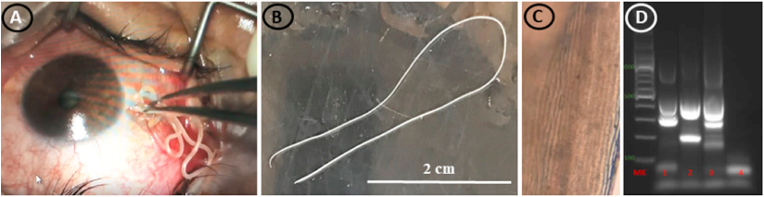
Purpose: Human dirofilariasis cases have increased in Europe for the last few decades. We document an autochthonous case of dirofilariasis infection in the subconjunctival space of a 60-year-old Spanish man.
Observations: The patient presented with pain in his right eye, which was diagnosed as epi-scleritis. In spite of the treatment administered, no improvement was reported. An external exam showed conjunctival congestion on the temporal part of the right eye bulbar conjunctiva. The anterior chamber showed no flare or cells in both eyes and dilated fundus exam was normal. Nevertheless, a long whitish vermiform mobile mass was detected under the conjunctiva in the temporal part of the right eye. The worm was surgically removed and diagnosed morphologically and also molecularly as Dirofilaria repens. This species uses dogs and wild canids as definitive hosts and principal reservoirs, while mosquito species are transmitters. Humans act as accidental hosts, and clinical manifestations depend on the location of the worm in the organs and tissues.
Conclusions and importance: The correct diagnosis and control of subcutaneous/ocular dirofilariasis by D. repens require several professionals under the One Health approach to deal with this zoonotic disease, which poses a serious public health problem, at least in the Mediterranean Basin.
Keywords: Dirofilaria repens; Human infection; Subconjunctival dirofilariasis.
© 2022 The Authors.
Conflict of interest statement
The authors declare no conflict of interest.
Figures
References
-
- Gioia G., Lecová L., Genchi M., Ferri E., Genchi C., Mortarino M. Highly sensitive multiplex PCR for simultaneous detection and discrimination of Dirofilaria immitis and Dirofilaria repens in canine peripheral blood. Vet Parasitol. 2010;172:160–163. - PubMed
-
- Bueno-Marí R., Bernués-Bañeres A., Jiménez-Peydró R. Updated checklist and distribution maps of mosquitoes (Diptera: Culicidae) of Spain. Eur Mosq Bull. 2012;30:91–126.
Publication types
LinkOut - more resources
Full Text Sources
