


Overweight and obesity among children and adolescents in Germany. Results of the cross-sectional KiGGS Wave 2 study and trends
- PMID: 35586172
- PMCID: PMC8848784
- DOI: 10.17886/RKI-GBE-2018-022.2
Overweight and obesity among children and adolescents in Germany. Results of the cross-sectional KiGGS Wave 2 study and trends
Abstract
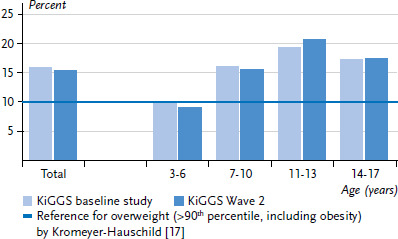
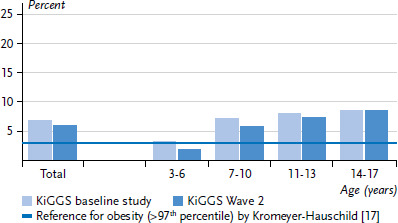
For some time, there have been indications that the prevalence of overweight and obesity among children and adolescents in Germany has stabilised at a high level. The second wave of the German Health Interview and Examination Survey for Children and Adolescents (KiGGS Wave 2, 2014-2017) once again provides nationwide measurements on height and weight of children and adolescents aged 3 to 17 years. The results are confirming this trend. The prevalence of overweight is 15.4% and 5.9% for obesity. There are no differences between girls and boys. Overweight and obesity prevalence increases with age. Children and adolescents with low socioeconomic status (SES) are more likely to be overweight and obese than those with high SES. Compared to the KiGGS baseline study (2003-2006), there was no further increase in overweight and obesity prevalence overall and in all age groups.
Keywords: EXAMINATION SURVEY; HEALTH MONITORING; KIGGS; OBESITY; OVERWEIGHT.
© Robert Koch Institute. All rights reserved unless explicitly granted.
Conflict of interest statement
Conflicts of interest The authors declared no conflicts of interest.
Figures
Erratum for
- J Health Monit. 3:15-22.
References
-
- Llewellyn A, Simmonds M, Owen CG, et al. (2016) Childhood obesity as a predictor of morbidity in adulthood: a systematic review and meta-analysis. Obes Rev 17(1):56-67 - PubMed
-
- Tsiros MD, Olds T, Buckley JD, et al. (2009) Health-related quality of life in obese children and adolescents. Int J Obes (Lond) 33(4):387-400 - PubMed
-
- Puhl RM, King KM. (2013) Weight discrimination and bullying. Best Pract Res Clin Endocrinol Metab 27(2):117-127 - PubMed
LinkOut - more resources
Full Text Sources