


Selecting and defining indicators for diabetes surveillance in Germany
- PMID: 35586543
- PMCID: PMC8852787
- DOI: 10.17886/RKI-GBE-2018-063
Selecting and defining indicators for diabetes surveillance in Germany
Abstract
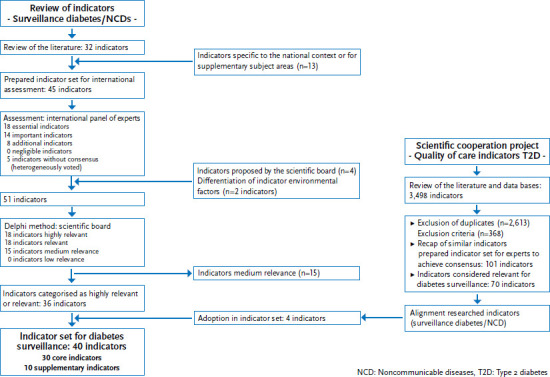
Mainly because of the large number of people affected and associated significant health policy implications, the Robert Koch Institute (RKI) is developing a public health surveillance system using diabetes as an example. In a first step to ensure long-term and comparable data collection and establish efficient surveillance structures, the RKI has defined a set of relevant indicators for diabetes surveillance. An extensive review of the available literature followed by a structured process of consensus provided the basis for a harmonised set of 30 core and 10 supplementary indicators. They correspond to the following four fields of activity: (1) reducing diabetes risk, (2) improving diabetes early detection and treatment, (3) reducing diabetes complications, (4) reducing the disease burden and overall costs of the disease. In future, in addition to the primary data provided by RKI health monitoring diabetes surveillance needs to also consider the results from secondary data sources. Currently, barriers to accessing this data remain, which will have to be overcome, and gaps in the data closed. The RKI intentends to continuously update this set of indicators and at some point apply it also to further chronic diseases with high public health relevance.
Keywords: DIABETES MELLITUS; INDICATORS; NCD; PUBLIC HEALTH; SURVEILLANCE.
© Robert Koch Institute. All rights reserved unless explicitly granted.
Conflict of interest statement
Conflicts of interest Joachim Szecsenyi is CEO and shareholder of the aQua Institute. For the other co-authors and for herself, the Corresponding author declares that there is no conflict of interest.
Figures
References
-
- Institute of Medicine (1988) The future of public health. National Academy Press. Washington, DC
-
- Centers for Disease Control and Prevention (2012) CDC’s Vision for Public Health Surveillance in the 21st Century. MMWR (61(Suppl; July 27)):1-40 - PubMed
-
- World Health Organization (2015) Integrated surveillance of non-communicable diseases (iNCD). Copenhagen, Denmark
-
- World Health Organization (2018) The 10 Essential Public Health Operations. http://www.euro.who.int/en/health-topics/Health-systems/public-health-se... (As at 16.02.2018)
-
- World Health Organization (2013) Global action plan for the prevention and control of noncommunicable diseases 2013-2020. WHO, Geneva
LinkOut - more resources
Full Text Sources