Association of Diabetes Medication With Open-Angle Glaucoma, Age-Related Macular Degeneration, and Cataract in the Rotterdam Study
- PMID: 35587864
- PMCID: PMC9121302
- DOI: 10.1001/jamaophthalmol.2022.1435
Association of Diabetes Medication With Open-Angle Glaucoma, Age-Related Macular Degeneration, and Cataract in the Rotterdam Study
Abstract
Importance: Recent studies suggest that the diabetes drug metformin has a protective effect on open-angle glaucoma (OAG) and age-related macular degeneration (AMD). However, studies have not addressed the critical issue of confounding by indication, and associations have not been evaluated in a large prospective cohort.
Objective: To determine the association between diabetes medication and the common eye diseases OAG, AMD, and cataract and to evaluate their cumulative lifetime risks in a large cohort study.
Design, setting, and participants: This cohort study included participants from 3 independent cohorts from the prospective, population-based Rotterdam Study between April 23, 1990, and June 25, 2014. Participants were monitored for incident eye diseases (OAG, AMD, cataract) and had baseline measurements of serum glucose. Data on diabetes medication use and data from ophthalmologic examinations were gathered.
Exposures: Type 2 diabetes (T2D) and the diabetes medications metformin, insulin, and sulfonylurea derivatives.
Main outcomes and measures: Diagnosis and cumulative lifetime risk of OAG, AMD, and cataract.
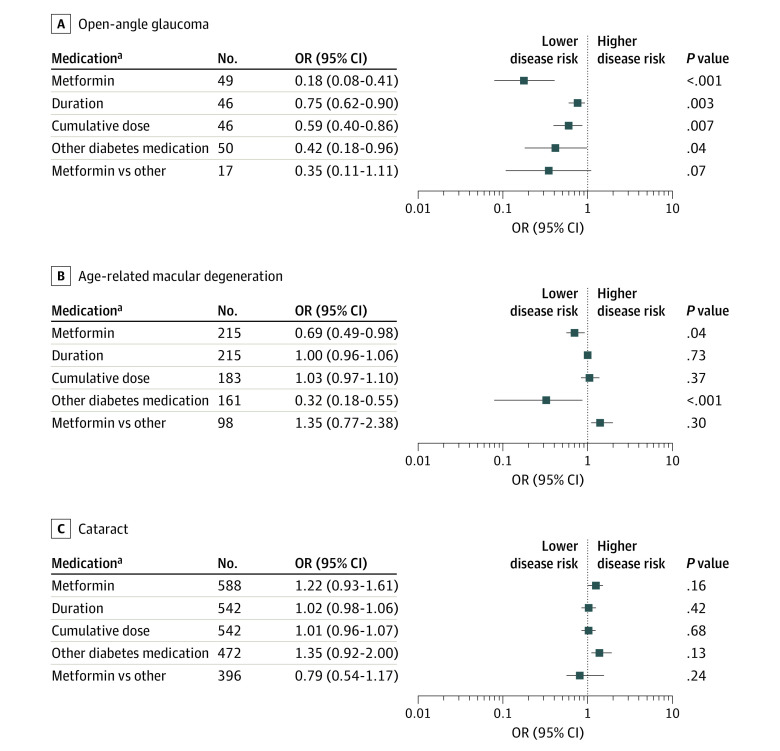
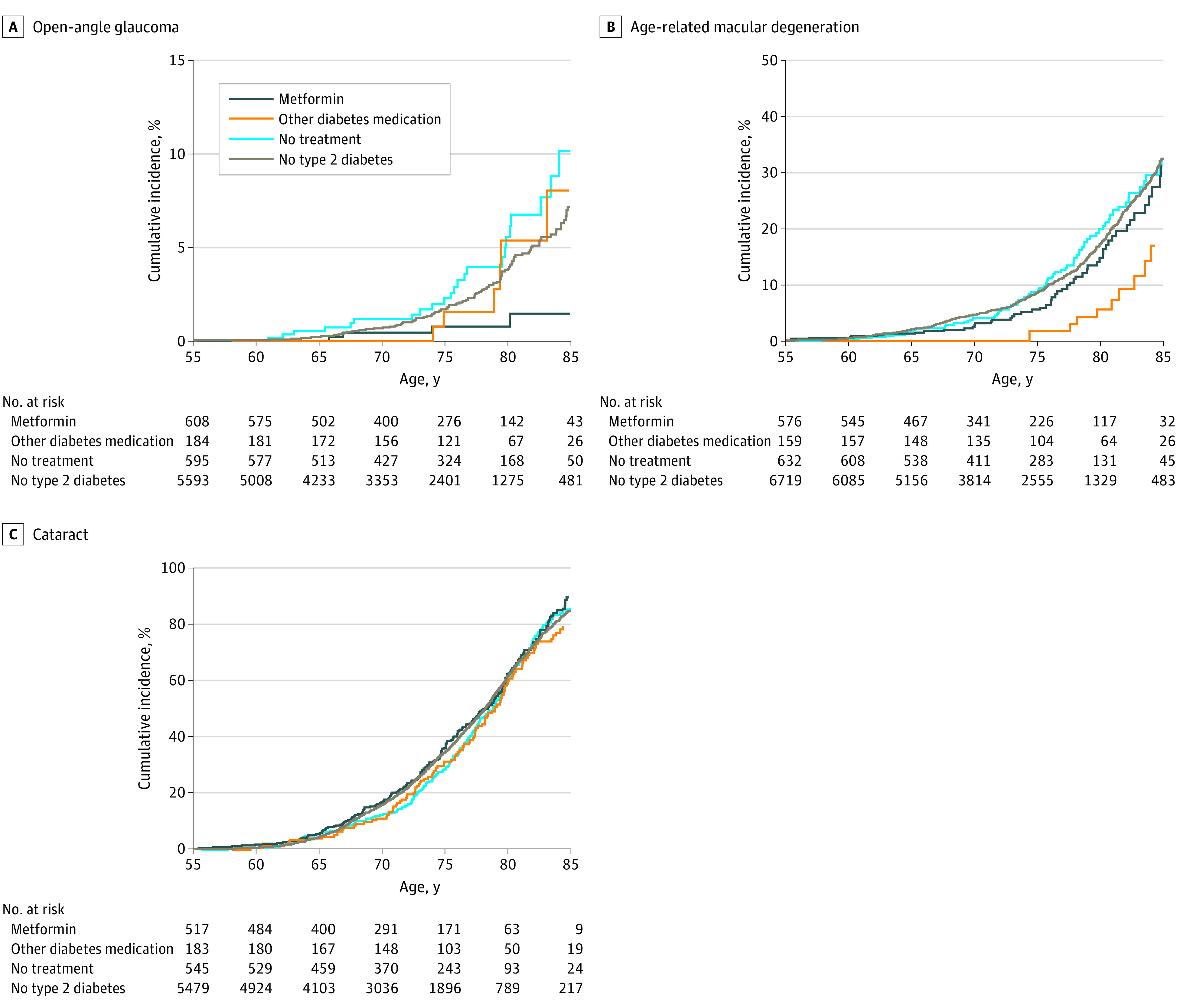
Results: This study included 11 260 participants (mean [SD] age, 65.1 [9.8]; 6610 women [58.7%]). T2D was diagnosed in 2406 participants (28.4%), OAG was diagnosed in 324 of 7394 participants (4.4%), AMD was diagnosed in 1935 of 10 993 participants (17.6%), and cataract was diagnosed in 4203 of 11 260 participants (37.3%). Untreated T2D was associated with a higher risk of OAG (odds ratio [OR], 1.50; 95% CI, 1.06-2.13; P = .02), AMD (OR, 1.35; 95% CI, 1.11-1.64; P = .003), and cataract (OR, 1.63; 95% CI, 1.39-1.92; P < .001). T2D treated with metformin was associated with a lower risk of OAG (OR, 0.18; 95% CI, 0.08-0.41; P < .001). Other diabetes medication (ie, insulin, sulfonylurea derivates) was associated with a lower risk of AMD (combined OR, 0.32; 95% CI, 0.18 to 0.55; P < .001). The cumulative lifetime risk of OAG was lower for individuals taking metformin (1.5%; 95% CI, 0.01%-3.1%) than for individuals without T2D (7.2%; 95% CI, 5.7%-8.7%); the lifetime risk of AMD was lower for individuals taking other diabetes medication (17.0%; 95% CI, 5.8%-26.8% vs 33.1%; 95% CI, 30.6%-35.6%).
Conclusions and relevance: Results of this cohort study suggest that, although diabetes was clearly associated with cataract, diabetes medication was not. Treatment with metformin was associated with a lower risk of OAG, and other diabetes medication was associated with a lower risk of AMD. Proof of benefit would require interventional clinical trials.
Conflict of interest statement
Figures
Comment in
-
A Call for Health Equity in Diabetic Care to Improve Eye Health.JAMA Ophthalmol. 2022 Jul 1;140(7):681-682. doi: 10.1001/jamaophthalmol.2022.1436. JAMA Ophthalmol. 2022. PMID: 35587338 No abstract available.
-
Diabetes Medication to Reduce Age-Related Eye Disorders Beyond Glucose Control.JAMA Ophthalmol. 2023 Apr 1;141(4):405. doi: 10.1001/jamaophthalmol.2022.6320. JAMA Ophthalmol. 2023. PMID: 36795384 No abstract available.
-
Diabetes Medication to Reduce Age-Related Eye Disorders Beyond Glucose Control-Reply.JAMA Ophthalmol. 2023 Apr 1;141(4):405-406. doi: 10.1001/jamaophthalmol.2022.6317. JAMA Ophthalmol. 2023. PMID: 36795385 No abstract available.
References
-
- GBD 2019 Blindness and Vision Impairment Collaborators; Vision Loss Expert Group of the Global Burden of Disease Study . Causes of blindness and vision impairment in 2020 and trends over 30 years, and prevalence of avoidable blindness in relation to VISION 2020: the Right to Sight: an analysis for the Global Burden of Disease Study. Lancet Glob Health. 2021;9(2):e144-e160. doi: 10.1016/S2214-109X(20)30489-7 - DOI - PMC - PubMed
Publication types
MeSH terms
Substances
LinkOut - more resources
Full Text Sources
Medical
Miscellaneous