Review
. 2022 Jul:115:103342.
doi: 10.1016/j.dnarep.2022.103342. Epub 2022 May 13.

New twists to the ALTernative endings at telomeres

Affiliations
Review

New twists to the ALTernative endings at telomeres

Ragini Bhargava et al. DNA Repair (Amst). 2022 Jul.

Abstract

Activation of a telomere maintenance mechanism is key to achieving replicative immortality. Alternative Lengthening of Telomeres (ALT) is a telomerase-independent pathway that hijacks the homologous recombination pathways to elongate telomeres. Commitment to ALT is often associated with several hallmarks including long telomeres of heterogenous lengths, mutations in histone H3.3 or the ATRX/DAXX histone chaperone complex, and incorporation of non-canonical telomere sequences. The consequences of these genetic and epigenetic changes include enhanced replication stress and the presence of transcriptionally permissive chromatin, which can result in replication-associated DNA damage. Here, we detail the molecular mechanisms that are critical to repairing DNA damage at ALT telomeres, including the BLM Helicase, which acts at several steps in the ALT process. Furthermore, we discuss the emerging findings related to the telomere-associated RNA, TERRA, and its roles in maintaining telomeric integrity. Finally, we review new evidence for therapeutic interventions for ALT-positive cancers which are rooted in understanding the molecular underpinnings of this process.

Keywords: ALT; Cancer; Chromatin; TERRA; Telomere.


Conflict of interest statement

Declaration of Competing Interest

The authors have no conflicts of interest to declare.

Figures
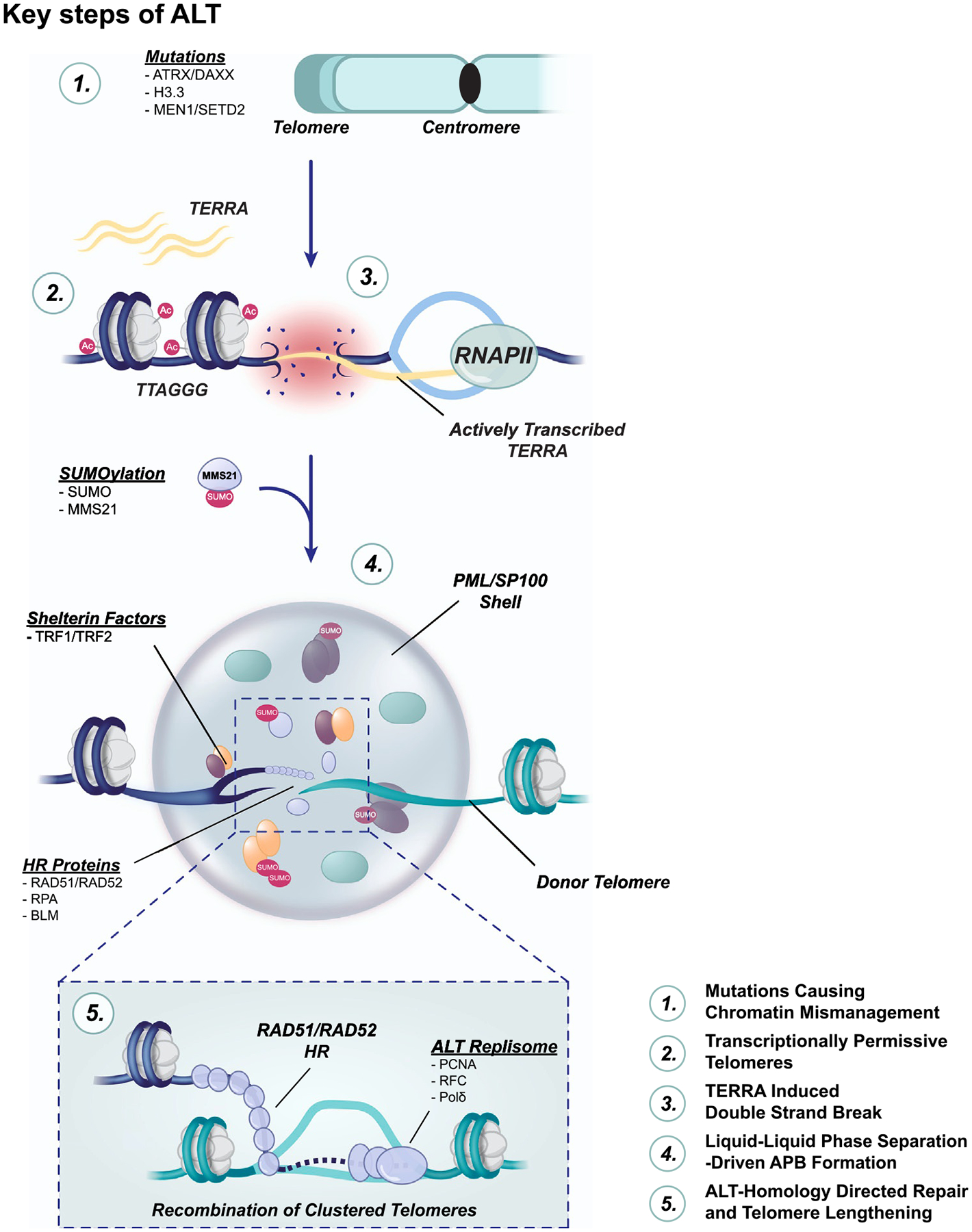
Fig. 1.
Fig. 1.
The key features and stages of ALT telomere maintenance. Mutations in chromatin modifiers ATRX-DAXX, histone H3.3, MEN1 and SETD2 are frequent in ALT cancer cells. As a result, decondensed chromatin at telomeres is rich in euchromatin histone marks (i.e., H3K9ac) and transcription of TERRA. TERRA can promote replication stress at ALT telomeres leading to collapsed replication forks and DNA breaks. Those broken telomeres are trafficked and encased in phase-separated condensates within the nucleus that are formed through SUMO-SIM interactions among PML, telomeric and HR proteins. These structures, ALT-associated PML bodies (APBs), seem to be integral for telomere DNA synthesis that follows RAD51 or RAD52 dependent homologous recombination that sets the stage for telomere extension by the ALT replisome: PCNA-RFC1–5-Polδ.
Fig. 2.
Fig. 2.
Outstanding Questions Surrounding TERRA. The telomeric-specific long noncoding RNA molecule, TERRA, has been linked to DNA repair, regulation of telomeric protein localization, as well as other cellular processes. Despite recent advances, certain aspects of TERRA regulation and activity remain unclear. A) It is unknown whether TERRA exerts its regulatory functions at telomeres as it is actively transcribed (in cis) or post-transcriptionally at other telomeres (in trans). B) TERRA transcription is posited to be initiated at many sub-telomeres. Characterization and classification of the specific sub-telomeres of origin will be crucial to understanding TERRA function. C) Telomeric DNA sequences can occur outside of telomeres (shown in orange). It is unknown whether mature TERRA can localize to these genomic regions and execute its regulatory roles. D) A comprehensive characterization of the factors necessary for RNA strand invasion and R-Loop formation is needed. Understanding the formation TERRA: DNA hybrids may provide key insight into the relationship between R-loops, DR-Loops, and ALT-specific HR.
Fig. 3.
Fig. 3.
Synthetic Lethality Strategies for ALT Cancers. (Top) FANCM-BLM Synthetic Lethality. ALT telomeres harbor DNA secondary structures that are difficult to replicate across, e.g., G4 quadruplexes, that can lead to the formation of stalled replication forks. FANCM is required for fork reversal and to facilitate fork restart. Loss of FANCM leads to fork collapse which needs to be repaired in a Bloom helicase (BLM)-dependent manner. Thus, combined FANCM and BLM deficiencies lead to a failure to repair collapsed form and loss of cellular viability. (Below) ALT/ATRX Synthetic Lethality. (Top left) Due to the prevalence of loss of function mutations in the ATRX/DAXX histone chaperone complex in ALT cancer cells, several strategies for targeting these cancers have been focused on developing synthetic lethality strategies for ATRX/DAXX deficiency. Evidence from sequencing analyses of neuroblastomas indicates that MYCN amplification is incompatible with ATRX/DAXX-deficiency. In fact, MYCN amplification in ATRX/DAXX-deficient cells results in DNA damage and mitochondrial dysfunction. (Top right) Both PARP inhibitors (PARPi), ATR inhibitors (ATRi) and Wee1 kinase inhibitors (Wee1i) are currently in clinical trials for different cancers due to their ability to induce replication-associated DNA damage and dampen the DNA repair response to stalled replication forks, respectively. ALT telomeres harbor transcriptionally permissive chromatin and replicative stress burden. Thus, combinatorial treatment of ATRX-deficient cells with both PARPi and ATRi amplifies the replication stress to toxic levels and limits cellular viability. Wee1 kinase inhibition may synergize with ATRX loss to impair the G2/M checkpoint leading to replicative stress. (Below Left) Newly synthesized telomeric DNA needs to be appropriately chromatinized before cell division. A recent study reported that the HIRA-complex is indispensable for depositing histone H3.3 in ATRX mutated ALT cancer cells. Thus, this compensatory complex has emerged as a possible therapeutic target. (Below Center) ATRX/DAXX-deficient are sensitive to infection by the ICP0-deficient Herpes Simplex Virus (HSV)– 1 since ATRX inhibits the expression of viral proteins. ATRX-deficient ALT cells also harbor specialized nuclear structures called ALT-associated PML bodies (APBs). (Below Right) TSPYL5 localizes to APBs and inhibits USP7, thus preventing the proteasomal degradation of POT1, a critical member of the Shelterin complex that ensures telomere integrity. Thus, depleting TSPYL5 causes a loss of viability of ALT cancer cells due to telomere destabilization.

References

    1. Maciejowski J, de Lange T, Telomeres in cancer: tumour suppression and genome instability, Nat. Rev. Mol. Cell Biol 18 (2017) 175–186, 10.1038/nrm.2016.171. - DOI - PMC - PubMed
    1. Nassour J, Radford R, Correia A, Fusté JM, Schoell B, Jauch A, et al., Autophagic cell death restricts chromosomal instability during replicative crisis, Nature 565 (2019) 659–663, 10.1038/s41586-019-0885-0. - DOI - PMC - PubMed
    1. Kim NW, Piatyszek MA, Prowse KR, Harley CB, West MD, Ho PL, et al., Specific association of human telomerase activity with immortal cells and cancer, Science 266 (1994) 2011–2015, 10.1126/science.7605428. - DOI - PubMed
    1. Bryan TM, Englezou A, Dalla-Pozza L, Dunham MA, Reddel RR, Evidence for an alternative mechanism for maintaining telomere length in human tumors and tumor-derived cell lines, Nat. Med 3 (1997) 1271–1274, 10.1038/nm1197-1271. - DOI - PubMed
    1. Lundblad V, Blackburn EH, An alternative pathway for yeast telomere maintenance rescues est1- senescence, Cell 73 (1993) 347–360, 10.1016/0092-8674(93)90234-h. - DOI - PubMed

Publication types

LinkOut - more resources
