


Black carbon aerosol number and mass concentration measurements by picosecond short-range elastic backscatter lidar
- PMID: 35589746
- PMCID: PMC9120489
- DOI: 10.1038/s41598-022-11954-7
Black carbon aerosol number and mass concentration measurements by picosecond short-range elastic backscatter lidar
Abstract
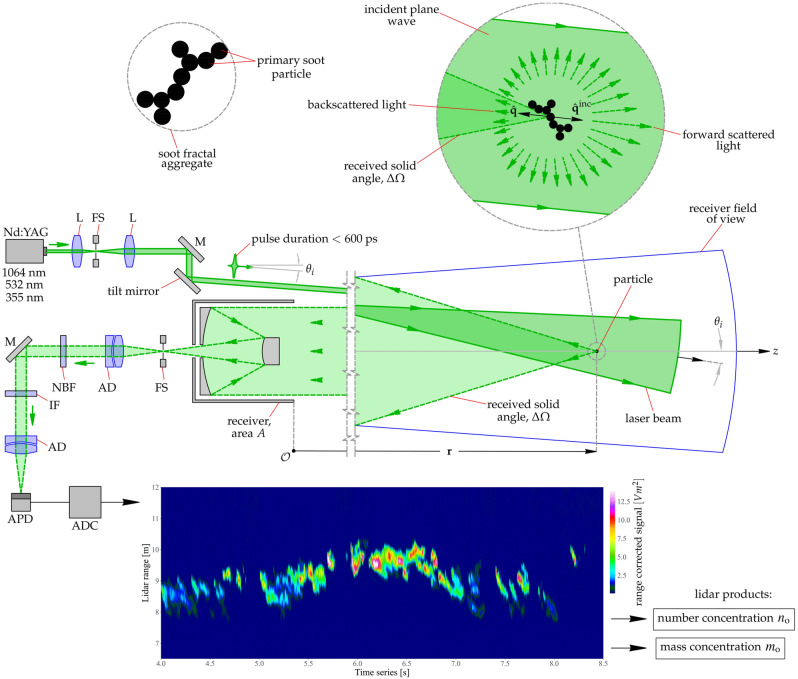
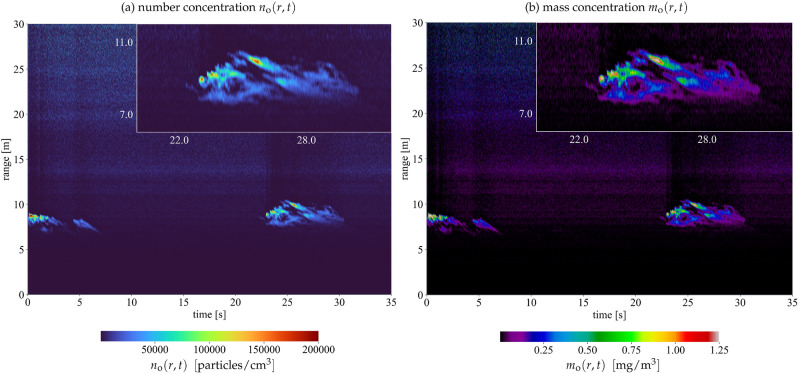
Black carbon aerosol emissions are recognized as contributors to global warming and air pollution. There remains, however, a lack of techniques to remotely measure black carbon aerosol particles with high range and time resolution. This article presents a direct and contact-free remote technique to estimate the black carbon aerosol number and mass concentration at a few meters from the emission source. This is done using the Colibri instrument based on a novel technique, referred to here as Picosecond Short-Range Elastic Backscatter Lidar (PSR-EBL). To address the complexity of retrieving lidar products at short measurement ranges, we apply a forward inversion method featuring radiometric lidar calibration. Our method is based on an extension of a well-established light-scattering model, the Rayleigh-Debye-Gans for Fractal-Aggregates (RDG-FA) theory, which computes an analytical expression of lidar parameters. These parameters are the backscattering cross-sections and the lidar ratio for black carbon fractal aggregates. Using a small-scale Jet A-1 kerosene pool fire, we demonstrate the ability of the technique to quantify the aerosol number and mass concentration with centimetre range-resolution and millisecond time-resolution.
© 2022. The Author(s).
Conflict of interest statement
The authors declare no competing interests.
Figures
References
-
- Bowman, D. M. J. S. et al. Fire in the earth system. Science. 324, 481–484, 10.1126/science.1163886. https://science.sciencemag.org/content/324/5926/481.full.pdf (2009). - PubMed
-
- Chýlek P, et al. Black carbon and absorption of solar radiation by clouds. J. Geophys. Res.: Atmos. 1996;101:23365–23371. doi: 10.1029/96JD01901. - DOI
-
- Bond TC, et al. Bounding the role of black carbon in the climate system: A scientific assessment. J. Geophys. Res.: Atmos. 2013;118:5380–5552. doi: 10.1002/jgrd.50171. - DOI
-
- Liu F, et al. Review of recent literature on the light absorption properties of black carbon: Refractive index, mass absorption cross section, and absorption function. Aerosol Sci. Technol. 2020;54:33–51. doi: 10.1080/02786826.2019.1676878. - DOI
-
- Cherian R, Quaas J, Salzmann M, Tomassini L. Black carbon indirect radiative effects in a climate model. Tellus B: Chem. Phys. Meteorol. 2017;69:1369342. doi: 10.1080/16000889.2017.1369342. - DOI
Grants and funding
LinkOut - more resources
Full Text Sources
