


Cannabis consumption and prosociality
- PMID: 35589766
- PMCID: PMC9119984
- DOI: 10.1038/s41598-022-12202-8
Cannabis consumption and prosociality
Abstract
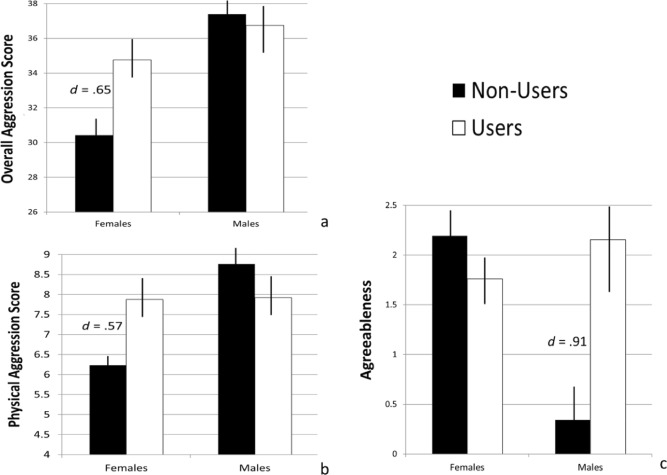
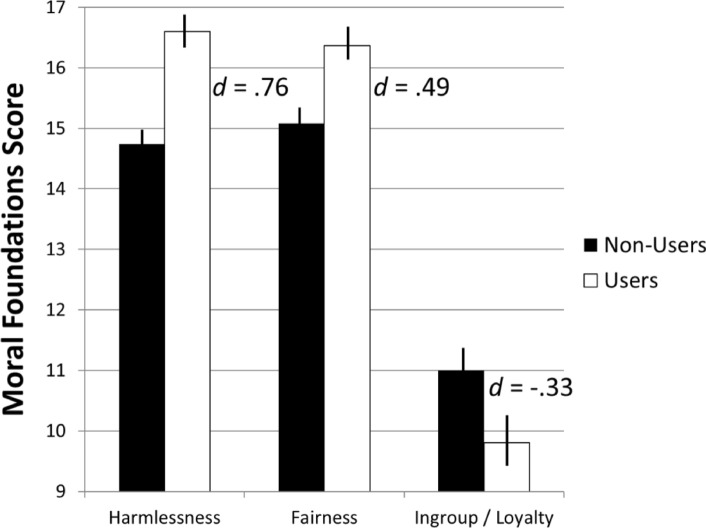
The existing literature largely focuses on health risks and other pharmacodynamics of using cannabis, with fewer investigations of other normative psychological effects from consumption among otherwise healthy people. We measured several basic constructs of social psychology corresponding to the concept of prosociality among 146 healthy young adults between 18 and 25 years (M = 18.9, SD = 1.4) with varying detectable levels of tetrahydrocannabinol (THC) in their urine, controlling for participant's sex, age, ethnicity, and childhood socio-economic status. Compared to THC-free individuals, cannabis users scored higher than non-users on validated measures of Prosocial Behaviors (d = .34, p = .04), the Empathy Quotient (d = .36, p < .01), Moral Harmlessness (d = .76, p < .01) and Moral Fairness (d = .49, p < .01), but exhibited a lower sense of Ingroup Loyalty (d = .33, p = .04). Relative to THC-free, same-sex individuals, female cannabis users scored significantly higher on measurements of Aggression (ds = .65 and .57, ps < .05) and male users scored higher on the Agreeableness dimension of personality (d = .91, p < .01).. Linear associations were found between the recency of last cannabis usage and the Prosocial Behaviors, Empathy Quotient, Moral Harmlessness, Moral Fairness and Agreeableness personality scores (rs from - .24 to .38, ps < .05). The findings suggest cannabis usage is associated with an increased sense of prosociality and prioritization of humanitarian behaviors that declines with time following cannabis consumption. Further research should focus on heterogeneity in the effects of cannabis consumption across users.
© 2022. The Author(s).
Conflict of interest statement
JMV and SSS are affiliated with the University of New Mexico Medical Cannabis Research Fund. All others authors have no conflicts of interest.
Figures

References
-
- Baumsteiger R. What the world needs now: an intervention for promoting prosocial behavior. Basic Appl. Soc. Psychol. 2019;41(4):215–229. doi: 10.1080/01973533.2019.1639507. - DOI
-
- Eisenberg N, Spinrad TL. Multidimensionality of Prosocial Behavior: Rethinking the Conceptualization and Development of Prosocial Behavior. In: Padilla-Walker LM, Carlo G, editors. Prosocial Development: A Multidimensional Approach. Oxford University Press; 2014. pp. 17–39.
-
- Caprara GV, Steca P. Self–efficacy beliefs as determinants of prosocial behavior conducive to life satisfaction across ages. J. Soc. Clin. Psychol. 2005;24(2):191–217. doi: 10.1521/jscp.24.2.191.62271. - DOI
Publication types
MeSH terms
Substances
LinkOut - more resources
Full Text Sources
