


General overview of the current status of human foodborne trematodiasis
- PMID: 35591777
- PMCID: PMC10090779
- DOI: 10.1017/S0031182022000725
General overview of the current status of human foodborne trematodiasis
Abstract
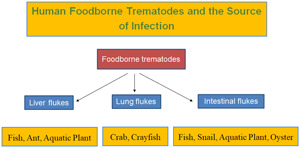
Foodborne trematodes (FBT) of public health significance include liver flukes (Clonorchis sinensis, Opisthorchis viverrini, O. felineus, Fasciola hepatica and F. gigantica), lung flukes (Paragonimus westermani and several other Paragonimus spp.) and intestinal flukes, which include heterophyids (Metagonimus yokogawai, Heterophyes nocens and Haplorchis taichui), echinostomes (Echinostoma revolutum, Isthmiophora hortensis, Echinochasmus japonicus and Artyfechinostomum malayanum) and miscellaneous species, including Fasciolopsis buski and Gymnophalloides seoi. These trematode infections are distributed worldwide but occur most commonly in Asia. The global burden of FBT diseases has been estimated at about 80 million, however, this seems to be a considerable underestimate. Their life cycle involves a molluscan first intermediate host, and a second intermediate host, including freshwater fish, crustaceans, aquatic vegetables and freshwater or brackish water gastropods and bivalves. The mode of human infection is the consumption of the second intermediate host under raw or improperly cooked conditions. The major pathogenesis of C. sinensis and Opisthorchis spp. infection includes inflammation of the bile duct which leads to cholangitis and cholecystitis, and in a substantial number of patients, serious complications, such as liver cirrhosis and cholangiocarcinoma, may develop. In lung fluke infections, cough, bloody sputum and bronchiectasis are the most common clinical manifestations. However, lung flukes often migrate to extrapulmonary sites, including the brain, spinal cord, skin, subcutaneous tissues and abdominal organs. Intestinal flukes can induce inflammation in the intestinal mucosa, and they may at times undergo extraintestinal migration, in particular, in immunocompromised patients. In order to control FBT infections, eating foods after proper cooking is strongly recommended.
Keywords: Human foodborne trematode; intestinal fluke; liver fluke; lung fluke; paratenic host.
Conflict of interest statement
The authors declare that they have no conflicts of interest related to this review article.
References
-
- Abdul-Ghani RA, Loutfy N and Hassan A (2009) Myrrh and trematodes in Egypt: an overview of safety, efficacy and effectiveness profiles. Parasitology International 58, 210–214. - PubMed
-
- Africa CM, de Leon W and Garcia EY (1940) Visceral complications in intestinal heterophyidiasis of man. Acta Medica Philippina (Monographic Series), 1–132.
-
- Agatsuma T, Arakawa Y, Iwagami M, Honzako Y, Cahyangsih U, Kang SY and Hong SJ (2000) Molecular evidence of natural hybridization between Fasciola hepatica and F. gigantica. Parasitology International 49, 231–238. - PubMed
-
- Agatsuma T, Iwagami M, Sato Y, Iwashita J, Hong SJ, Kang SY, Ho LY, Su KE, Kawashima K and Abe T (2003) The origin of the triploid in Paragonimus westermani on the basis of variable regions in the mitochondrial DNA. Journal of Helminthology 77, 279–285. - PubMed
-
- Ahn YK and Ryang YS (1988) Epidemiological studies on Metagonimus infection along the Hongcheon River, Kangwon Province. Korean Journal of Parasitology 26, 207–213 (in Korean). - PubMed
Publication types
MeSH terms
LinkOut - more resources
Full Text Sources
Miscellaneous
