


Predictors of upgrading from low-grade cancer at prostatectomy in men with biparametric magnetic resonance imaging
- PMID: 35591966
- PMCID: PMC9074070
- DOI: 10.5173/ceju.2021.0217
Predictors of upgrading from low-grade cancer at prostatectomy in men with biparametric magnetic resonance imaging
Abstract
Introduction: Prostate-specific antigen (PSA) density has previously been identified as a predictor of histological upgrading at radical prostatectomy, but how information from pre-treatment biparametric magnetic resonance imaging (bpMRI) contributes needs further clarification. The objective of this register-based study was to identify predictors of upgrading at prostatectomy in men with Grade group (GG) 1 and pre-treatment bpMRI.
Material and methods: This single-center study included men with GG 1 cancer on prediagnostic biopsy, who underwent bpMRI and robotic-assisted radical prostatectomy (RARP) between March 2014 and September 2019. We estimated logistic regression models to explore predictors for upgrading. The explored potential predictors were age, PSA density, tumor stage and Prostate Imaging Reporting and Data System (PI-RADS) score (dichotomised 1-3 versus 4-5).
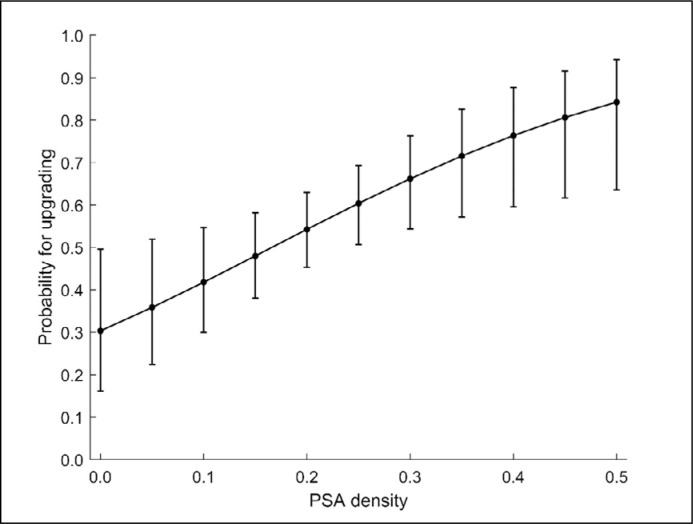
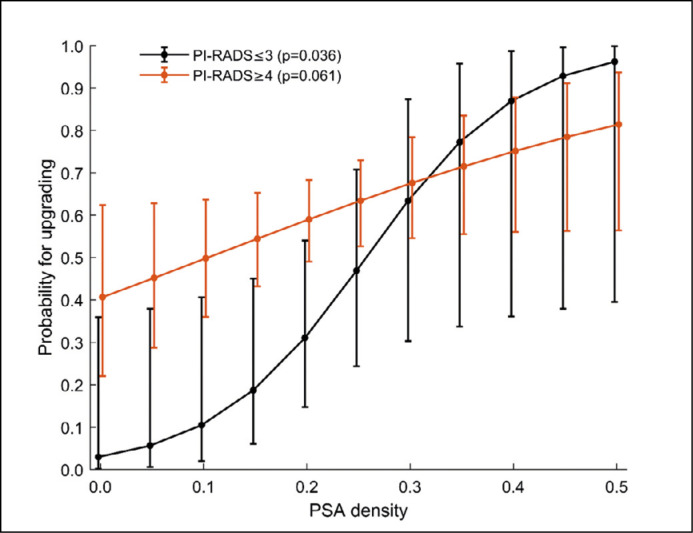
Results: Upgrading was observed in 56% (73/130) of the men. PSA density was the only significant predictor for upgrading (unadjusted OR = 1.7, 95% CI 1.2; 2.4 adjusted OR = 1.7, 95% CI 1.2; 2.5). The probability of upgrading was lower for men with a PIRADS 1-3 than for PIRADS 4-5, but the difference was not statistically significant (adjusted OR 0.4, 95% CI 0.2; 1.1, p = 0.082). Among men with PI-RADS 1-3, the probability increased with increasing PSA density (p = 0.036). With PI-RADS 4-5 the probability of upgrading was high over the entire PSA density range.
Conclusions: PSA density is a clinically important factor to predict upgrading from GG1 when bpMRI shows PI-RADS 1-3. In men with PI-RADS 4-5 on bpMRI, the probability of an undetected GG 2-5 cancer is high regardless of the PSA density.
Keywords: biparametric magnetic resonance imaging; histological upgrading; robotic-assisted radical prostatectomy.
Copyright by Polish Urological Association.
Conflict of interest statement
The authors declare no conflicts of interest.
Figures
References
-
- European Association of Urology (EAU) Prostate Cancer 2017. [Available from: http://uroweb.org/guideline/prostate-cancer/
-
- Athanazio D, Gotto G, Shea-Budgell M, Yilmaz A, Trpkov K. Global Gleason grade groups in prostate cancer: concordance of biopsy and radical prostatectomy grades and predictors of upgrade and downgrade. Histopathology. 2017;70:1098–1106. - PubMed
-
- Epstein JI, Egevad L, Amin MB, Delahunt B, Srigley JR, Humphrey PA. The 2014 International Society of Urological Pathology (ISUP) Consensus Conference on Gleason Grading of Prostatic Carcinoma: Definition of Grading Patterns and Proposal for a New Grading System. Am J Surg Pathol. 2016;40:244–252. - PubMed
-
- Vellekoop A, Loeb S, Folkvaljon Y, Stattin P. Population based study of predictors of adverse pathology among candidates for active surveillance with Gleason 6 prostate cancer. J Urol. 2014;191:350–357. - PubMed
LinkOut - more resources
Full Text Sources
Research Materials
Miscellaneous